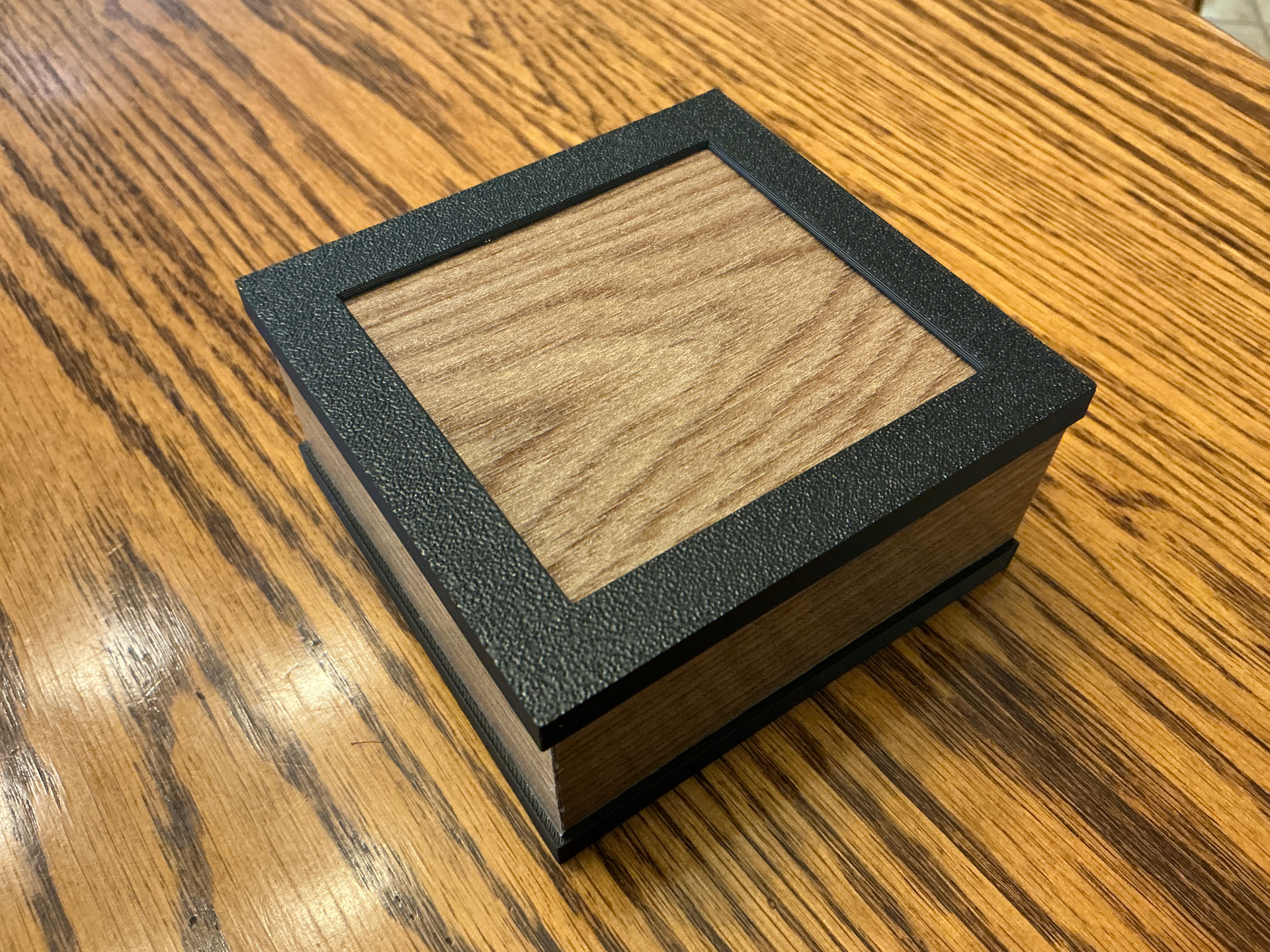
I’ve added wood texture to 3D prints for different purposes and it can look pretty cool. But I’m working on a gift print where I wanted real wood and the quality kind of look that brings. So far it’s looking good. Plastic and wood can make a nice combo. Plus, with all the specialty filaments available as well as a wide variety of woods available in thin veneers, this could be a fun side to 3D printing.
The woods are available in very thin, about 0.5mm thicknesses. It’s easy to not only print recesses, but also print templates to give perfectly-shaped inlays. The project I’m working on now has wood bits on 4 sides to accentuate the design.
I made a fixture to hold the sheets while varnishing. I’m finishing first then will cut to shape and stick down using special double-stick adhesive sheet. Here’s a shot while applying varnish and another testing how the gold silk+ looks next to it to see if they work together. The first shot has the veneer with the left side just a single coat of varnish. It’s clear gloss with no stain for this one and it does help the grain pop. The shot with the plastic is just one coat of varnish.
Anyway, possibly something that might fit with other prints. I got a pretty big assortment of veneers in different woods for about $25. The hardest part was picking the right wood and I narrowed it down to five different woods before settling on this one for trim on a music box.
I think absolutely that 3D printing projects can and should use more than just plastic in their designs! Why limit yourself when you have so many possible options out there? Personally, I suck at woodwork but I imagine that I might be able to cut a piece of veneer to fit into a slot or something on my print.
I decided to try and score and break a piece of acrylic sheet the other day to make a “stop the cat from accidentally going through the screen door shield” the other day and it amazed me at how easy it was to score and break the plastic. Not only that, but the break was so clean! It has opened some doors as far as I am concerned to trying some projects with the plastic!
(Our cat likes it when we push chair up to the door during the summer when she can look through the screen and see and smell the front yard. had a cheap Ikea shelf and bracket set that was just the right size to fit in our front door so I decided to print some holders that I could drop the shelf into so that instead of the chair she had the shelf to sit on. We decided that she might launch herself right through the screen getting up to the shelf and made a shield as well. Sneeze guard for cat, I guess.)
As I started looking into veneers, there’s other materials available too. Abalone veneer surprised me but that stuff is beautiful! It’s a little brittle though so I didn’t get any to try yet. Might in the future if this project turns out like it at least looks it will.
And the woodwork I’m doing is pretty simple so far. I printed jigs to use for cutting but so far it’s just painting on varnish with light sanding between coats. The cuts for this project are all straight line instead of delicate scrollwork style stuff to make it easier. But it’s all easier for sure than building furniture.
Here’s after light sanding and a second coat and the jig I’ll use for trimming to size. I’ll be varnishing both sides to keep the wood from wanting to curl and to give better grip to the double stick. Another coat or two on this side then flip to do the other. Then ready to trim to fit and install.
It’s not hard, though. I think it might be accessible to most pretty easily. Not much skill involved I think. Time will tell though.
I have actually thought about it (Buddha statues?) but the layer lines would probably show big time. Thinner layers and model prep could maybe minimize them. Not sure though.
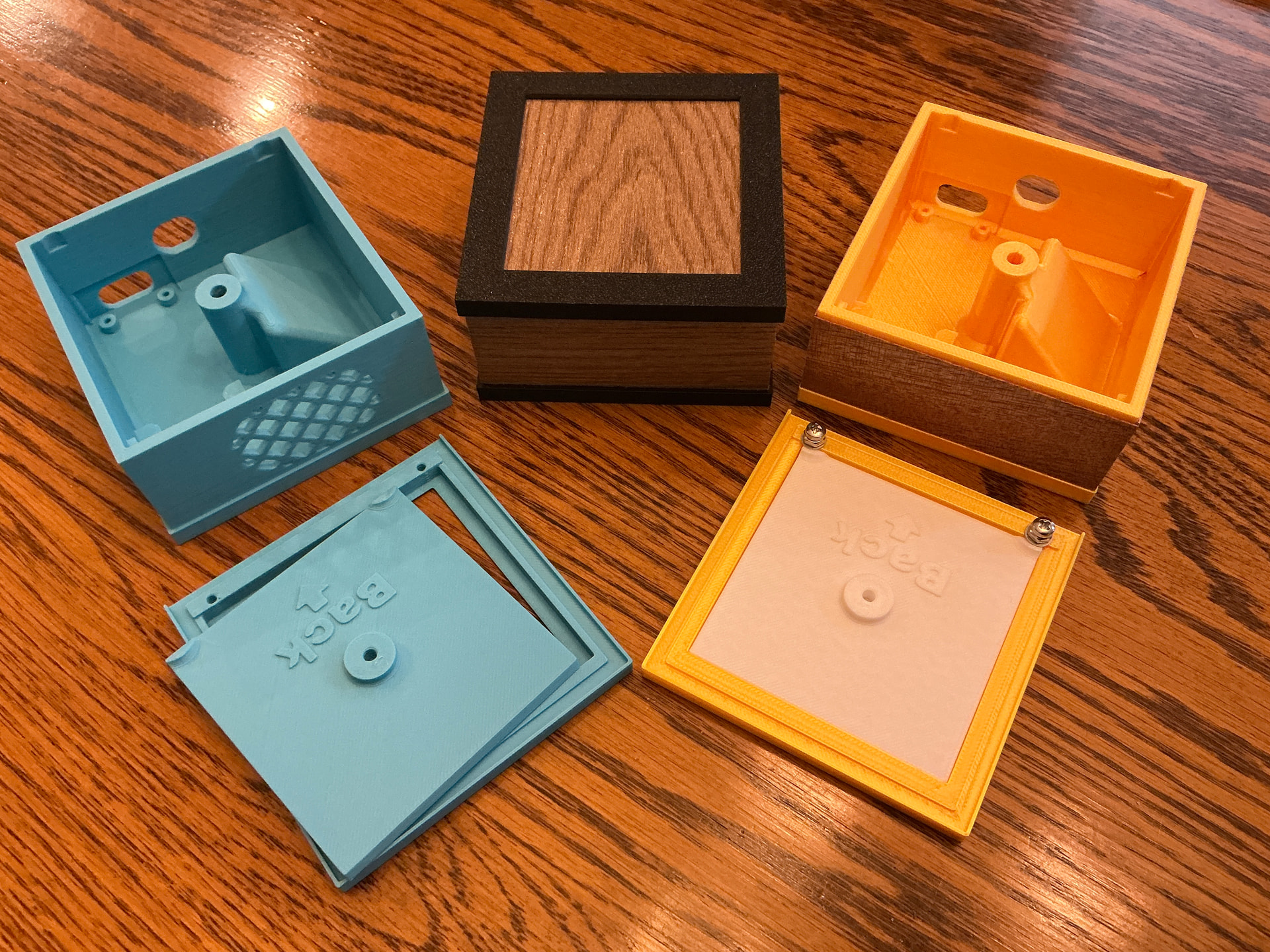
What I’m making is a music box and the first iterations were using filigree meshes for decorations. That’s where I was wondering about gold leaf. Decided to change directions when I found the veneers were so easy to get and so cheap. Plus, good wood with a nice finish can really look elegant.
Gold leaf isn’t too expensive though. It’s so thin there’s hardly any there but it shows the underlying surface like a bandit. In some applications I bet it could look really good. And layer lines may be able to be used to advantage too depending on the subject. Make lemonade. Gold is beautiful stuff.
I was thinking of like a cameo or medallion type figure inset. And , if it shows grain lines in wood, I’m not sure layer lines would really be a negative impact
Edit: It’s not something I have tried myself but the picture of your frame sitting on the wood made me flash on it.
That’s actually a really good point. I’d want to experiment on small pieces, but with the print oriented the right way and a texture applied to the mesh, it might make for some cool effects.
And if planned for, layer lines could be a nice addition with the parallel lines all showing through.
The “mixed media” thought is new to me. I’ve looked at (not done) the electroplating of 3D printed objects, but that seems more of an all or none type of thing. What @MZip is doing seems more mixed media/marquetry/craft work and I think the GL could have a nice place in it. Heck, you could probably print thin slabs and do screen print/linoleum block/italio printing on them. Hmmmm, 3D printing a linoleum block. Must be somebody doing ink stamps already.
I have seen few videos already along those lines, but the best results seem to still end up being laser cut versions. I think that 3D printing the handles and jigs for paper still would be a good plan though.
I have seem some pretty cool stuff done with adding wood grain textures to the surface. There have been a few good methods over the past little while. However I really like what using inlays for 3D projects illustrates: we don’t have to print everything. I love 3D printing for what it can do for me, in particular that I can use a computer to control the outcome instead of relying on my toddler-like hand eye coordination. I think inlays are something one can add fairly easily without having to resort to a huge amount of sawdust. Well, I expect I will ruin a few the first few times either way, but you know what I mean.
In the near future I want to make a case for a HAM radio kit my Dad is putting together. It would look really cool if it used the old school faceplate + wooden sides attached to the chassis / case. I don’t have the tools for the wood (although I might be able to get some small enough pieces to try) but I can imagine that an inlay or maybe veneer might work to give me a similar effect and be possible within the space and tools I have.
As for wood filament itself, I dunno, I printed something with some already and it is neat and all but the wood textures seem to give a better effect so far and are easier on my nozzles. I expect some really skilled makers can push the combination of the two to extremes but I am not there yet!
Here’s the final print. The combination of wood and plastic looks like it can really enhance the look of models but is a different look for 3D prints I think. The 3M 468MP double-sided adhesive works great. Not repositionable though. Once you stick it down the wood will only peel back off as splinters and chunks.
@Blyzzard - Wood-filled filament is pretty homogenous stuff. You can print wood grain textures and they can look pretty good, but this puts the wood choice for color/texture in end user hands. I’m not a fan of the gold/mahogany version but the black/walnut version looks pretty good to me. With choices so open, I think better for any builders to choose for themselves.
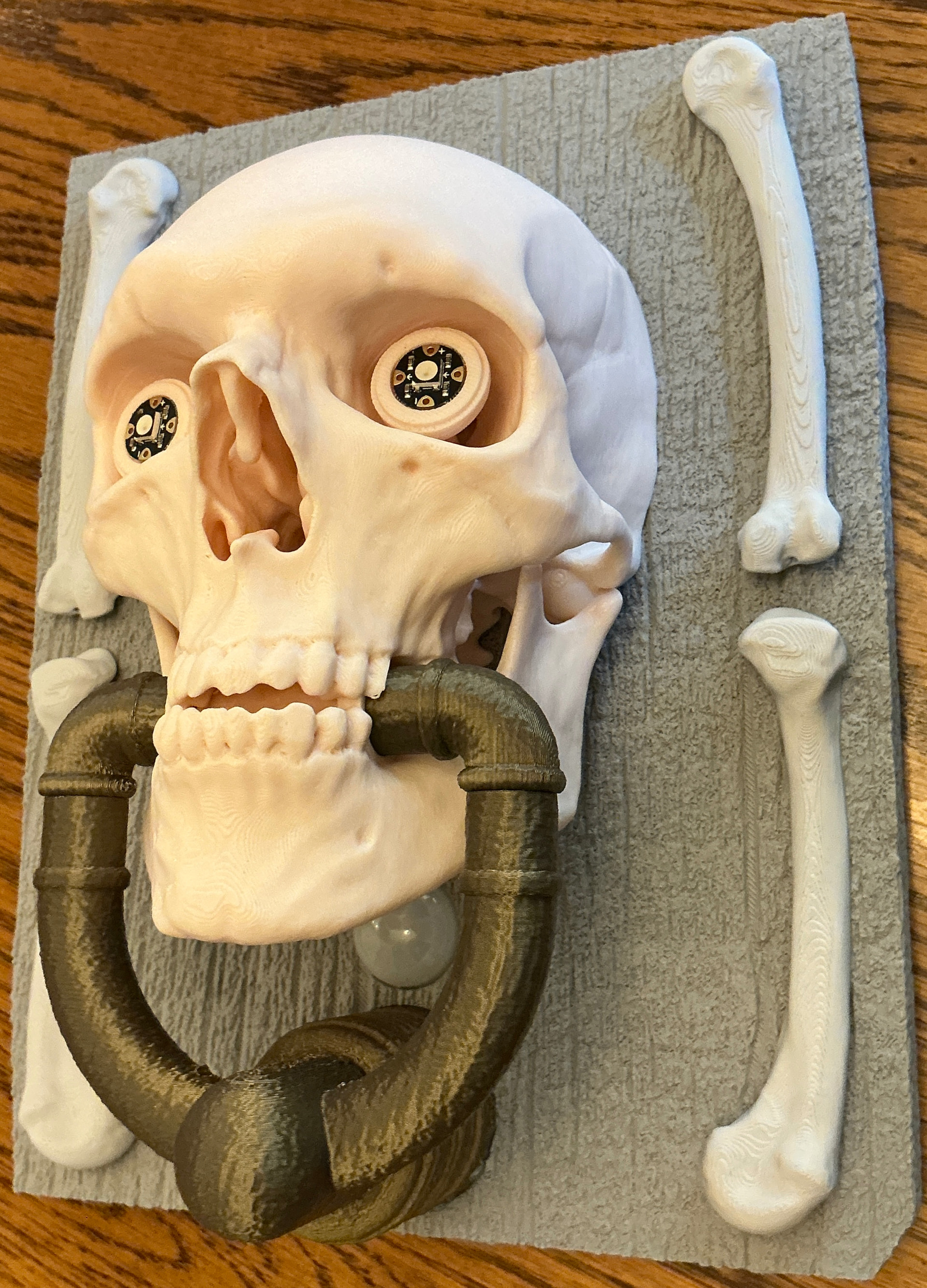
Plus real wood just has a presence that printed wood doesn’t. I did a wood textured back for an animated halloween door knocker last year (photo below) and it looks good I think in that application but IMO real wood looks better.
But there’s probably some better ways to add wood. Accent or main feature, dealing with edges, etc. Not perfect but I think there is potential.


 When are you going to try gold leaf?