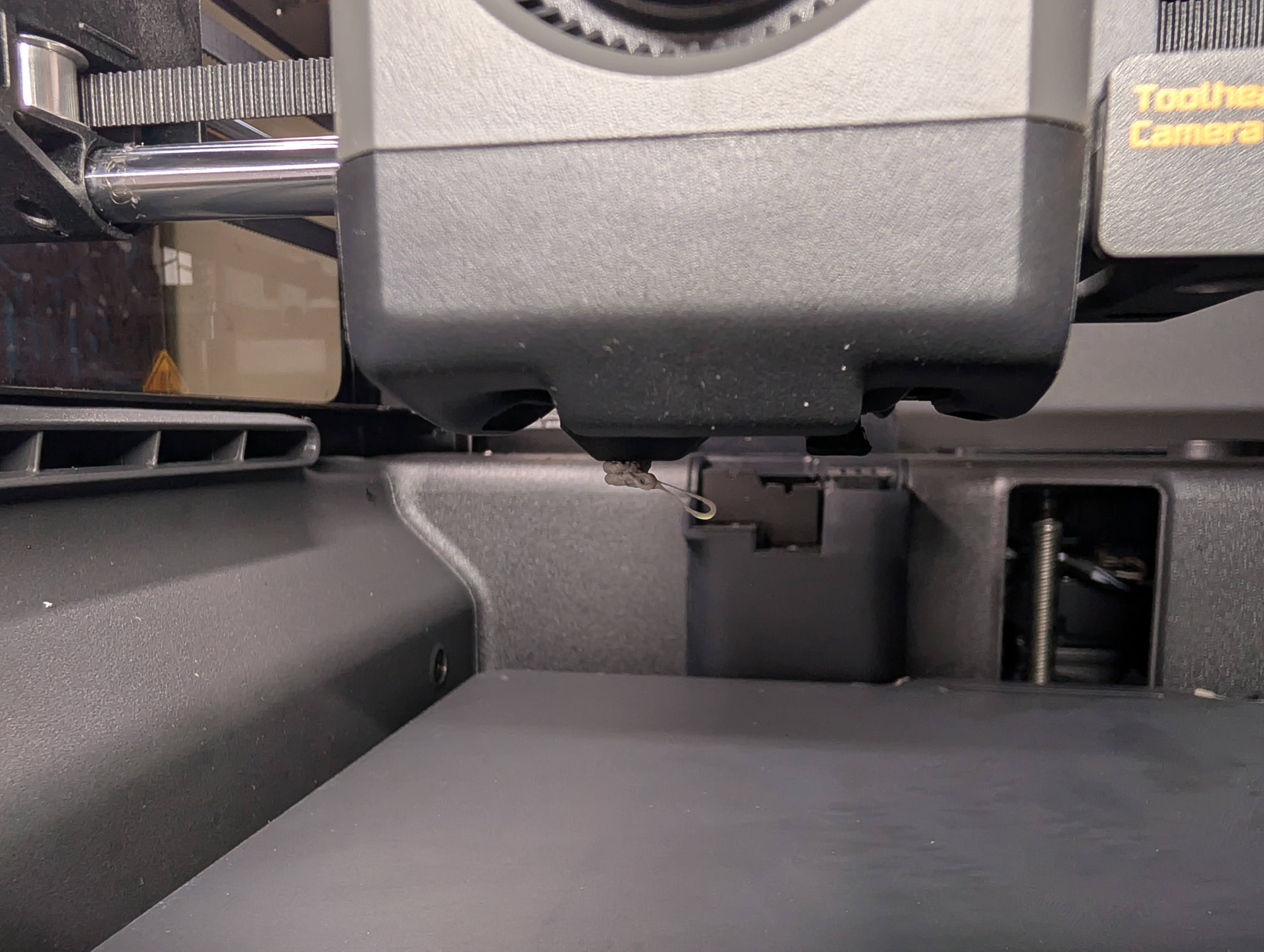
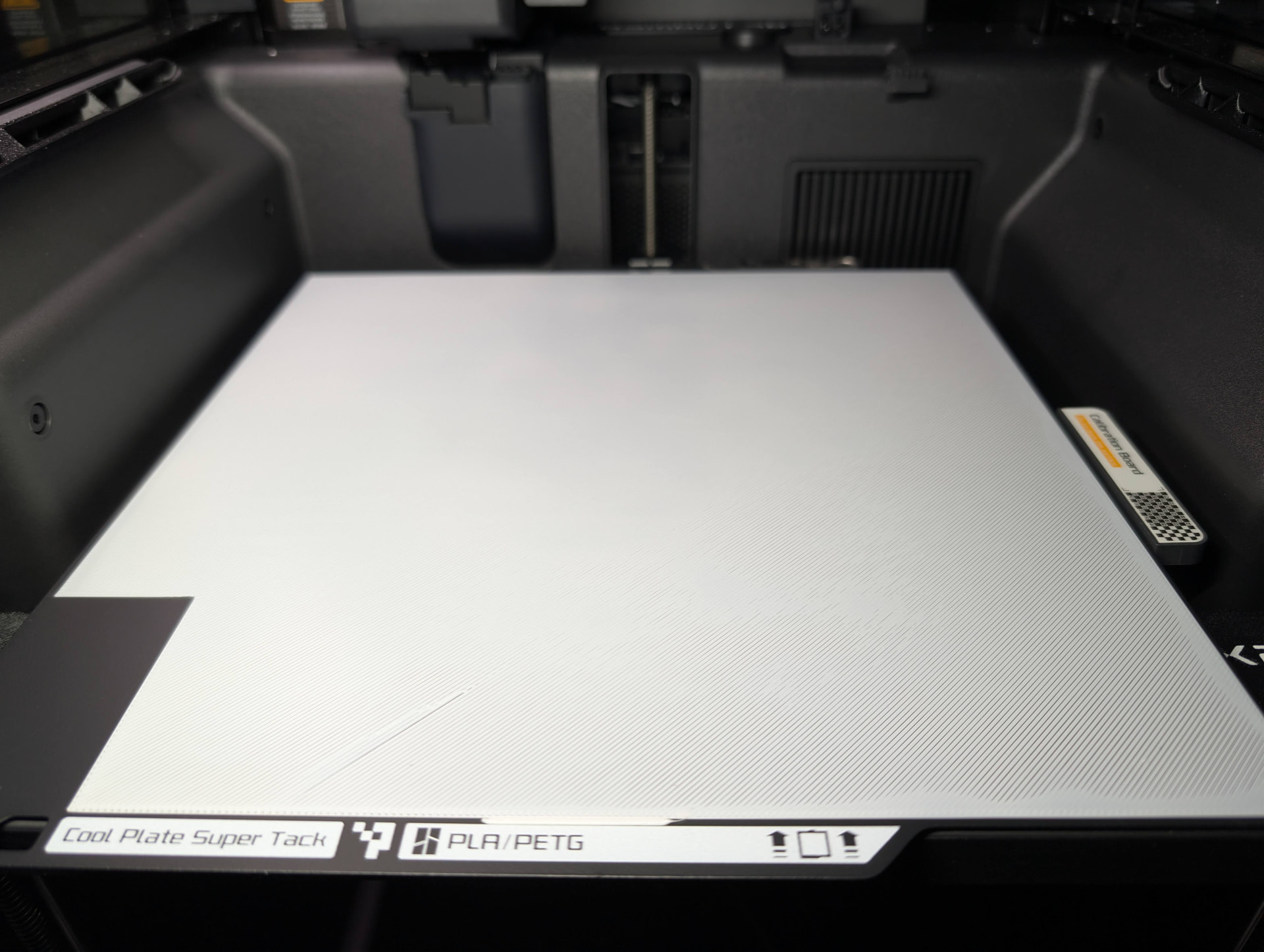
As you can see, because of the total lack of adhesion everything just clumps up on the nozzle.
Now, here’s some context - I previously had an A1 and this exact same model would print without issues. I then upgraded to a P2S and this is when the adhesion issues began. After a lot of back and forth with technical support no solution was found and Bambu agreed to a return. I then purchased my X2D - and as you can see, I have the exact same problems.
I am using stock settings (although during the troubleshooting process they asked me to play with the bed temperatures but this had no effect). I have tried with both PLA and PETG (all Bambu and all dried properly). I have tried different build plates - textured, super tack and even a BIQU Cryogrip (Frostbite). I have added the auxiliary airflow diffusers. Nothing helps. I see videos of people struggling to get their prints off of their Cryogrip/super tack plates… Well mine is the total opposite. Everything comes off with ease.
I know the example I have given is always going to be a bit of a challenge for a 3D printer with those small letters/numbers. But I know I didn’t have these issues with my A1… And this example just shows clearly the problem I am having overall. There is just a fundamental lack of adhesion all round. I am still able to print things but I can just feel the lack of adhesion when I am removing the models from the build plate. And I know it didn’t feel like that when removing the models from my A1…
I haven’t tried using glue - and that may well help. However, I want to try and get to the bottom of what is causing the underlying issue. Does anyone have any ideas/theories as to what is happening here?
The vast majority of adhesion issues stem from contaminated build plates. So I must ask how are you cleaning your build plates? From the picture you posted you can see the oil marks on it.
Apologies, I should have included that in my initial post. I clean with soap and water. That build plate wasn’t freshly cleaned when I took that picture but I have tried with freshly cleaned build plates and it didn’t help…
I am surprised that support did not go over proper plate cleaning before replacing a printer.
For the sake of sanity, before we do any troubleshooting…
Clean the plate with HOT water and DAWN dish soap (my preference is powerwash)
Rinse fully and wipe off with paper towels
Print one of the “bed cleaner” models, which is pretty much one layer on the entire plate.
Post some pictures.
Running the “High Temp Bed Leveling” seems to be more accurate than the normal one in my opinion. This is probably not a leveling thing, but its nice to check.
Did you see the bed reaching the set temp on the display? What are the readings? Any chance that you do not have enough power in the power outlet? Maybe it is not able to keep up with the heater?
My PLA prints are mostly easy to come off from the plate. Sometimes if I print very thin and wide stuff I may have hard times to remove them. If I print PETG and no glue most of the time hard to remove.
So for the adhesion on the plate you need good temp on the nozzle/filament, no fan, clean plate and heat from the bed. This is second and different model printer so this is strange.
Any chance that the water is very hard and you have some limestone or similar minerals left on the plate after washing? And moisturizing or softening agents in the soap/detergent?
Clearly some under-extrusion but that’s a problem for another day. I then tried the spool print again and it did seem to be a bit better… the small elements of the numbers didn’t just clump onto the nozzle like last time. Although they did seem to be on the edge of coming away… However, maybe that’s all I can really expect with those small intricate elements. I will investigate with my other plates over the weekend.
It’s definitely not a power issue - temps are all as they should be. The water is fairly hard here but the plates look very clean after washing. No signs of any residue…
“looks clean” does not mean anything. and PETG (you sure it actually is PETG?) should literally stick to anything, unless your (first layer) settings are way off.
some dish liquids contain hand moisturizers (i.e. oils - for your skin) that immediately destroy any adhesion on any pei sheet - this is very likely the root cause in your instance.
IPA (not to be used on cryogrip and supertack afaik) just spreads oils around, it doesnt remove anything (though i am wondering if there are IPAs out there that also contain oily residues/impurities) The IPA i have only gets used for the releasing of TPU prints, NOT for cleaning (because it makes bed adhesion worse)
some glue sticks actually make adhesion worse. I suspect that they have additives that also have a negative effect. Generally i like to avoid glues, in 99% they are not necessary anyway.
for PEI - acetone (pure acetone, not some ■■■■■■ nail polish remover with additives) is your friend. That stuff actually removes oils. Been using the stuff on pei sheets from when they started to become a thing, years ago. never ruined one with it… make sure the sheet is cold (otherwise the acetone evaporates too quickly) and only wipe the sheet with a towel with some on it. dont soak it. DO NOT USE ACETONE ON THE CRYOGRIP AND COOL PLATE SUPERTACK… only the pei, dont overdo it and itl be fine.
So to sum up how I get to get the textured pei to work/stick with PLA, PETG and ABS:
wash with warm (no need to burn your hands) water and dish soap without any perfumes/additives/hand moisturizers - very important!
use a clean and brand new scrubber/sponge (not the one that you use to clean your frying pans, that one will be full of fats/oils), make plenty of foam, let it sit for a minute or two and then rinse it off… you could consider doing an after rinse with a bit of destilled water if the water in your place is too hard. (but id try without, should not make a difference)
after that let the build plate dry, or wipe dry with a clean dry paper towel
soak paper towel with acetone (only for PEI!). give the build plate a good wipe with it. dont soak the plate
never ever touch the plate with your bare hands after that. dont even think about touching it or your pei sheet will lose adhesion on that spot…
Thank you for these detailed instructions! So I gave my textured sheet a thorough clean and, fingers crossed, it seems to be sticking! I guess maybe before I was using the wrong kind of soap that had some kind of oil in it like you suspected. I haven’t tried with all my plates and I’m pretty sure the cryogrip failed straight out of the packaging… But maybe you’re meant to clean them before using even if they’ve never been touched?
Anyways, thank you all for your help. Seems to be working now!
I’ve always internalized it like this: Any cleaning procedure on these plates and their little microscopic pore structures is only gonna be 95% effective. Math says that if you add one or two repetitions, it will often get you to 99.■■%. So repeat once as a matter of course.
I find that if your build plate came with a protective sticker on it, you absolutely gotta wash that like 3 or 4 times right away. Common in those “effects plates” but idk how the cool plate comes packed.
Limestone/hard water + not clean soap/detergent but with some additives for sure will result in troubles. I found this the hard way by trying to wash my glasses. If the soap is not clean from any additives it becomes mess on the glass! So most of the time but not always cheapest and crystal clear soaps ( liquid one, the solid one always have fats and oils!!! ) either only for hands or for dishes. So Crystal clear, cheap and with less perfume usual = win. And because of the lime stone either you need to use some kind of filter/softener or you need to dry immediately with a towel or paper towel. This way you will remove the limestone, if left with some water droplets it will stick to the pores and will fail you. You can also try to use some light acid for cleaning like apple, lime or wine acids to clear it from time to time from the lime stone. Or use some of this salts or tablets used to clean for example cafe machines, solved in water.
BTW I use glue to be able to easily remove the PETG from the PEI plate.