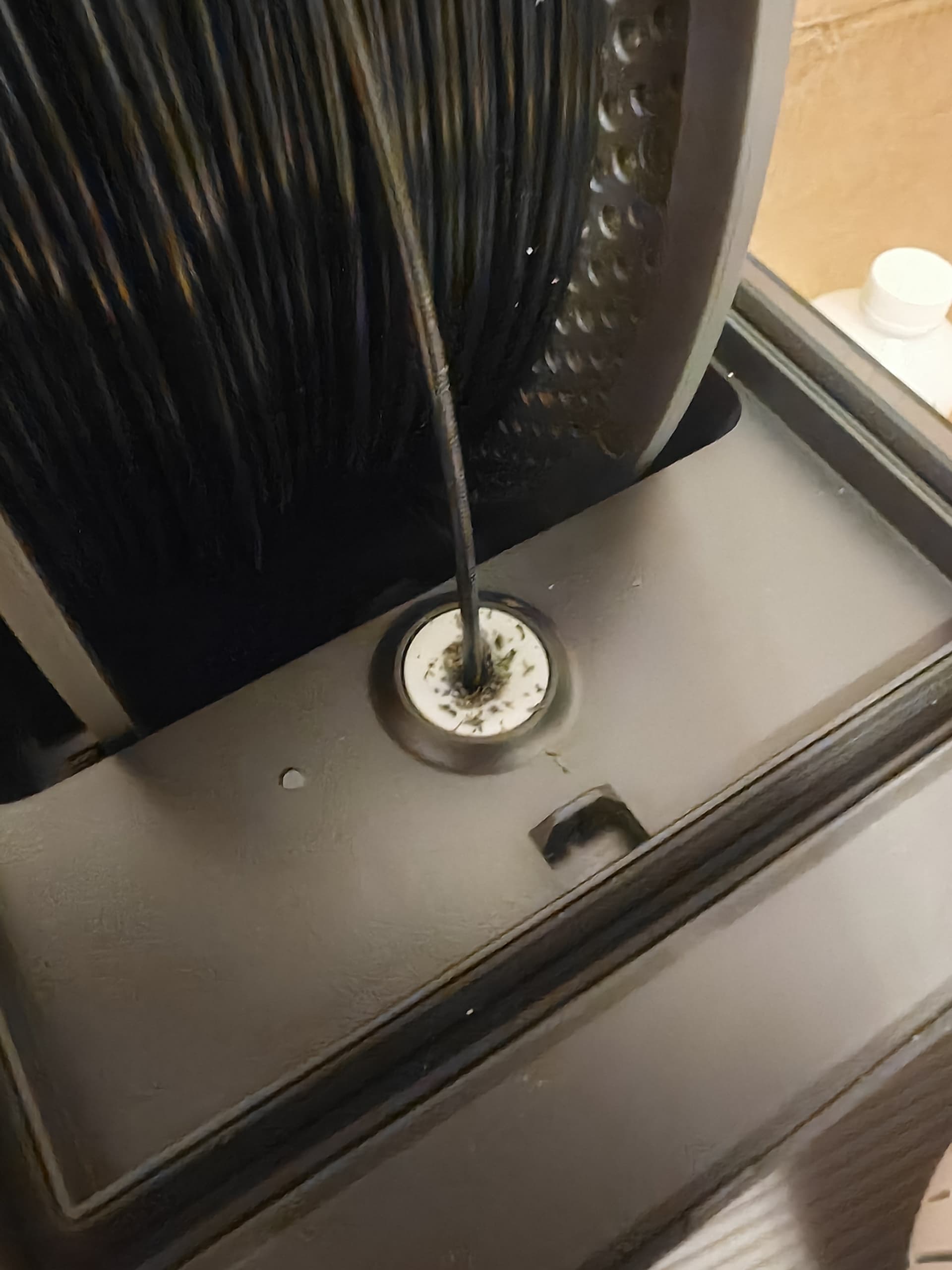
the heavy grinding of filament probably is due to the 5 attempts it makes to feed the filament into the extruder gears and failing for whatever reason we all suffer from.
This is how my inlet looked after a few attempts to get ASA fed to the X1. I even cut off the grind section after failed attempts. This did not help.
Support then suggested to use PLA or sth more stiff instead. I gave the AMS HT a good vacuum to get rid of as much debris as possible without disassembly and after that it actually worked for a few times now to feed PETG and ASA. I could complete some prints.
My best guess so far is that the drive gear in the AMS HT has too little friction and slips too much, failing to feed.
My plain, old original 1st Gen AMS just works…it imo is an issue with the new AMS HT itself.
I’ve got one thing for all you guys to check. I ran in to this same thing a few days ago with the AMS 2 Pro. I tried everything but it keep feeding, pulling it back, feeding, pulling it back. On and on. I finally checked the firmware in the app and strangely the firmware on the printer was the newest, but the AMS 2 Pro firmware was a previous version… I updated the firmware on the 2 Pro to the newest and it immediately started working. It might not fix everyone’s problem but it’s worth a shot.
I believe it’s actually the opposite issue—both the AMS2 PRO and AMS HT grip the filament too tightly.
Why do I say that?
Because I used to have filament detection enabled at printer startup, and over time that caused enough stress to weaken the filament. After just a few power cycles, the filament would break inside the PTFE tubes.
If your AMS unit is struggling to load filament, check the seating of the PTFE tubes. Release and reseat them carefully, making sure they are fully inserted into the couplers.
If grip was to strong, how could it fail to enter the hotend? Once the AMS HT pushes against the hotenend extruder, at least on my side, the extruder starts spinning so it should just grab the filament. Mechanically there is nothing actively blocking on hotend side.
If friction inside the AMS HT was too low instead, it then might push against the hotend extruder, slips before managing to get it inside and then reports blockage due to slippage. The 4x tries after first fail then just worsen the situation as it grinds down the filament in the exact same spot.
Imo Bambu should stop trying to feed earlier than just after 5 attempts.
PTFE could be an issue indeed, yet not on my side.
For cutting PTFE i have a jig which guides the blade in a clean 90° angle and i used a fresh blade. Means i can say that the PTFE is 100% perfectly fine as i just exchanged it recently while trying to figure all this out. Seating it properly i also took care of with my older Bowden printer i learned to be careful here, as there the extrusion consistency suffered from bad quality material and installation
also i re-checked my firmware status, all are up2date right now.
If the filament can’t enter the extruder, I would check the PTFE path for broken filament or any other debris. I once had an issue with a tiny fragment that broke off near the extruder, completely hidden from view. It caused my AMS HT to cycle the filament back and forth until it was thoroughly chewed up, and I eventually had to cut off the damaged section.
While investigating on this issue regarding the failure of feeding filaments with my AMS HT, I realized that the direct connection with my X1C was in fact too direct.
The PTFE tube coming from the AMS HT was attached to a 4-in-1 PTFE tube adapter without the spring loaded buffer!
My regular AMS was instead connected to the spring loaded buffer and then to the 4-in-1 tube adapter, and actually it was working fine.
So the solution for me was to connect both my regular AMS and the AMS HT first to the 4-in-1 PTFE tube adapter that was then connected to the spring loaded filament buffer.
Then the output of the spring loaded filament buffer was attached to the X1C.
Now both AMSs feed the filament smoothly.
Hope this information could be helpful for you.
strangely while buying the HT, the 4in1 PTFE was advertised as matching product, however wiki says a buffer or hub is needed which seems to be the case.
The last reply i got from bambu support is that it they think it is an issue with the cable connecting the AMS HT causing those loading fails. Yet i don’t get how it could be the cable, maybe someone has a somewhat deeper understanding of how it could interfere and cause failed loads.
As I mentioned before, I had the same problems, but I updated my P1s and therefore also the AMS hub. Now everything works flawlessly, but I can no longer use my Panda Touch. I will try to downgrade only the P1S en disconnect the Ams/hub. Update: downgrade worked panda up and running
Same problem here! $150 dollar machine only functioning as a dryer right now
UPDATE: My HT was connected to a Y-splitter acting as an external spool. In an earlier comment I saw that having it run through the filament buffer fixed their problem. I can confirm that this also worked for me. Kind of weird though
The 4-in-1 PTFE adapter should be connected before the buffer on both the H2D and X1 Carbon if you’re attempting to use them as an AMS. However, if the intention is to use them as an external spool, the adapter should be connected after the buffer. On the H2D, the bypass port must be used in that case — and the same applies to the AMS HT: the bypass port must be used, otherwise it won’t work properly.
Also, if you’re currently using only a single AMS, a 4-way buffer is required to ensure everything functions correctly.
I had the same problem, and support sent me a new feed unit. However, that did not fix the error. But Bambu Studio reported that everything was up to date. I thought of turning off LAN mode. After doing so, Bambu Studio showed that there were updates for my P1S and HUB. I updated, and since then, AMS-HT has been working for me. I tried PLA and ASA several times. Maybe this will help someone.
I just loaded my brand new never used HT AMS with PLA and it timed out and would not properly load the filament. Never got more than 2 inches past the exit tube from the HT AMS. Seemed to move inconsistently and the spool did not roll steady. Tube path was clear and tried loading several times, no snags. Finally pulled out the drive roller shaft and snapped back in and now it fed fine. Hope it keeps working right. Drive gear looked very flimsy.
I have four AMS HT units feeding four P1S printers, and they are a constant headache. Grinding notches into my filament. Constantly saying the filament can’t be loaded. The AMS HT is truly the most broken thing I’ve experienced from Bambu Labs, and now I know I’m not alone.
I have been fighting this battle for months now. After numerous attempts at solving the issue I have come to the conclusion that the feed motor of the AMS HT is simply undersized. The filament path in the H2D buffer has added resistance due to the embedded filament sensor that adds a lot of extra tension, and while the AMS and AMS 2 Pro can easily overcome it, the AMS HT slows to a crawl the moment it makes it to the buffer. Then afterwards it does not have the strength to also overcome the buffer spring when it has arrived at the toolhead. I don’t know if this is just a problem with my particular unit, but the motor on mine appears to lack the required voltage, or be generally undersized. That said, the PTFE tube length on my setup is only 30 cm, since I know that some of you will bring it up.
For whatever it’s worth, when I assembled my PTFE tubes, 4-in-1 combiner, and AMS units, I noticed that the PTFE tube end forms a narrow ledge in the connectors that can possibly hang up filament as it’s being pushed through.
I chamfered all the tubing ends that filament would see as it gets pushed in to eliminate the ledges. Whenever I’m cutting a filament end I always use wire cutters to create a point in the center of the filament strand instead of a flat end. I very rarely get filament hangs.
The issue is not the length but how the tube is cut. I had this issue on my X1C and the end cut of the PTFE tube was slightly angled. That let the filament tip hanging on that very small gap impeding the load of the filament. As soon as I cut the PTFE tube perfectly straight the filament was loaded with no issues.
Hope this helps.
It looks like I’m not the only one having this issue. It’s 50/50 toss up for me. Sometimes it feeds through properly and some it’s stuck making aloud grinding noise. I may have to record it and open a ticket.