Big cabinet vs small dry boxes vs just the AMS — what's your setup?

After weeks of chasing “mystery” print failures (stringing, zits, brittle parts), I finally figured out my filament was absorbing moisture sitting out in my ~65% RH room. Embarrassing how long that took. :sweat_smile:

Now I’m trying to settle on a long-term storage setup and I keep going back and forth:

  1. One big sealed cabinet (180L-ish) — set and forget, but it eats floor space
  2. A few small sealed dry boxes — flexible, but you end up juggling spools
  3. Just drying in the AMS right before printing — works great, but everything sits exposed the rest of the time

Right now I run a mix: sealed box + molecular sieve holding around <20% RH for the spools I use most, and the rest… ziplock bags. :smiling_face_with_tear:

Curious what actually holds humidity well long-term vs what just looks good on paper. Does anyone run a hygrometer inside their cabinet — what RH do you actually see? And for the big-cabinet folks: is it storage-only, or do you dry in it too?

I usually just store then in zip-lock bags but I don’t have loads of spools.

How many spools are you taking about?

How does the sealed cabinet work? If you go to get a spool from it then does the whole thing become unsealed? Doesn’t sound good to me, if that is the case.

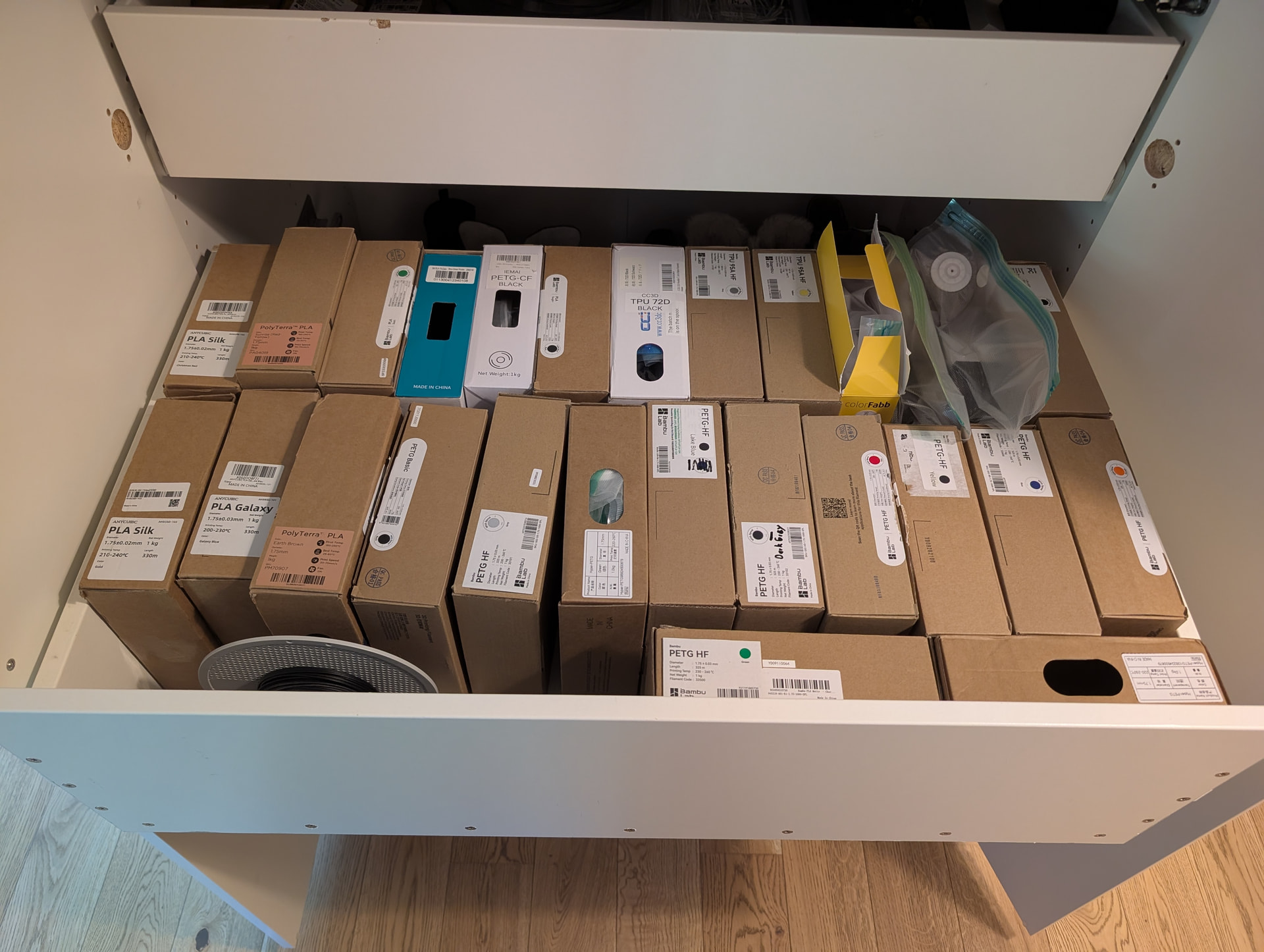
So far, I have been using those filament vacuum bags for each individual spool, with molecular sieve and a Bluetooth hygrometer inside each. I keep the bags inside the original cardboard boxes and have them standing in a drawer inside a Ikea PAX wardrobe (100x60cm). I don’t keep PLA dry, only PETG, PC,TPU,… undried refills are in some high cabinet in the kitchen, that my wife doesn’t reach anyway :squinting_face_with_tongue:
They typically sit around 2-4 %RH. I get a warning in the app, when humidity rises above 10% and then exchange the sieve.

I have built a custom drawer with heavy duty kitchen rails, because the ikea drawers have very low load capacity and don’t pull out fully.

I would really like that solution if only those bags would be tighter for water vapor. I have ~90g of sieve in each bag, but they are saturated after typically 2-4 months. with currently 15 spools kept dry, not a single week passes without the app ringing alarm. For some filaments, I have exchanged the sieve several times without using the filament for a print :joy:

So I’m currently working on a new solution.
My plan is to create a tight box inside the drawer and have a big 1kg pack of molecular sieve. I want to make the box from 6mm PVC, that should allow only minimal diffusion. The PVC can be easily weld-glued air tight. The box gets a top lid with an inside shroud, and a sealing around the shroud. The walls of the drawer should be stiff enough to support the drybox walls and prevent bending from the pressure of the sealing.

I’m aware that the cardboard boxes can hold serious amounts of water and that I introduce new humidity with the air, each time I open the lid. the cardboard should be a one time issue. When the sieve has drawn out the water, they shouldn’t be an issue anymore. When you calculate, how much water is in the air inside the box volume, opening the lid shouldn’t add too much water.
In the end, I will gladly accept having to exchange the molecular sieve every few months if it doesn’t happen all the time. In exchange, when I need a filament, I can just open the box, take it out and after printing put it back in without the hassle of the vacuum bags. That is absolutely worth it for me.

My experience is a little limited, but I have found the vacuum bags tend to leak. At least some have lost vacuum. But I also understand that the thin bags can pass moisture over prolonged time and a vacuum will just aggravate the problem.

I’ve since switched to 4 liter plastic cereal boxes. The plastic is much thicker and they have a rubber seal for the lid. I pop a cheap hygrometer in there along with sieve which keeps humidity at ≤10% for long durations.

I feel there are some advantages to individual boxes. One, opening a single box does not disturb the integrity of other filaments. Two, provides some flexibility in how I store and stack them. Three, they are easier to use than plastic bags and I don’t need to pump out air every time I pull a roll out or put it in. Once humidity is absorbed by the sieve it stays that way virtually indefinitely.

One thing I have learned is to not trust the AMS-HT for long-term low RH storage. After a dry and even with a fairly large load of desiccant the RH seems to inevitably and relentlessly rise. The sensitive stuff I use (PETG-HF and TPU), after opening and drying a new roll, goes in Polydryer boxes with several add-on desiccant containers. Those generally stay below the 10% cutoff of the supplied hygrometers for long periods. Those rolls come out of the box and go in the HT (external spool holder for TPU), get printed and then get put away. As for the PLA I don’t worry much about it. It is generally in the various AMS 2 Pro boxes (which with a metric crap-ton of desiccant do seem to maintain their humidity levels better than the HT) or in bags or printed boxes, as much as anything just to keep the dust off.

In the cold weather RH in my house averages 35% so for a lot of the year it isn’t a problem. Sometimes I wonder if we aren’t worrying too much about this anyway, going down the rabbit hole of chasing low readings on hygrometers. In the end if things print well, that’s all that really matters, no?

The HT version seems to have issues with sealing and does not do well with reigning in humidity, even when using sieve desiccant.

I’ve been experimenting with that. What puzzles me is that in my unit with desiccant inside a hygrometer in the filament area stays at the 10% minimum while the front panel display steadily climbs past 20% and 30%.

No, this is absolutely incorrect.

Some moisture can be eliminated through drying, but some (due to molecular bonding) does not, and will not be removable, with any amount of drying. The material is permanently altered.

Secondly, every heat cycle degrades filament.

In my opinion, the correct answer is storage in the driest environment possible, and additional filament drying only when needed.

I use a single sealed cabinet with a rosahl membrane dehumidifier and two large dessicant dryers that the internal air is circulated through constantly.

As I said before, those cheap hygrometers really are inaccurate and much less so when reading below 10-20% RH. I suspect that whatever sensors used by Bambu Lab are probably of better caliber.

This summer I put open rolls in a ziploc/etc bag, and THEN put them in a gasketed tote. Inside the tote is a large amount of dessicant, and in each ziploc is a small dessicant pack.

The thought process is that any water getting into the tote from the environment is gonna get eaten by the dessicant more readily than it will diffuse thru another barrier [ziploc]. And the same goes for inside the ziploc, small dessicant as last line of defense

My vibe based measurement says its been going ok. Dry stuff has stayed dry, at least. A little finicky and handsy to get stuff in and out though, so not super happy.

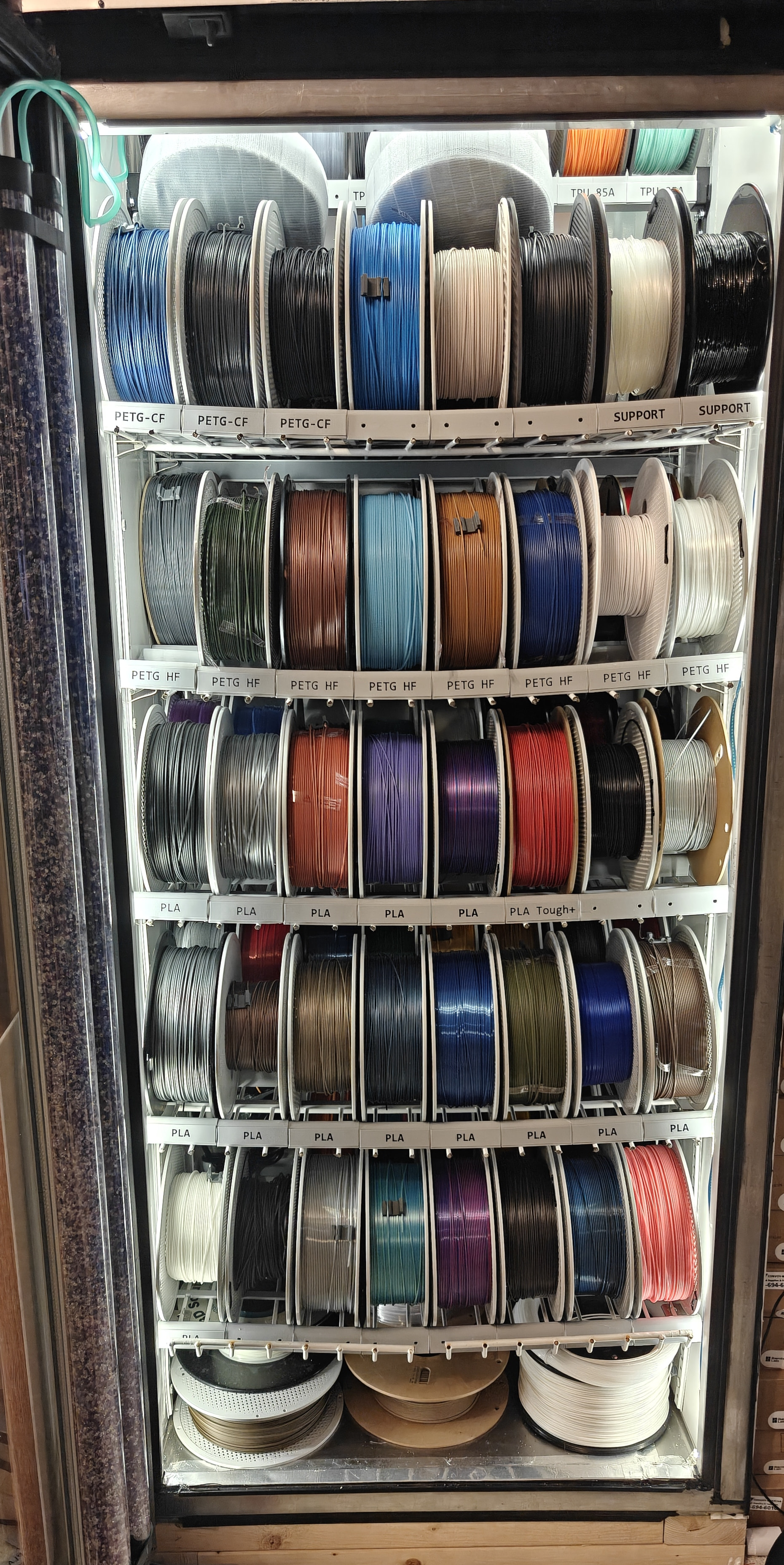
I’m a 180L cabinet dude. The cabinet I have seems to be holding at 25% - 24%. The point, to me, is that it is drier than just lying about in plastic. The cabinet is activly drying; static containers are at best what your desiccant can hold it at.

When a spool goes in one of my AMS’s, it enters another active drying environment. Which seems to go down to ~10% RH.

I think trying to keep the material as dry as you can afford to is the wisest thing.

If I go get a beer from the fridge, does the whole fridge get hot? No. It will run on it’s own to maintain a level in degrees.

Likewise, an actively drying cabinet will dehydrate itself back to whatever it is set for, or can dehydrate too.

My 180L drybox has maintained a 25-24% RH, which is OK. It gets dried more in one of my AMS’s.

And that’s good enough for the girls I print for. :wink:

Fair point on the cabinet sealing — that’s actually the tradeoff I keep coming back to. The big cabinet I’m looking at has a proper gasketed door (fridge-style seal), so it does re-seal each time, but you’re right that every open lets some humidity in. I’m at around 15 spools right now, so I’m leaning toward one sealed cabinet + a couple of small boxes for the ones in rotation. What’s your setup — just ziplocks?

That 2-4% RH with the vacuum bags + Bluetooth hygrometer is seriously impressive — I didn’t realize molecular sieve could hold that low. The PVC dry box you’re planning sounds solid. Do you find the 1kg pack of sieve is a one-time setup, or how often do you expect to recharge it? Also, do the cardboard boxes really hold enough moisture to matter?

Interesting — the 10% vs 20-30% discrepancy between the hygrometer and the front panel is exactly the kind of thing that makes me want to verify readings with a second sensor. Do you think the front panel sensor is just in a less-sealed spot, or is it reading a different point? What hygrometer are you using?

I don’t use that many colours, so I don’t have that many open spools.

My current set-up is : anything other than PLA get put in a zip-lock bag. I have about 20 on the shelves.

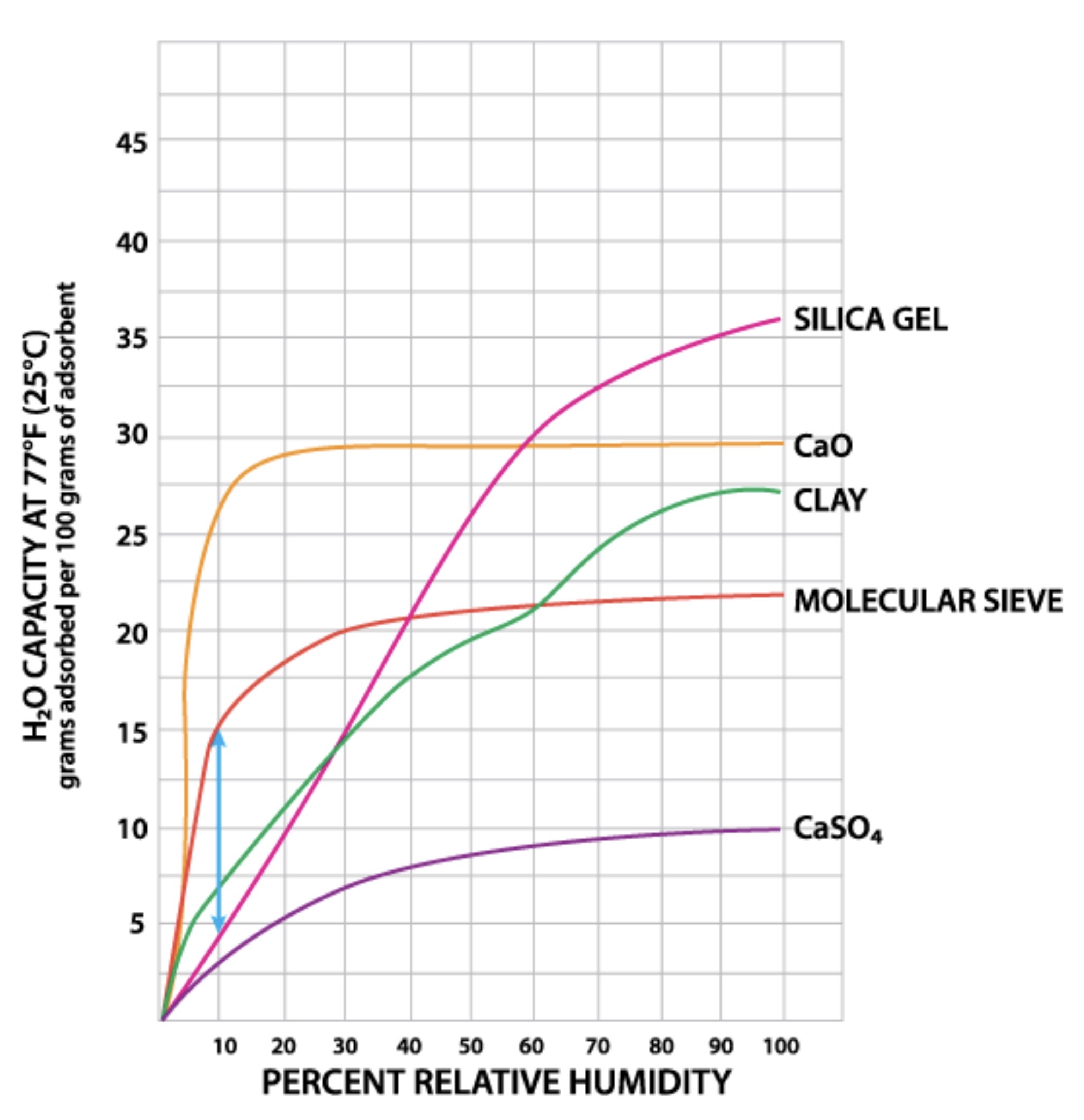
When you look up specifications, it is not directly obvious. Looking up datasheets, it first seems like silica gel is much better because it can hold 50% of its own weight in water while molecular sieve can only hold 20-25%. But that is only true at 50%RH air humidity. When humidity is lower, that number flips very fast. Molecular sieve can still take up considerable water well below 1%RH.

In my experience when exchanging silica gel for molecular sieve, water take up rate is also much faster than silica gel, although I didn’t find any numbers.

And it still takes up water far above 100°C, where silica gel is already expelling it.

Only drying is a pita, you have to heat it to at least 250°C, better 300°C for 2-3 hours. In the beginning I used our household oven, spreading the beads on a baking pan. But pouring tiny beads from a huge pan into a jar for cooling at that temperature is really a calling for desaster.

I now built a custom jig with some cheap parts, that works perfectly fine and takes little storage space. With that, drying has become a non-issue for me.
I showed it here: My setup for regenerating molecular sieve

If sticking to a household oven, today I would skip the pans and instead use a stainless steel cullender (right word? had to look it up) in some fixture. Don’t use alumina! as I already learned, it starts reacting at those temperatures :neutral_face:

In the AMS, 200g hold up for half a year I think, maybe even longer, didn’t take notes. I guess, that my box will be less tight and I will open it far more often, so I expect the sieve to hold up maybe 2-3 months until I have to swap and regenerate it. Currently I have ~3kg, so U can exchange 2x before having to regenerate the sieve again.

From what I read, cardboard really is a sponge :squinting_face_with_tongue: I heard a few times that filament on cardboard spools looses a lot more weight than filament on plastic spools when drying. It therefore is much more difficult to dry filament on cardboard spools. But I was curious about actual numbers and asked ChatGPT.
The result: When I dry the container from 50%RH to 1%RH, 1kg will expel roughly 50-80g water until it is in equilibrium again. I just assumed 1kg total weight, but could also be quite off. Assuming 1kg MS can hold 200g water, that would significantly use up some capacity when I take everything into operation. After that, adding a new box now and then shouldn’t hurt too much.

In a graph… Thing is, at low humidities silica gel is one of the lowest performing in terms of water weight and humidity, but it still goes to near 0-0 like the others. If silica gel is kept fairly dry it performs very well and it’s pretty easy to keep dry.

Cardboard spools are big water holders. That’s a funny statement about filament on cardboard spools holding more water. Those that related that are missing that it’s the cardboard holding the extra water. :grin:

Ahh, nono! I probably reproduced that misleadingly. They stated, that the entire spools loose more weight, because they not only have to dry the filament but also the cardboard spool.

I could also imagine that drying filament on cardboard spools takes considerably longer, because they have closed sides, so that humidity of the inner windings has to travel through the outer layers or the cardboard. But I don’t have first hand experience on that. When I buy filament on cardboard, I usually transfer it onto Bambu spools, either by rewinding or by ripping of the sides and treating the filament like a refill.

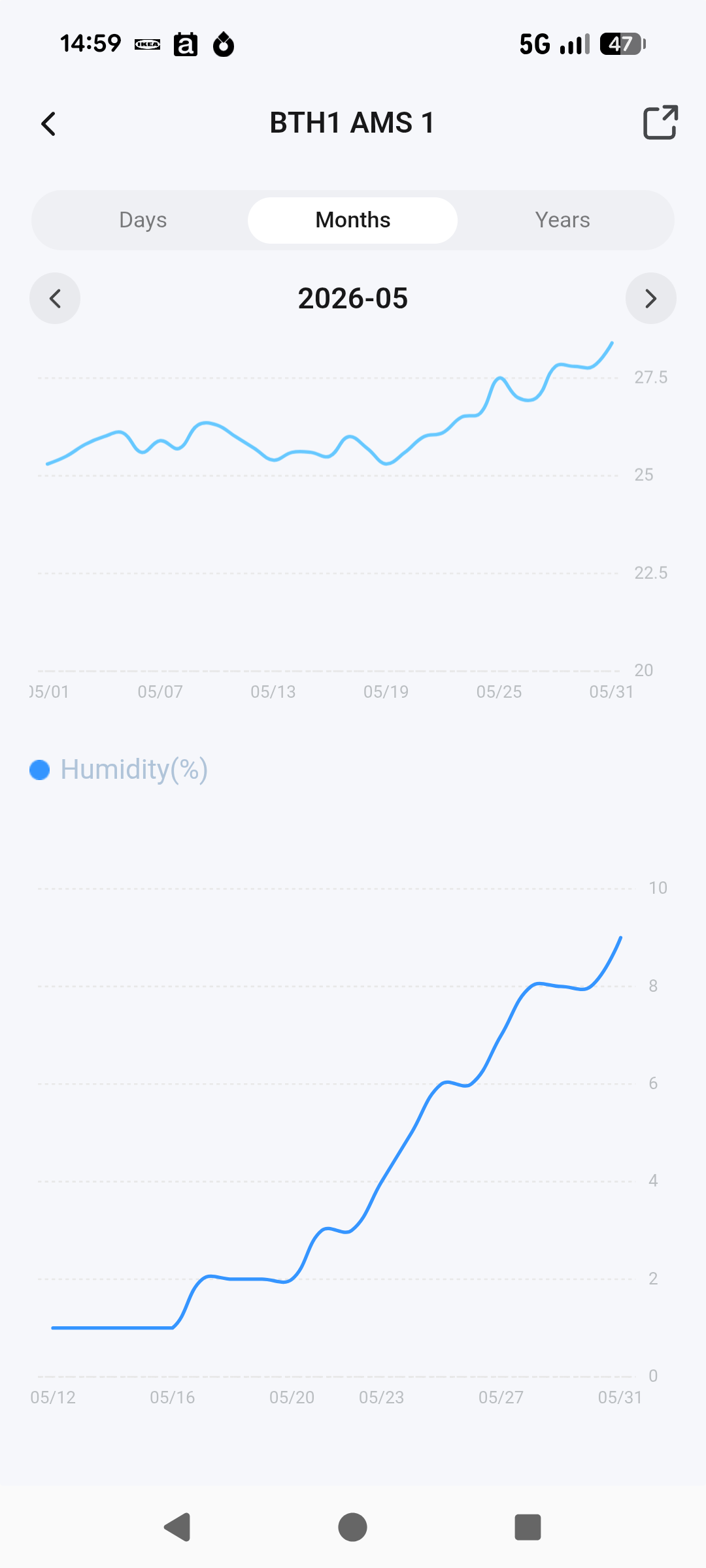
It is also quite interesting, how humidity usually rises slowly when the sieve saturates. This is one of my AMS that last saturated in may:

I think one can see nicely, how the sieve isn’t able to maintain 1%RH, but it still considerably slows down the rise, taking almost a month from 1-10%. Maybe because with higher humidity it also has more capacity so it still takes up some more?
When I weigh the sieve before and after drying, it typically looses 18-20% in weight out of 23-25% specified capacity. No idea if this is because my imperfect drying or because I exchange it “prematurely” at 10% humidity, where the capacity is still lower? I could leave it open at room climate a few days to make sure it’s fully saturated.

One thing is irritating in that graph: I always read that silica gel has a capacity of ±50% of its dry weight, but in the graph it only goes to like 26% at 50%RH or 36% at 100%RH. Somehow that doesn’t match. Maybe the graph is not quantitative but is more intended as a qualitative indication?

Sorry for derailing from the topic a bit :grimacing: I just find it a really interesting matter.