
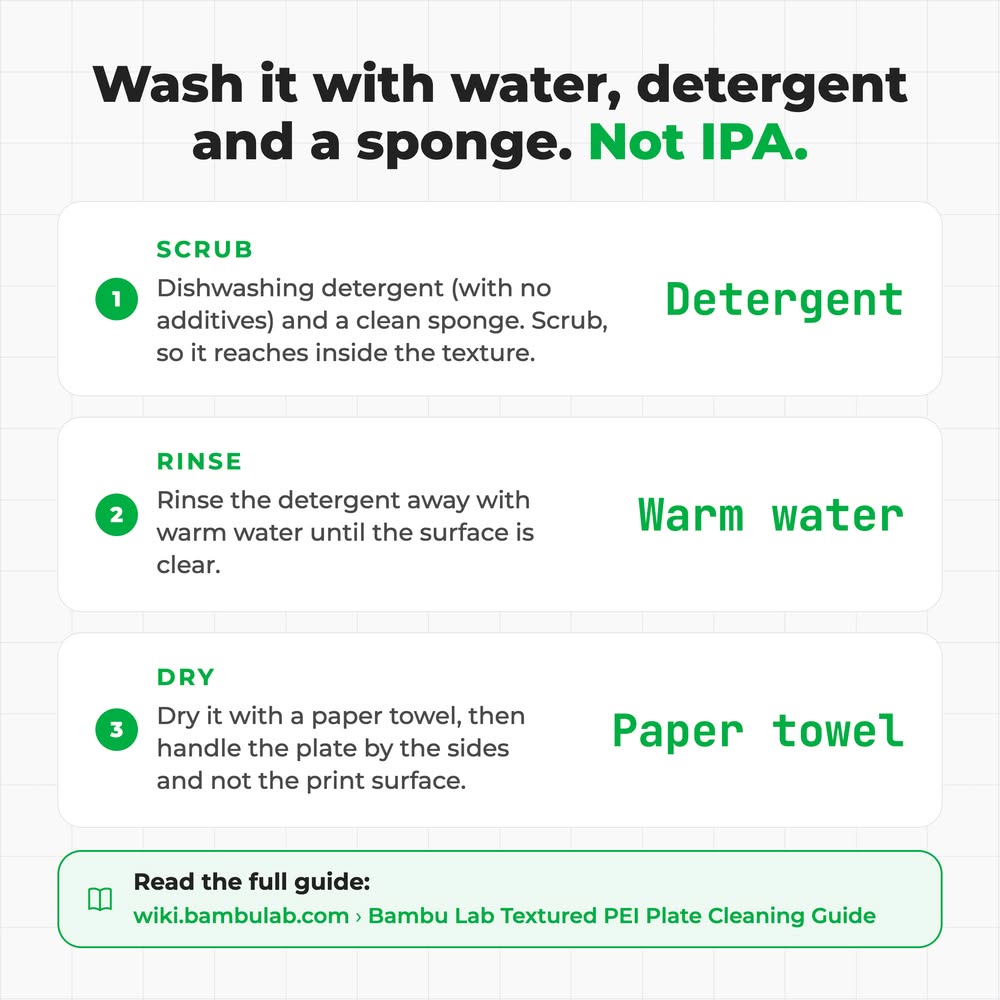
If you want to learn more about cleaning your plate, check out the Bambu Lab Wiki article:
There’s also a helpful YouTube video showing the entire process of cleaning the plate.

If you want to learn more about cleaning your plate, check out the Bambu Lab Wiki article:
There’s also a helpful YouTube video showing the entire process of cleaning the plate.
Is wiping-with-IPA verses scrubbing-with-detergent a like-for-like comparison?
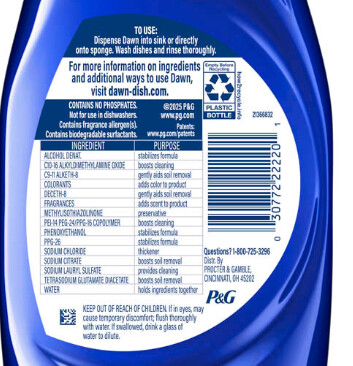
IPA is a commonly used degreaser, so it’s not IPA/Alcohol itself that’s the issue, and buying a detergent without additives is not as easy as you might think - look at the label the next time you wash the dishes.
Wiping-with-IPA verses wiping-with-detergent, or scrubbing-with-IPA verses scrubbing-with-detergent might be the fairer comparison.
Not that it really matters, use whatever method you like and that works for you 
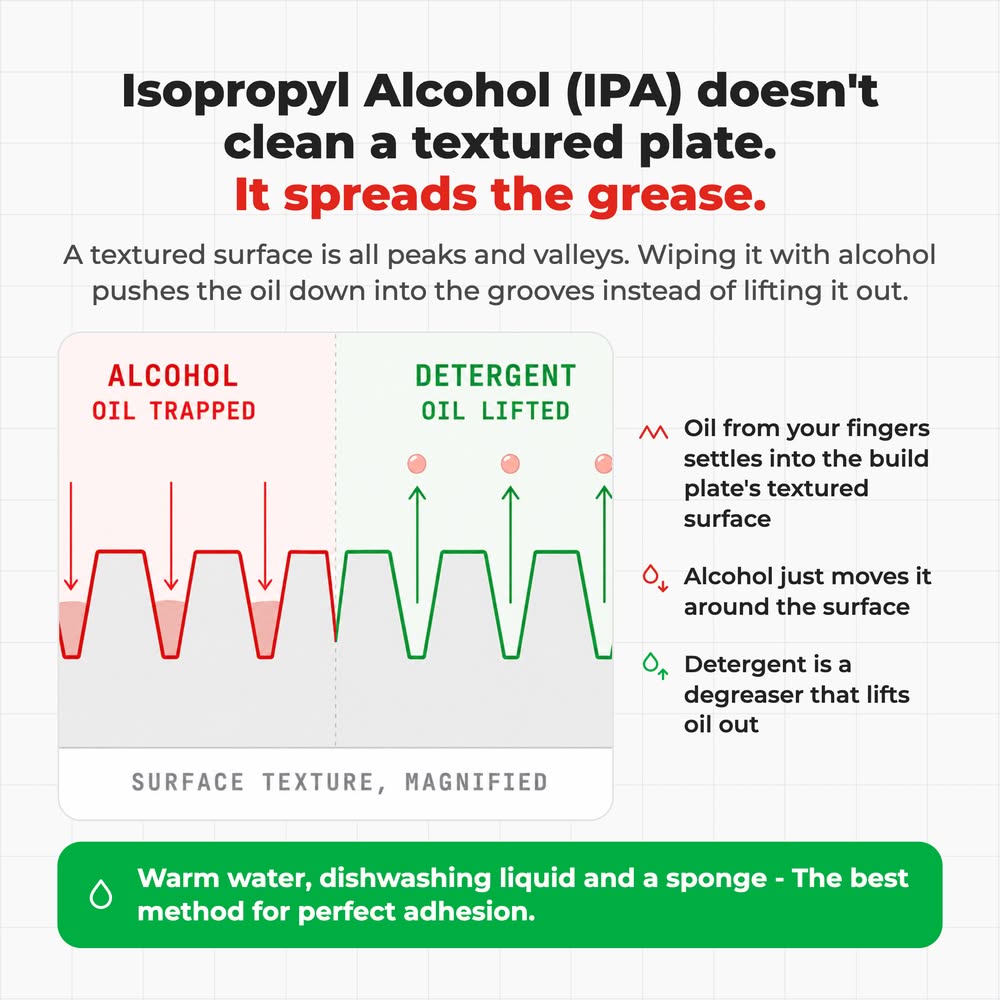
I think, the point is, with water + detergent, the oil goes into a solution with the water. When you then rinse the plate, it takes the soluted oil & grease with it.
IPA also dissolves the oil, but IPA vaporises really fast, so that the oil already gets deposited back onto the plate before you can take it away. So however fast you scrub the IPA, it will always leave some oil behind.
@TriplexD These topics are meant for beginners, and I’m not sure the “Ummmm, akshually” is the right way to go here, particularly when you conclude with “not that it really matters, use whatever you want” - like…seriously? Going in behind Bambu on these posts and saying “actually, just do whatever you want, it doesn’t matter” really isn’t a great look.
There’s enough confusion on this topic already, we get a lot of new users here who are wasting time and filament and not enjoying their new hobby because they think they’re cleaning their plates properly, but when we dig into it further they aren’t - often because of conflicting or confusing directions.
The best messaging for new users is the simplest, which is why I always say “Dish soap, hot water, scrub with a nylon brush, dry with paper towel afterward”. It covers 99.5% of users, anyone can do it and nobody is gonna screw that up.
As soon as isopropyl enters the picture there are a lot more things to consider. What are they trying to remove? Isopropyl doesn’t remove all types of contaminant. Is it 99.9% or is it 70%? That matters because of molecular polarity. How much are they using? It needs to be a lot to achieve sufficient dilution. How are they removing it? Then there’s a safety element that needs to be considered…
Bambu has only ever recommended soap and water in all of their material up to this point, I really don’t see that changing anytime soon.
There are people that you will never convince about this, the “I’ve been using IPA since my Prusa i3 and have never had a problem” type. It is almost like a religious thing where they get irate if you challenge their beliefs with reason and science.
@TriplexD, plain Dawn dish soap is easy to find, and there are more and more “free and clear” variants of most major brands. I could turn it all around like CarbonForge said, you have no idea whet is in your IPA. Is the 70% variant diluted down with distilled water or just tap water from the local municipal supply with whatever that contains?
If Bambu Lab, who actually makes this stuff, recommends the “dish soap and water” method, why assume you know better than they do?
The comparison is between the two most-likely cleaning scenarios.
IPA might work well enough if you flushed the plate with a sufficient quantity, but few people could afford to use even a liter of IPA to clean a plate. Detergents separate and surround oil molecules so they cannot cling to the plate and are easily rinsed away.
All detergents have multiple ingredients; they should have been more specific about the type of “additives”. None of the ingredients on the Dawn label will remain on the plate after a good rinse or reduce adhesion. The “additives” that can cause a problem are those that claim to be gentle on skin— moisturizers and fats. Also avoid using fabric softener on towels used to dry the plate; fabric softeners often contain wax.
When you use IPA, why doesn’t at least some part of the contamination stick to the cloth you wipe the plate with? I would rather hear a fact-based claim that the amount removed on the cloth is small than see claims that it doesn’t do anything. It doesn’t ring true.
Some does. Some doesn’t. It’s the “some doesn’t” part that is the problem.
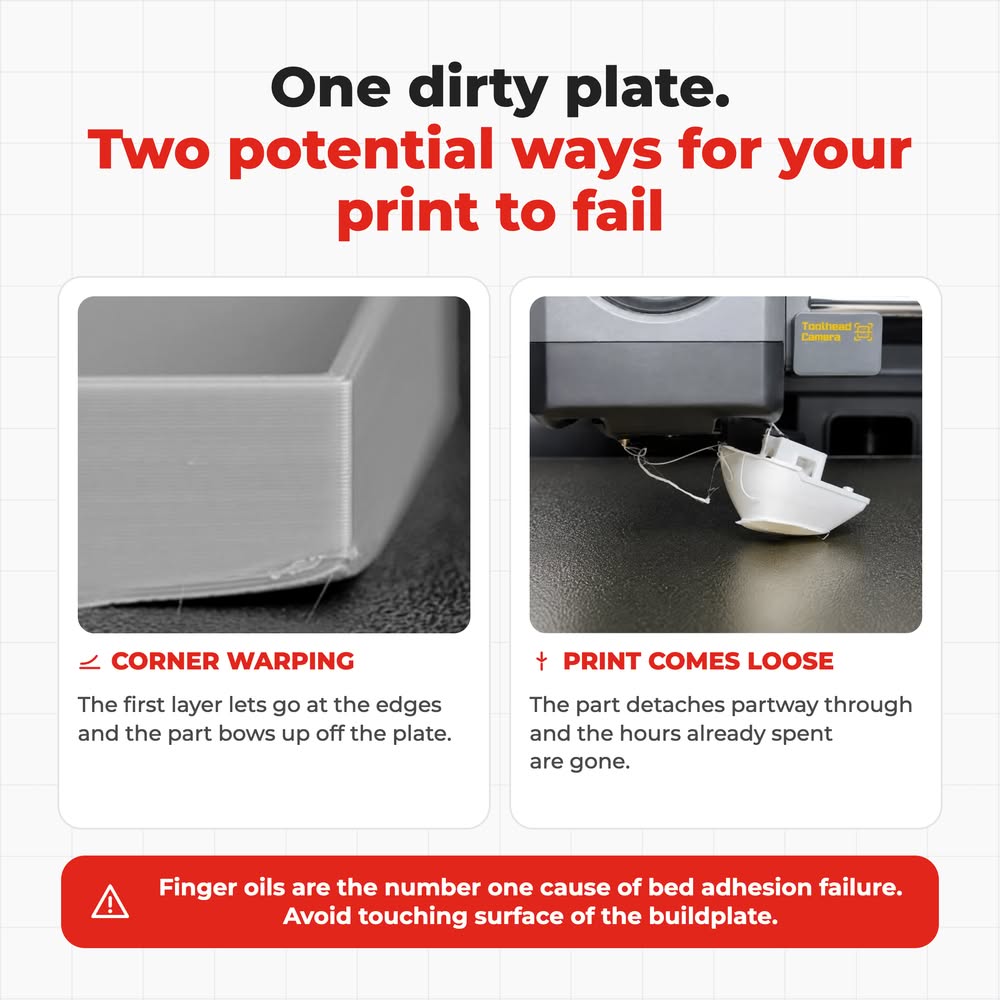
and if you use lye and bare hands like the person in the video you will be creating your own natural soap to do the cleaning! Ok, obviously DO NOT USE LYE! Lye is caustic and does very bad things. I do find it humorus that they state that finger oils are the number one cause and then show someone using bare hands. Yes, you will get it clean but you will be depositing some traces back on the plate from the handling.
Edit: In general I do like their PSA
fully agreed.
the only use case for IPA is as a release agend to get a stubborn tpu print off the plate.

I think the instruciton about handle the plate by the sides and not the print surface deserves just as much attention as the washing.
Probably a good idea to have a video showing how to handle the build plate when taking it out of the bed and putting it back, highlighting holding the plate only by the side edges and never touch the printing surface. Visual info is easier to absorb than words alone.
@DWdesigns Thanks for highlighting that. You make good points. To me, the person in the video is not just handleing by the sides although they are just on one corner. Using non-coated gloves when washing is also an option.
Another use case is for helping apply glue. I use IPA as a wetting agent to evenly spread glue stick on my plate and to re-spread existing glue after prints.
I suppose it would be useful in between washings, but I find that the most effective way of keeping it clean is to just not touch the surface with hands. If I need to man handle the plate, I put on some cotton gloves to help keep finger oils off.
I was initially expecting another "spaghetti on buildplate picture. 
That’s a sign, sure enough.
I use my 4 printers 24/7 for over 1,5 years, and 3 of them have the stock pei plate. I clean them everyday with ipa 99% and a microfiber cloth, and they are still as new.
The other printer has a biqu cryo plate. Which i touch with my fingers, almost never clean, and everything sticks like crazy on it.
Most of my adhesion problem occur when I switch from one type of filament to another, mostly from ASA to PLA or PETG.
I find that slowly wiping the plate with a soft rag or paper towel impregnated with a bit of acetone and then flushing with warm water works very well.
My daughter tells me she sticks her plates in the dishwasher! I am not very sure about that one.
What kind of plate? Acetone will ruin a powder-coated textured PEI plate, and will eventually damage a smooth PEI plate.
The dishwasher isn’t a good choice either. Dishwasher detergents contain harsh chemicals that can damage the surface and extended exposure to hot water can lead to the plate warping and even rusting.
Why won’t people simply use dish soap and a rinse in warm water, as the manufacturer recommends?
no it wont.
Dish soap/water is good, if the soap has no additives (many do and dont state it anywhere)
DMeader has already explained a about this to you, so to follow up on that comment:
That’s also why you should only put regular dinner knives in the dishwasher. No chef’s knives, no sharp knives, no cutting knives. They’ll all get dull.
Especially when all three points come together.
Many make the mistake of buying the version with 70% isopropyl alcohol, and it has little to no effect because it contains too much water or other things used to dilute the isopropyl alcohol. But if you stick to 99% isopropyl alcohol, you can remove the grease/oil that’s on your texture and other plates you use.