Having problems with prints sticking to my build plate. Cleaned the build plate several times with dish soap, hot water, and sponge. Hasn’t done the job. Looking into possibly using some type of glue. Which is better, easier to apply, easier to clean off, liquid glue or a glue stick? Seems like a liquid applicator would put put a more even surface. Any suggestions?
What are you printing? Both material and the part, if possible.
What build plate are you using?
How are you monitoring and ensuring filament dryness?
Glue should not be used as a fix for adhesion issues. It is best as a release agent.
It is better to fix the main issue than putting a band aid on it.
Best to answer Carbonforges questions first, but I like Vision Miner NPA, someone recommended it here awhile back and it has been my go to ever since.
I would add…
How many hours on the build plate? They are consumable parts
What soap are you using? I like dawn powerwash
And use a sponge that you only use for cleaning build plates
Using eSun PLA+, have been trying several different builds, using the original PEI plate that came with the P2S, using the AMS with dessicant to try filament, hygrometer says 20% humidty in unit.
Helps prevent a nozzle build up of a heavy handed glue stick.
Using Dawn and a new soft sponge. Have cleaned both side of the build plate with same results. Have had the P2S for about 3 weeks, maybe 50-60 hours on the plate.
Do you see any visible damage on the build plate?
Does increasing heat bed temperature by +5 degrees make it stick better? (This is more a workaround to get you temporarily printing, than an actual fix)
Does a different roll of filament have the same problem?
Out of curiosity, got any pictures as an example?
A quick wipe down with IPA wouldnt hurt either. Some people have hard water and they can effect it.
Bed temp is something to look at as well. I am assuming your printing with a generic profile, the esun might need a slightly higher temp.
The build plate (original PEI that came with the P2S) doesn’t appear to be damaged - I’ve tried both sides. Was originally printing with a build plate temp of 55, increased it to 60 with same results.
I’m going to do some routine maintenance (oiling and greasing) to see if that might help. I’ll try to get a picture of what the prints look like, if I can get one to stick well enough. Might try the IPA as you suggested…
At this point i would a different build plate or roll of filament, and determine if that is the cause. Glue may help but it’s a temporary patch to a problem that should be fixed.
For whatever it’s worth, I’m a big fan of using glue. I use stick on smooth plates and liquid on textured plates. My textured PEI plates lost their ability to hold onto a print long ago but with glue they work fine.
@Eponymous’ suggestion to increase the build plate temperature is absolutely true. Extra heat (but not too much) does help things stick down. I think their suggestion about a different spool is a sideways look at possible filament moisture issues.
Without photos, and your cleaning sounds good, have you dried your filament? Filament moisture can also prevent prints from staying stuck down.
I assume this test has been passsed?
So to answer in a short form:
glue stick as a release agent;
liquid glue as an adhesion promoter.
In a longer form: There are a lot of factors when it comes to PLA printing. From my experience, large PLA prints tend to warp way more on textured or satin plates. I use smooth PEI plate for PLA, textured/satin for PETG and TPU, G10 for anything else
Also, the material itself may be an issues. If this is a new roll and you have issues with it - it may be a defective spool. While it’s not common, but some batches from some manufacturers may have a wrong material composition. But again, this is super rare.
On a build plate washing - use warm water, down soap (with no additives) and use bristles or scrubbing pad. Don’t use the one that you use for dishes - oily residue from dishes may ruin it.
This is how Textured PEI looks like -
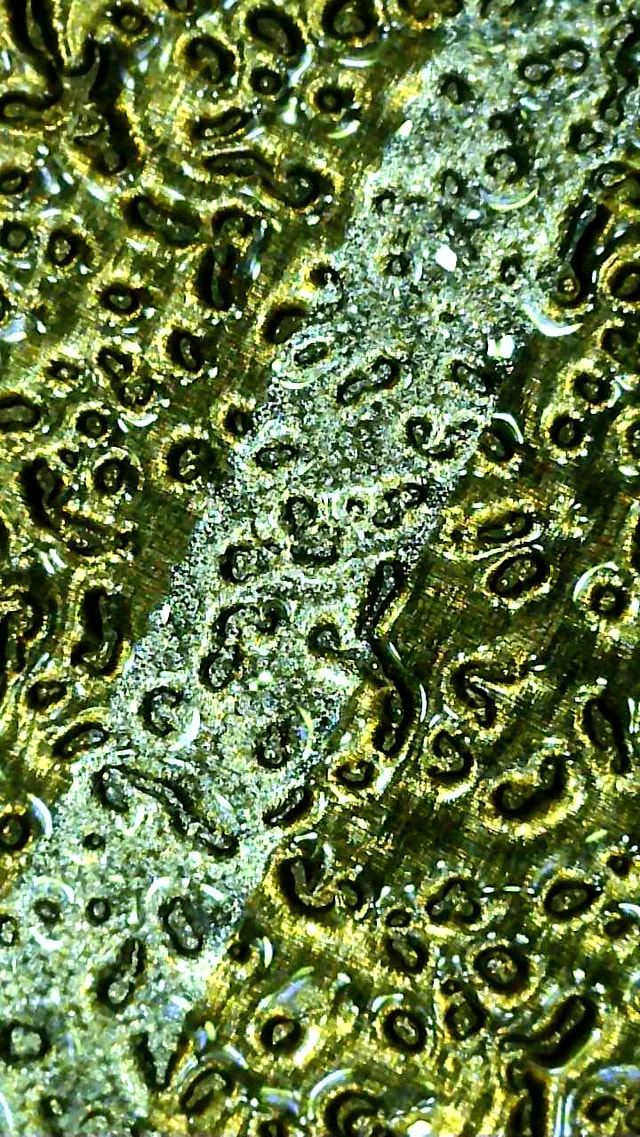
It has a lot of pits and that’s how it holds the material in it. Soft sponge rarely does it well as you want to get in there and dislodge whatever oil or residue is left on the plate.
The last step, when nothing else helps - take a scotch-brite pad or a sandpaper and lightly scuff the plate. Yes, scuff the plate, you’ve read it right. Sanding down the plate helps to “renew it”.
It’s an official procedure by Bambu Lab, by the way.
Wait let me check. Nope, nothing changed. Still the wrong pronoun.
Sanding time. I still have the original textured PEI plate from 2023 that went through ■■■■. I used 400 grit pad on an oscillator and did a light pass - now it works much better than a brand new plate for X2D.
I have yet to get a plate to the point of needing to do something like that. If one side seems like it is starting to wear out, time to flip it over.
My money is on filament moisture especially with this and…
That  . New(ish) printer. Is your filament stored out in the open? It’s very common that people get printers that print well at first but then have various issues a few weeks or even months later as filament soaks up water from the air.
Do you know your ambient humidity?
One thing about that humidity reading in the AMS. In any enclosure that actively dries, using membranes, sieves, or just desiccant (like the AMS I), the humidity you read is the combination of water coming off filament and water being removed from the enclosure. At 20% humidity, your desiccant is either getting loaded up with water or your filament is a fairly strong water source if the desiccant is fresh (guessing it’s fairly fresh since the printer is pretty new).
You can take all the filament out of your AMS and see what the humidity inside does without a potential water load. If the number goes significantly lower after an hour or so, you likely have wet filament. Whether or not that’s causing the lack of adhesion to the build plate is another story but things seem like they could be pointing that way to me.
Apologies. I haven’t looked up your user name if that might reveal anything. I just assumed (and again I apologize) since most here are he/him.
If you care to share appropriate pronouns here or DM I’m happy to use them. And hopefully fixed in original post.
omg, didn’t expect to see pronoun offenders here.
It’s actually quite easy to screw it up. I used my old as a soldering mat, greasing plate and whatever else I used it for (at that point in time I deprecated the plate, so I wasn’t really concerned about its condition).
With good habits it would last a really long time.