Having a heck of a time trying to compensate for skew errors. It turns out the H2C does not use the M1005 command, it seems to be ignored. I tried using the vision encoder and my prints actually got worse, confirmed twice with factory resets. So right now I cannot use it to make dimensionally accurate parts. I have a ticket open but have not heard back yet.
Hi, this filament seems to be sold out at the moment, amazon told me that it will arive in february 14-20 instead of today. So we need to wait.
Surprise, surprise, the filament arrived today. In test mode now, more later.
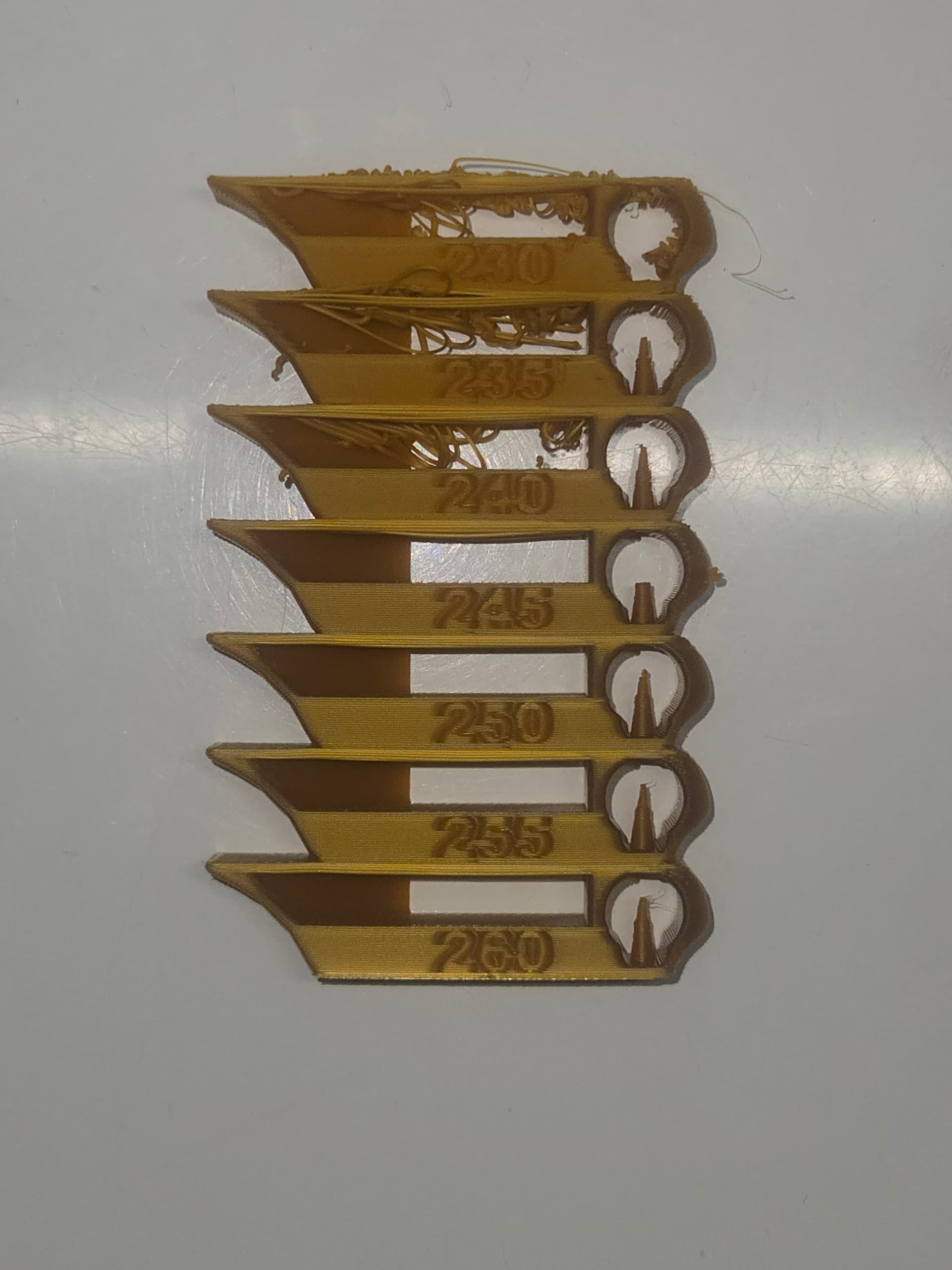
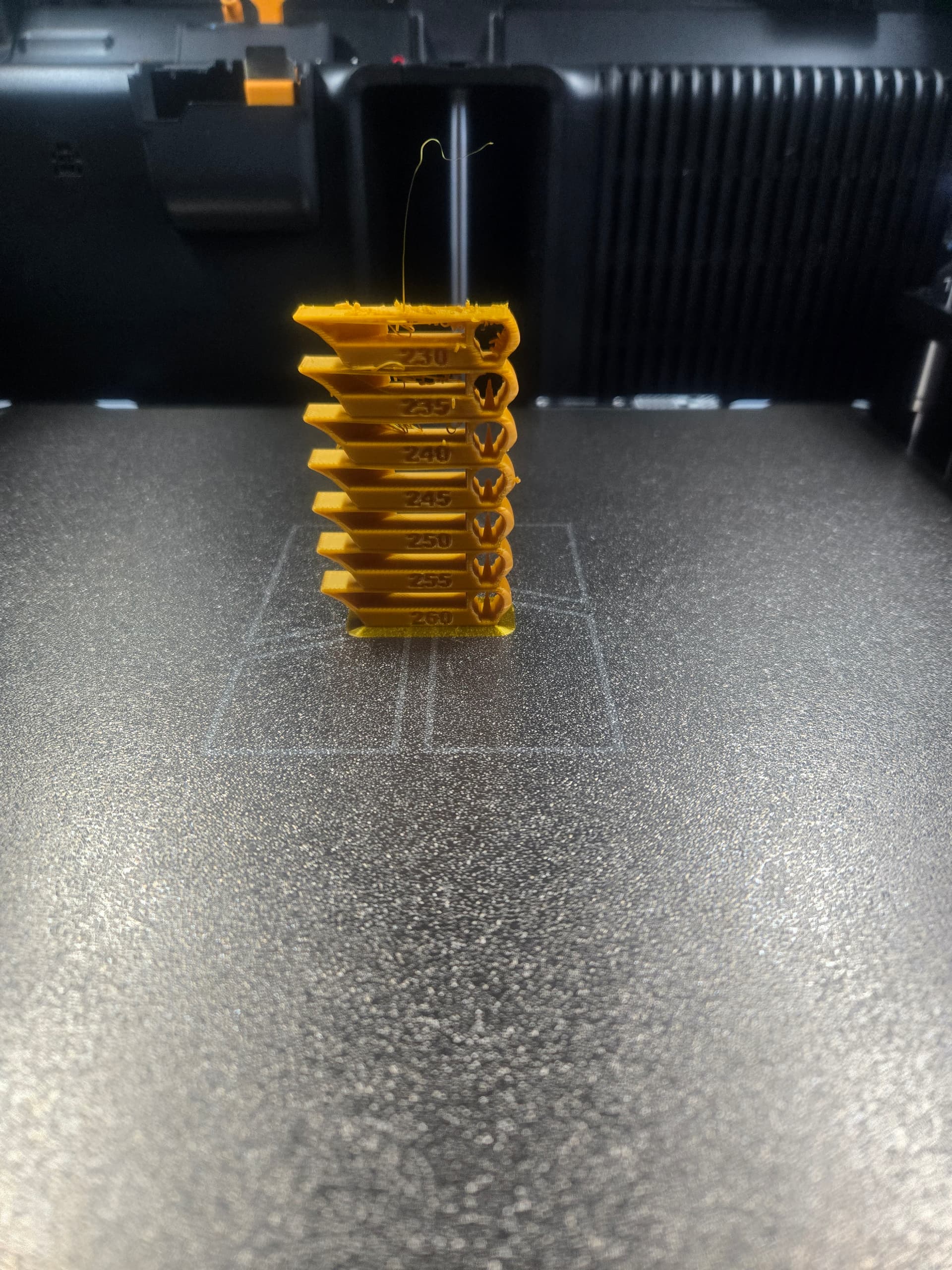
Test complete. The setup was as follows: PETG straight from the box, undried, into the AMS. The heat plate was cleaned as usual with generic glass cleaner. The Vortek nozzle was previously used with PLA, no cold pull. Then I simply selected the temperature tower to see how the filament would behave. Overture specifies 230-250 degrees. I set it to 230-260 degrees. As you can see, adhesion wasn’t a problem, but the filament needs at least 250 degrees, preferably more. I stopped at 230 degrees because only garbage was coming out. The heat plate was at 70 degrees. Perhaps the temperature was your problem, or your heat plate, or the cleaning. Glass cleaner works great on my printers.
Thank you — this is very helpful!
I recently repeated my test using all the default generic PETG settings and changed only the speed. The print was successful.
I believe your finding about temperature alone and my test involving speed alone lead to very similar results. The main difference between our prints was model height: mine was about 60 mm tall, and in my case speed proved to be the decisive factor.
Thank you again. Clearly, this is about respecting Overture’s material parameters (not only Gold — I had similar issues with an Overture Grey filament). I have used many other brands from various vendors without problems, so I will simply be more cautious when using Overture.
The temp tower is also 60mm, and as you can see in the pictures, you dont have to take the overture settings, thos needs more temperature, 260-265 degrees, and with higher temp you can use higher speed. I alway do temp towers with non bambu filament to check how it reacts. And the overture surprised me, because their recommended settings didn’t work.
Hi, I’m not sure if this the correct place, but I got the gyro grip build plate and after several attempts I have the issue that the H2C says that the build plate is not in the markers. I selected the cool super track plate. Is this an issue with the quality of the plate or a normal behavior of the H2C?
After lowering only the speed to the required values, I achieved a perfect result.
Stringing during fast extruder moves was ruining the model—starting from the support trees and continuing up to the first layer and/or beyond 10+ mm, always tearing my prints off entirely. All of this clearly indicated the need to slow down (or use glue, which I tried, with only minor improvement).
If slowing down had produced only partial improvement, I would have proceeded with temperature adjustments. However, based on how my prints behave, I tend to avoid Overture filaments altogether; they appear to be designed for the era of slower printers.
The issue is not about combining speed experiments with your valuable temperature research. It is about using Overture alongside other filaments in the AMS (none of them are Bambu-branded—just a mix of random brands ranging from very cheap to budget). Because of this, I will keep the few Overture spools I have for H2S or H2C single-color printing only, which happens very rarely for me now.
Thank you for the follow-up. I appreciate your attention to this issue.
I am enjoying my H2C for about a month now. I did have some issues occasionally with spaghetti prime towers (not to an extend that fails prints) and had an issue with usage of the left nozzle (I suppose it was a wrongly inserted PTFE tube by factory).
Apart from that, every print is coming out perfectly. I am just a little angry with myself as I do almost no dual nozzle prints… most works with two AMS connected to the right nozzle.
Also, crazy good adhesion with the structured PEI plate… almost too good.
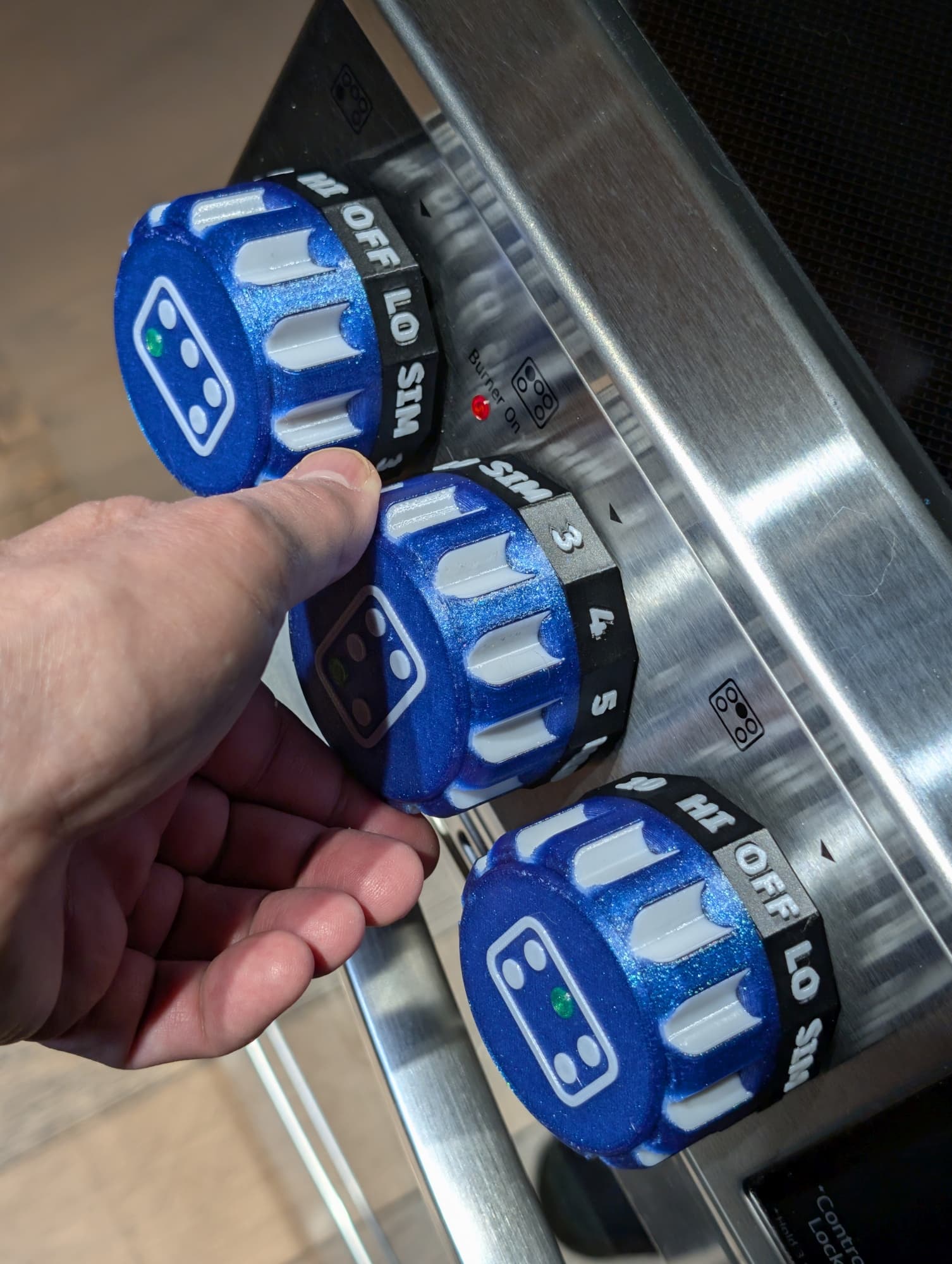
I’m curious, was that PLA or Petg? They look great BTW
PETG FTW! Thanks! I don’t print anything with PLA. I designed these knobs around the inserts from the original knobs- they snap off so the prints can be put into a dishwasher, then snapped back onto the inserts. PLA would not survive in a dishwasher.
I just ran a print with some tree supports that were leaning precariously in the slicer. When it printed, the support fell over and the printer paused and sent me a spaghetti notification. I went to the printer, removed the failed support, and tapped the “defect acceptable, resume print” button and it finished fine. Very nice!
I’m also having trouble with the induction nozzles on the right side of my H2C printer. I constantly experience clogging problems before every print. The filament left over from the previous print can’t be discharged from the nozzle, causing the clogging. I have to unclog it manually every time.
That’s strange. I have two H2Cs and have never had a clog with any of the nozzles. What size nozzle is clogging and what type of filament is it?
I’m using a 0.4 mm nozzle. For filament, I’m using Bambu Lab and Polymaker PLA and ABS. The filament diameter is 1.75 mm.
I have been designing, building, and using 3D printers for 13 years. When I first started printing, I used PLA. Clogged nozzles were a constant problem. I switched to ABS, and much more recently PETG. I have not had a clogged nozzle since I stopped using PLA, about 12 years ago.
I want most of my prints to last, or I wouldn’t bother printing them. PLA melts in a car parked in the sun. I can’t guarantee that my prints are never going to be transported by car or truck, so I don’t print with PLA. The only good use for PLA, as far as I can tell, is as support material for PETG prints. But then you might still have to deal with clogged nozzles. It’s probably not worth it.
PETG, ABS, and PLA all cost about the same, so why use PLA at all?
Just a heads up. Petg melts in the sun too. ASA is what you want, for that purpose.
PLA for quick prototypes and normal items that aren’t subject to anything more than room temperature. I get black/white PLA for about 8 dollars a spool 10kg at a time. ABS is about 12 dollars now in the same quantity.
For almost everything functional or subject to heat I use ABS.
Despite it being the default material for many 3D printing enthusiasts, I don’t use PETG too often.
Aye, this looks awsome.
I already sliced this but not printed yet.
Gussing this came out great with only few pooops:)