not gonna bother trying to edit the code, ill simply generate an STL based on the GCODE, its gonna be lower ress as the only reference is gonna be the printed resolution, so the end result is going to be a bit worse in quality (but it might also just coincide perfectly, we will see) . But ill just end up with a presupported model, perfect to test.
I hope
1 Like
Aha, I see what you mean now. Clever!
Ιt didnt work, at least with the tools at my disposal. I guess the support walls are not thick enough, so they just appear like artifacts all the way up to like the last 8-10 layers (like i can see the top 15% of the supports, the rest is a mangled mess hah)
Thinking I might just copy-paste the gcode part related to the actually movement/extrusion , but honestly I really dont wanna do it, Im really afraid the damn machine will act weird and ram a head into something
Supposedly Simplify3D can take a g-code file and generate a preview for it. From what I’ve read, it works for X1C. It wouldn’t have anything specifically for H2D, so you’d probably need to run the preview as though it was an X1C. Not sure to what degree the g-code language used by the two machines might be different, though. If you’re lucky, then X1C would just be a subset of H2D’s g-code language (e.g. basic movement and extrusion might be the same, but the X1C would obviously lack the language for switching nozzles the way the H2D can).
Well all that i need is to find a way to take Model+Supports as sliced for my P1P, turn it into stl so that its pressuported and then slice it for H2D in BS with supports off.
So for context, THIS is the result I expect and get when supports do their work.
Any time the ironing is failing there, I ALWAYS know the supports failed one way or another.
On this job I attempted to fix the previously stated kinda failing tree supports by slowing down bridging to 35mm, and 0.025 more flow. Forgot to turn down ironing flow from 30 to 20 tho, thats why i got that wringles on the ironing, but thats ok, onces it cools down thats minimal and will go away/hide.
If the supports fail though, its immediatly evident in the ironing because it being so thin and delicate the subtle lower position of the layer ends up in the ironing looking like scratches.
Hey buddy, I’ll DM you about it
I’m very curious with what’s going on. I have a strong feeling its a slicing problem (a setting that needed to be adjusted for H2D but wans’t or something alike). I haven’t had any support issues with the H2D since I got it. As for the number of interface layers, that was expected behavior given the difference in default layer height / top interface spacing.
Νo its not expected, what are you talking about? Regardless if the Independent layer height is activated, the Support Transition layer is always there, and its an EXTRA layer added to the number of interface layers you set . Say you have the independent layer height ON, it will adjust the number and height of layers of the support STRUCTURE not the number of interface layers, thats why you SET it.
Moreover, the supports are not generated optimally but rather crude, as evident in my comparisson with orca (ie the interface layers instead of interlocking diagonally to the structure lines, they cut it vertically, which honestly i can easily see it adding to its Shagging issue.
But no matter how you see it, it just adds an additional layer EVERY time, you set it to 1 interface layer, you get 2, you set it to 2 you get 3.
Top interface spacing also is about how far apart the lines are, not how tall or how many layers.
1 Like
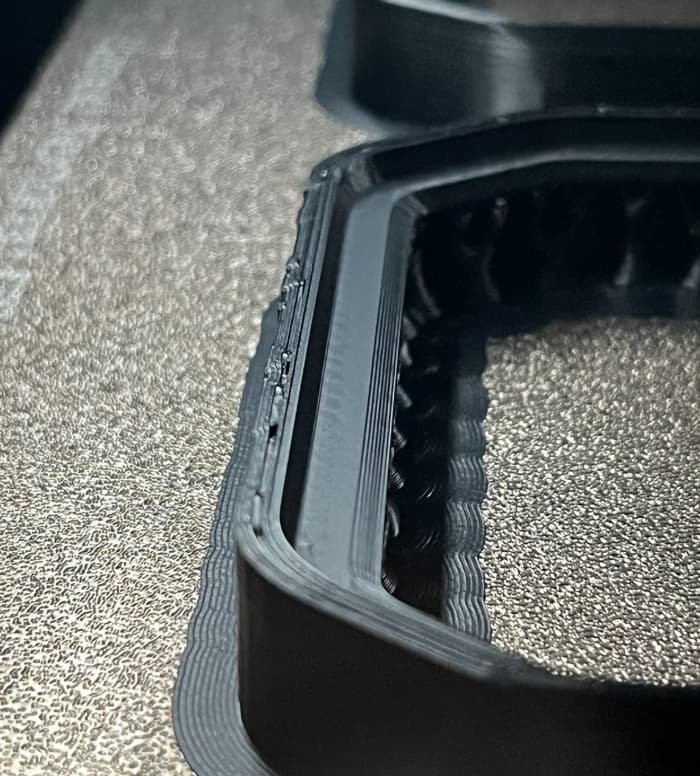
It looks like support is sagging here. Have you tried increasing part cooling? Increased part cooling and slowing down on support printing might help.
HO finally a guy with eyes! Yes thats exactly what im trying to find out why its happening. Cant really bump cooling , as its abs and it will just warp away, producing negative results, but im trying to find WHY they shag on the H2D but not on 4 other machines
Side update, my Z-banding seems to have gone away after couple more days of continous use, I suspect that just the break-in period of H2D is a bit longer and more highlighted than the previous models.
@NothingHam Do you own any other Bambulab printer models? I was just thinking: you could slice your model as per usual using orca slicer, since it still works for all non-H2D models, and see if it prints as expected. Presumably it would. Then slice the same model for that same printer using Bambu Studio and see if it then fails. What would be the point of this? It might establish that it’s a slicer issue rather than a hardware difference.
[Edit: looking back, I see you do have a P1P, so you could use that to run the AB comparison]
It does , thats the point, the same models are just spewd out from P1P, Voron Trident and surprise, 2 neptunes, modified yes, but still, all of them nail it, the neptunes run different settings yes, but voron is modified to work IDENTICALLY to the p1p (yes even extruder and hotend wise) , and run EXACTLY the same settings I run on H2D , which is not even “pushed”, its pretty conservative to ensure quality , so its not like im trying to print an extreme job ,just one that the other machines print all the time
I print this model about 50 times more than benchies, to put it into perspective.
(edit, you might notice sometimes my screenshots/photos are from different models, but its the same rules, every model I print was printed on all the other machines already, many times) .
I need consistency in my quality so all my machines are tuned to produce the EXACT same result, but also Im perfectionist, I dont take mishaps, I dont sell items with defects over a certain threshold, so I know what to expect from my machines 
Reread, yeat tireness took some comprehensive abilities away.
I see you meant to slice from bs for P1, good idea !
I suspect its a bit of both actually, h2d not perfectly tuned for ABS yet AND the way BS generates supports. This time around its gonna take a bit for me to try again unfortunately ! Long prints ahead, so its trees for now, plus more clients incoming , so for couple days ill be way too busy to try anything, ill just stick to what works for now. On a happier note, at this stage the issue with supports is my only one, quality is improving print by print actually.
2 Likes
Silly question. About 14 months ago I had an issue like this on the X1C and simply slowing down the support printing speeds specifically the support interface solved my problem.
Please not I do not yet own an H2D, so again, only talking about one issue on the X1 and I was printing a nylon part for a friend. I’m not a technical/ engineering parts printer so take everything I said with a grain of salt. Just my two cents.
I’m curious to see if you find a solution that’s acceptable for you and what that is.
Happy printing! 
No it won’t help. I had similar experiences with a1 and x1s. A1 was printing PLA and X1 was printing PETG CF, abs. It’s basically as simple as the single layer support wall is just not that reliable, so when you draw a long wall in fast speed with high extrusion pressure, it bows.
1 Like
Cant really bump cooling , as its abs and it will just warp away
Not really. One big difference between your Voron, P1S and H2D is the active chamber heating. ABS really like hotter ambient so the stress don’t build up the part. Because of the chamber heating, you can increase the part cooling.
Try either increasing the part cooling or reducing the chamber heating temperature. I have not tried printing ABS on my H2D yet, but I printed bunch of parts with ASA with chamber temperature set to 50C. (default setting was 60C).
When Bambu Studio 2 released the prime tower changed, and the support generation was changed, especially tree supports. I can only assume the reason they did this has to be because of the H2D because otherwise why would they change the tree supports to generate worse.
I saw a youtuber who had lots of problems with supports and Bambu actually wrote out a whole multiparagraph report of recommendations on why supports on the H2D keep failing. They said to use hybrid tree supports and they went on about lots of specifics. It occurred to me that theirs still problems being worked out in regards to support settings and the H2D.
wow, sounds like a lot of valuable information! would you kindly share the link to the discussion there? I usually don’t have support failing issue but always I would like to know more

1 Like
Infact lowering the chamber temperature a bit is my next step but the job on h2D failed overnight , tree supports were flinged away and AGAIN AI DIDNT DETECT IT