The problem with conventional PVA interfaces
During my tests, I discovered a major limitation of using only three thin PVA interface layers between PLA supports and the printed object.
Bambu PVA adheres extremely well, both to the build plate and to PLA. This is excellent during printing, but becomes a serious problem when removing the supports.
The PVA interface is trapped between two solid PLA surfaces, leaving very little surface area exposed to water.
How long are we supposed to wait for such a thin, enclosed interface to dissolve? Three years? Or perhaps it will never dissolve completely under these conditions.. 
In my case, even after soaking the part in warm water, the supports remained firmly attached. I eventually broke the printed part while trying to remove them.
By contrast, my 100% PVA tree supports printed successfully and dissolved much more effectively.
The problem is not PVA adhesion or solubility. The problem is water accessibility.
## 1. A new open-structure PVA interface
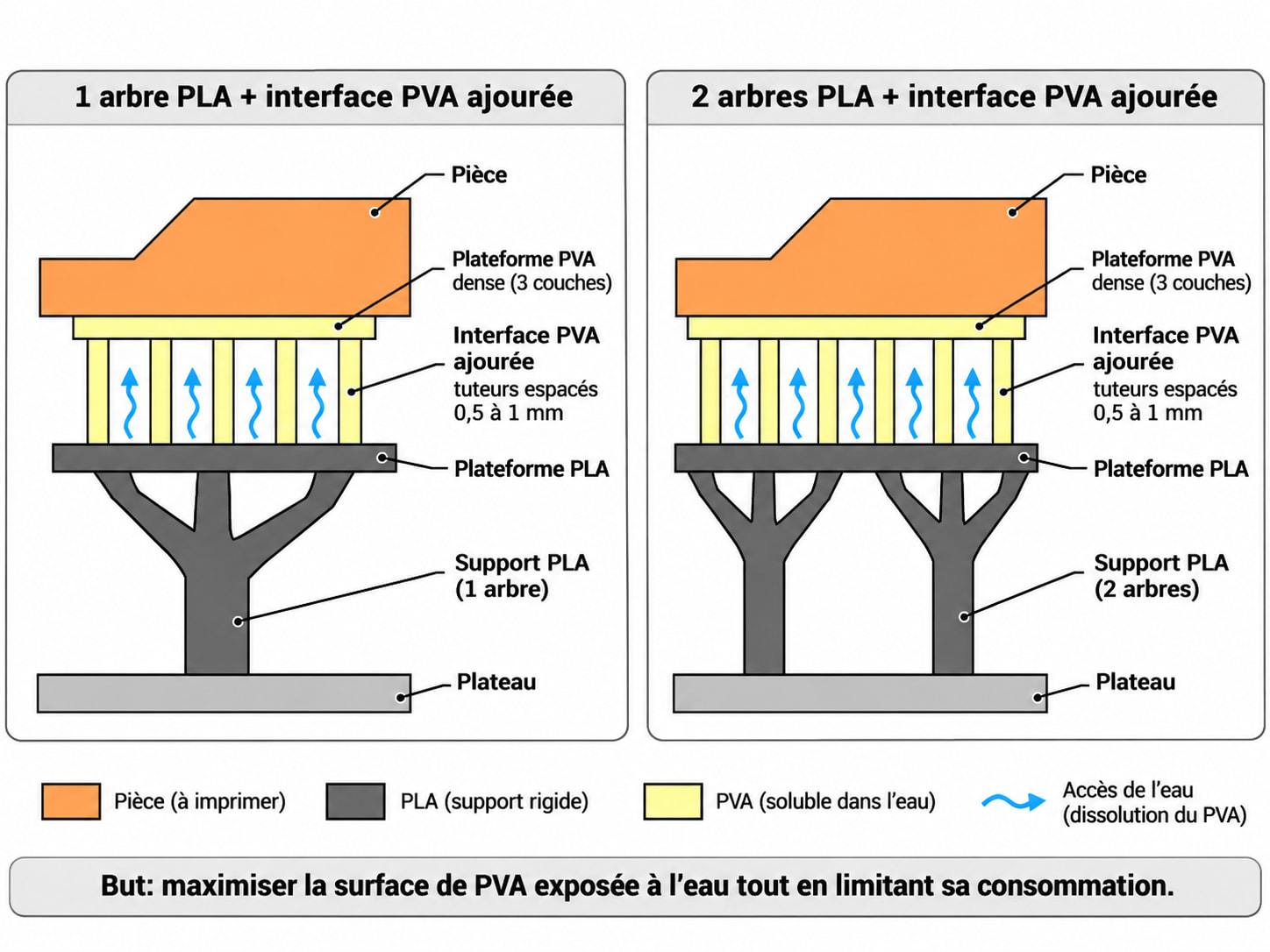
I suggest replacing the conventional thin PVA interface with a thicker, open lattice structure designed to maximize water exposure.
The structure would consist of:
-
A lower support structure printed with the main material (PLA, ASA, PETG, etc.).
-
A small, stable platform made from the same material.
-
A 2–3 mm high open lattice of PVA pillars, spaced approximately 0.5–1 mm apart.
-
A dense top PVA platform consisting of three layers to properly support the printed object.
This would allow water to circulate freely between the PVA pillars, exposing much more soluble material to water and potentially accelerating dissolution significantly.
The objective is simple: use less PVA while making it much easier to dissolve and remove.
## 2. Two support types in the same print, selected by painting
Related to my previous suggestion, but with a simpler and more practical approach:
This idea could also be combined with my previous suggestion about using different support types within the same print.
Instead of introducing dozens of complicated options, Bambu Studio could offer just two soluble support modes:
Mode A — Hybrid Supports
Supports made from the main filament, ending with the new open-structure PVA interface described above.
This would be the default solution for most accessible support areas, providing good mechanical stability while minimizing PVA consumption.
Mode B — 100% PVA Supports
Fully soluble supports, including the entire tree or support structure, intended for inaccessible cavities, narrow gaps, internal features, or any location where mechanical support removal is impossible.
Selection using manual support painting
The existing support painting tool could be extended with a second painting color.
For example:
-
Default support painting color: Hybrid supports with open-structure PVA interfaces.
-
Pale yellow painting color: 100% PVA supports.
Both types could coexist within the same print, allowing users to choose the most appropriate solution for each area of the model.
No need for dozens of new settings or complicated workflows.
3. Why this combination makes sense
These two complementary support types could cover practically all situations encountered in 3D printing:
-
Accessible supports: economical hybrid structures.
-
Difficult-to-remove supports: hybrid structures with easily accessible soluble interfaces.
-
Inaccessible internal supports: fully soluble PVA structures.
This would be particularly beneficial for dual-nozzle printers, where different materials can be used without purging the same nozzle.
Two support types, two painting colors, one print.
The goal is not to improve the PVA filament itself, but to improve how Bambu Studio uses it.
By maximizing the surface of PVA exposed to water, while allowing fully soluble supports wherever necessary, we could achieve easier removal, reduced material consumption, and less risk of damaging delicate printed parts.