I think you replied to the wrong person. 
I love watching this thread.
You guys know you’re right. Why keep trying to convince someone who doesn’t believe it’s impossible? You aren’t going to win.
I am afraid this thread shows the cause of the trolling phenomenon back in the day. I am writing down my experience and than 10 people tell me I inserted the magnets the wrong way, or the printing head is interfering, so stating they did not read my post…
I absolutely did read your post. It’s too bad you aren’t open to examining your own procedure.
The thing is, the discussions of Curie point, magnetic strength, small domains, and field blocking by the build plate are all absolutely valid and if you would just do a little checking with a textbook and how magnets are manufactured, you would see why the points made are valid.
You claim a procedure that isn’t backed up by your photos. Your photos actually indicate a different procedure is being used. We can’t look over your shoulder and you don’t seem interested in doing the minor stuff like marking poles that would immediately show what the problem actually is.
It’s the internet but some of us here are engineers and other professions (or retired from technical professions) that know what we are talking about. None of us are trolling you. In fact it’s starting to look like it’s you trolling us.
You don’t believe it apparently, but not one post in this thread is out of line. To people who understand this stuff just about every post is correct and only posted here to help you out. It’s actually pretty rare to see so much accurate technical help in a thread here.
If you would only mark the magnets for polarity before putting them in you might discover your error, but I assure you - this is your error and getting upset with the people trying to help you is counterproductive. When you are actually ready to sort it out give us a heads-up. I for one am done. It’s not my problem at all if you never figure it out.
Read a physics textbook with a chapter on magnets for crying out loud.
This is just GCode, I can do nothing with it.
Ok, I did find one post with inaccurate information. Not to pick on Sultan, but this isn’t correct.
The heater in the print bed runs on mains (AC) voltage. Alternating magnetic fields are how you DE-magnetize things. If this had any effect on neodymium magnets they would come out with reduced strength - not domain flipping.
And the part about them being known to flip polarity implies it’s not hard to get them to flip. It’s hard to impossible without going through the original magnetization process. It just won’t happen at the temperatures a 3D printer sees.
Personally never used ring type magnets but a quick Google shows several possibilities.
Some strange field configurations out there. 
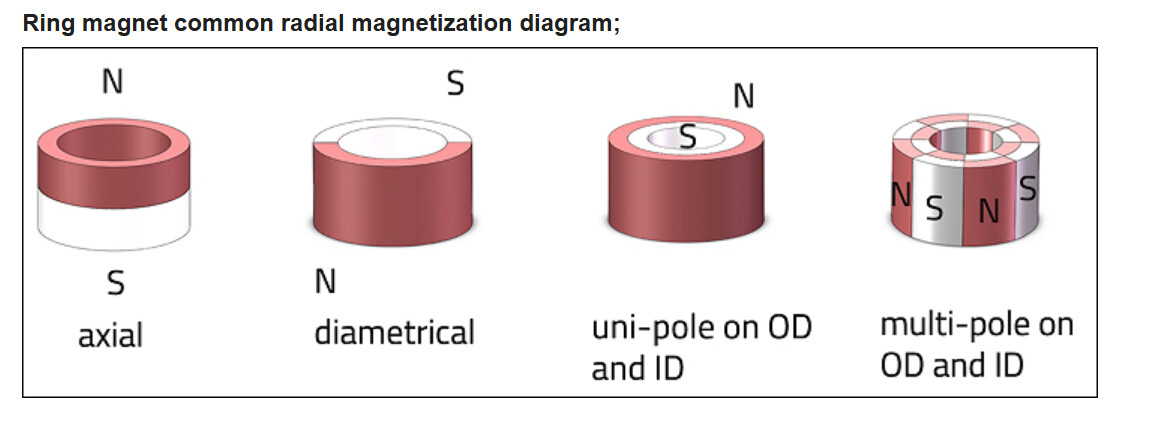
magnet holders.3mf (6,2 MB)
Did you do the test with the special sheet. when you switched on the heater ?
Currents through the heatbed are high, and have there own magnetic field ?
Sorry but it just starts getting confusing since this thread seems to keep going on and on!
Why are you using ring magnets in the first place. I had to modify the part to fit regular magnets. With ring magnets you are loosing so much material.
Also, why not just glue them in at the end? That would avoid this whole conspiracy in the first place.
I though it might be a problem that you are had too much material in between, but you only have a few layers. That shouldnt be a big deal.
The OP said it is on a H2D. So my theory does not apply. But I wonder? If it was on an H2C what would the affect be?
My guess is the induction heater focuses the field to be efficient. I have not looked at one with this in mind. In theory it could heat the magnet and provide sufficient field to set the direction. Not flip. Only “flipping” the one orientation.
Or just call BS.

Yeah, except you’d have to keep this on with the magnet inside while it cooled down. And you’d end up with something much less powerful than the original magnet.
We used Neodymium and Samarium Cobalt magnets in a product line I worked on. Both are basically compacted metal powders formed to the desired shaped, then they get exposed to a magnetic field before being compacted (which aligns all the particle grains), then it gets sintered (which turns the powder in to a solid) and after it cools down, it’s zapped to magnetize.
They usually magnetize with a capacitive discharge magnetizer. A big bank of capacitors charged individually and then discharged all at the same time, to deliver a short pulse of high voltage electricity to a magnetization coil. You get 3+ Tesla fields. Which again, is MRI range field strength. It just doesn’t last very long (but it doesn’t have to, the magnetization process is virtually instantaneous) so it doesn’t have time to suck the fillings out of your head.
Other comparisons… what you need to fully magnetize a Neodymium magnet is about 4x more powerful than the magnets junkyards use to pick up scrap metal. 60K times more powerful than the Earth’s magnetic field.
That white plastic thing is for magnetizing/demagnetizing stuff like a screwdriver. Carbon steel. Not strong enough by a long shot to do justice to a Neodymium magnet. 
Disagreement isn’t trolling. You have a problem and are in possession of all the information about that problem, you’ve shared a small portion of that information, and people are sharing their opinions on the subset of information youve shared. Nature of troubleshooting.
You still haven’t acknowledged the heat and tesla required to reorient a Nd magnet - aka the actual industrial process used to accomplish the thing you claim is happening. Will you? And after that, will you look at your problem with fresh eyes? Maybe put aside all your existing pieces and verification methods, start with a stack of magnets, and permanently mark a N / S on all of them at the same time, then begin again. So that if you encounter the problem again, you have a physical confirmation of a magnet side testing north but marked as previously measured south, etc. I highly recommend making a dual purpose QA tool + insertion helper.
Seems it would be easy enough to prove, just cut it open and show the reversed magnet ?
Are we really still on this?
We have established that it is not possible. To the point of me recreating his model, not having that issue.
Looking at the profile, its pla with the bed temp set to 55°C, no where near the curie temp. The magnets on the bed are not strong enough to manipulate the inputed magnets.
There is not a problem with reversing polarization here. The problem comes when they are not using the right supplies for the job. If they recreated this model using standard round neodymium, there would be no issue.
Fun conversation though. Wooosaw my friend
Or Serenity Now, If Wooosaw don’t work.