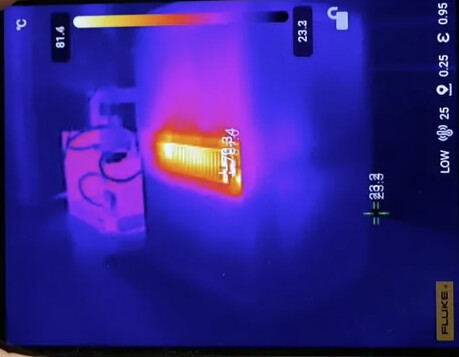
Yeah, definitely caught that VOC comment for the membrane dryers. In a heated dryer I can see that. Not as much on a room temperature cabinet though.
I’d bet we can swap out the sieves so even if they do wear (bet they do but no idea how fast) we can probably replace them. We’d just need to make sure to use the correct sieves.
But that’s another reason to only put dry spools in there. It will keep the number of cycles as low as possible and make the sieves last longer (if it’s a factor).
I’m guessing the lower temperature blasted air will work in our favor on longevity. Less thermal shock. So, there’s reason to be optimistic, as long as the sieves are packed and not bouncing around inside the desiccator like lottery balls.
This is an advert, not a review. It is sponsored by SUNLU.
In order to be a review, the unit must be purchased anonymously (to prevent a manufacturer sending a “golden unit” to a known reviewer) and nothing must be received from the manufacturer.
He even said at one point he hoped Sunlu would let him keep a part of his review in the video.
Sunlu definitely had oversight and you know he got a golden unit like you said.
The only counterpoint to that is the mechanism is simple. As long as better quality (non-production) parts weren’t used than in production units, we should be able to do a little PM (fix air leaks, etc) and have similar performance. Hopefully.
He’s risking his good reputation if he shills. Unlike most of the nobody’s in Sunlu’s initial youtube postings, he at least has something to lose by putting his reputation at risk. A sponsorship is an acknowledgement of potential bias, but it’s not permission for glossing over problems. One can only hope he would walk away and not post at all if Sunlu edited out legitimate criticisms on matters of substance.
It would be better if he disclosed the exact terms of his agreement. Supposedly when Bambulab gave out X1’s for early reviews, it came with no strings, which in that case boosted buyer confidence. For that reason, knowing that the terms would be made public might in itself make for better terms.
Teaching Tech made his boilerplate public. They should all do that.
I watched it close with as critical of an eye as I could muster and there wasn’t anything that I noticed out of place. He answered or demonstrated just about everything I had questions about too. I agree that it seemed like a fair review but I could have missed something. I’m still buying in, though.
As long as it can drive an empty chamber to 10%RH, then aside from the unknown longevity issue, it seems like anything else can be handled. If upon receipt it turns out it can’t get to 10%RH even on an empty chamber, then I’d re-evaluate whether it over-promised and consider sending it back. I’d have to cycle it enough to know that it didn’t get to 10% based purely on fresh molecular sieves that hadn’t seen humidity. It’s the regeneration that needs to be tested.
So, how to do that? Leave the door open and let it cycle for 48 hours or however long. Then close the door and see if it pumps down to 10%. Or really torture it by feeding it a strong dose of steam, enough to saturate its theoretical capacity, and see how it recovers after that. Just thinking out loud. Feel free to jump in with other test ideas.
I certainly don’t know for certain, but I think it might be better to just open the cabinet door with the unit unplugged. That way you aren’t cycling the sieves (no idea how much that might even matter though).
At my typical humidity (40-45% RH) that would load the sieves to a bit over 20% w/w if they follow the graph I posted above in the thread. At 10% RH it’s about 15% weight/weight so it would be well in the working range. I wouldn’t plug it but use another hygrometer to monitor the humidity. When it can hold close to ambient humidity with the door closed the sieves are probably nicely loaded up.
Then when you plug it in it will start cycling and you can watch how the humidity comes down from a good load.
OK, I’ve got the stress test figured: Skip the uncontrolled open loop ultrasonic humidifier. Instead, put a saturated potassium chloride solution inside a bowl, and put the bowl inside the Sunlu and close the door. That should drive interior humidity inside the Sunlu up to 85% at 70F ambient temperature. Indoor temperature is stable so no dew formation. Much better than the mister thing, which is open loop and would get everything too wet. I found one for under $1, so I was sorely tempted, but it’s just the wrong tool for the job. I have Saltfree potassium chloride on the spice shelf, so close to zero cost using science to set a high stress-test humidity for the molecular sieves in the sunlu to soak up and then (hopefully) eventually recover from after one or more regeneration cycles. After the saturation, remove the potassium chloride and initiate the empty closed door test and see if it can drive the Sunlu interior humidity to 10%RH. Maybe it’s overkill, but it will overcome any factory freshness in the Sunlu sieves that might have thrown off just the simple test without the forced saturation, and it will better approximate worst case humidity. If it were earlier in the summer, that 80%+RH would have been for free just by opening the door, but we’re past that now.
That said, I’ll start with the easier softball challenge @MZip proposed, because if it fails that, then there’s no point in creating the tougher challenge.
We’ll see. I have a hunch that if it passes the easier @Mzip test, the 85% test may be redundant. If it can dry itself from 50% ambient RH enough to drive humidity inside a cabinet down to 10%, I can’t really envisage how it would fail on 85%. It may or may not take more cycles, but either way it should get there. Right?
Well, then, @krellboy 's post explains it. It put to the questioin to grok what would happen if I blasted air from a hot air gun into a column of 3A at 80C and then transferred the sieves into a sealed container what the RH in the sealed container would equilibrate to at 20C ambient temperature, and the answer was 11-12%. If increased to 85C, then 10%. In both cases, it assumes that all the beads were uniformly heated to the given temperature.
It also confirmed the benefit of the air blast. If it were instead a thin layer in a vented oven (i.e. extracted moisture allowed to escape), then 85C drying temperature would translate to 12-15%RH, and if in a heap on the floor of the vented oven while baked for a few hours, 15-20% RH.
So, if @krellboy 's measurement is accurate, and it’s only around 80C, then 10% might require some luck, depending on how accurate Grok is in its calculatons.
[Edit: That’s the headline. There’s more to it though, depending on the exact composition of the 3A, as well as the RH of the makeup air used for the heated drying. So, it’s possible it could be less than 10%RH. And it also had suggestion for a more reliable way of estimating RH based on weight of absorbed water into the dry beads instead of what it considered less accurate RH sensors, but that’s a different topic for a different day.]
[Edit2: Chatgpt reviewed the work and added a bit more color to the question of 3A source by noting “UOP and Grace-Davison beads behaved appreciably differently, and binder/cation composition matters” in the scenario I put forth. In short, not all 3A beads will behave alike. Some could perform much better, resulting in a low digits RH% for the same scenario. From sunlu’s literature, I guess Sunlu didn’t pick that one, but if we ever did a swap-out on the beads, maybe we’d want to upgrade and enjoy the benefits.]