No, which is why I felt it needed to be mentioned because the video is scammy as heck and doesn’t outright announce it.
Just to summarize my intended off-label use case in the event it resonates with anyone else: I intend to install a couple bulkhead glands/connectors into the i10 so I can pump the i10’s dry air in a closed loop through my AMS HT and AMS 2 Pro. This will have the effect of importing the moisture leaks that are happening in the two AMS into the i10, where the i10’s desiccator will ultimately capture the moisture as it trickles in and then dumps it during regeneration. I’d want the filament spools in the AMS’s to be pre-dried as dry as possible so they aren’t adding anything more than what’s unavoidable to the moisture load on the i10. I’d probably add some amount of silica gel to the i10’s sealed chamber to act as a buffer, for quickly driving humidity back down whenever it spikes due to an AMS being opened as well as handling mop-up from the closed loop recirculation when the i10 is regenerating. I’d start with the silica gel beads as dry as possible, and so as not to put extra load onto the i10. This way the i10 should also help keep those silica gel beads dry and not require any silica gel manual regeneration, like what I currently have to do.
Well, that’s the notion. Whether it works in practice remains to be seen. I’m not knocking the i10’s normal intended use that most people will use it for, but for me ths would be an even bigger win that’s worth the gamble. It maybe sounds complicated, but it isn’t. Just some tubing, some gland connectors, and a small, low power closed-looo air pump, and a kilogram or two of silica gel desiccant to make the rapid mop-up happen while the i10 operates at a slower rate. Compared to the i10, the incremental parts cost is almost a rounding error.
If it bombs out and doesn’t perform the way I’m hoping, I simply plug the two glands holes that I’ll be drilling and then just use the i10 like everybody else, as a regular ordinary user.
I don’t think that 80°C expelled air necessarily means 80°C drying temperature. It could also be a result of a thoughtful design by Sunlu, realising that releasing 200-300°C temperature into the ambient could cause trouble.
They might cool down the drying air before releasing it. E.g. they have a bypass that mixes the drying air with ambient air, so that 1/4 air goes through the heater and the sieve, 3/4 goes around and recombines after the sieve.
If they go crazy they could even use a heat exchanger to save energy, warming incoming air before the heater with the heat from the exhaust. But I highly doubt they would go that far.
If they really dry sieve at 80°C, that would be a really poor design, because silica gel would have far better performance.
oh, and another important question is, in which phase of the regeneration cycle the 80°C was measured. If it was very early, that could simply mean that the air was cooled down by the sieve itself. The most relevant temperature would be at the very end of the cycle.
I’ll volunteer to run the experiment. I have some molecular sieve (unfortunately, I don’t remember whether it’s 3A, 4A, or 13X) that has been holding at a rock steady 2%RH inside a sealed cereal container for the last 10 months. I don’t want to shock it by dropping water on it, so I’ll open it to atmosphere and let it saturate to more or less the ambient humidity (to be confirmed by resealing in the same container with the same hygrometer). Then I’ll regenerate in a blast oven at 85C. For present purposes, a blast oven is not as good a simulation of an i10 regeneration as I would like, because it will only circulate air inside the oven, not blast the air through the sieves, but it’s a start. Afterward, I’ll pour it back into the same container with the same switchbot humidity sensor and see how it reads.
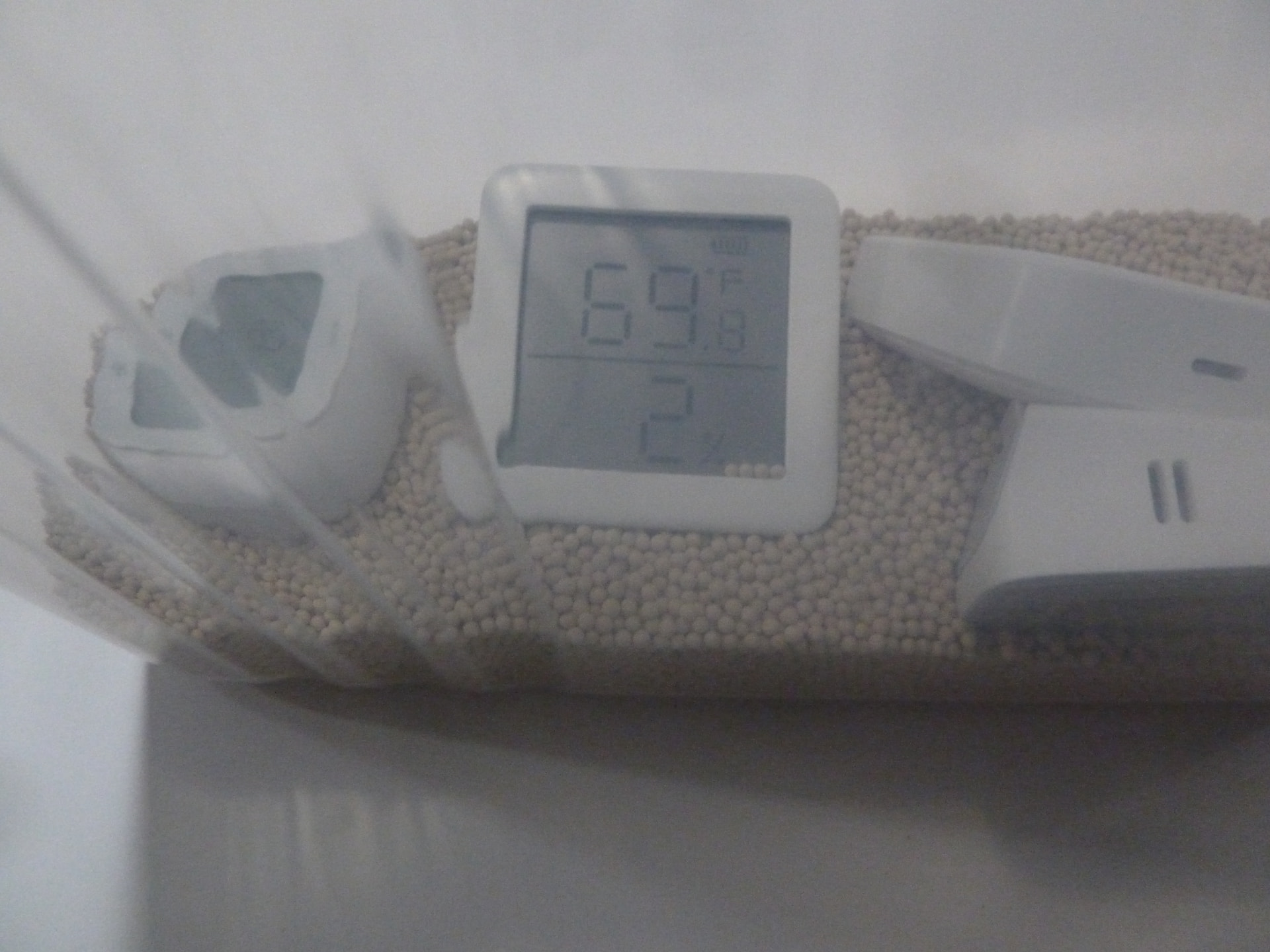
On the other hand, if anyone here has known 3A and wants to do it instead, please step-up as that would be more on-point with what we want to test. In that case I’ll either continue in parallel with my mystery sieve or step down because my results from a mystery sieve probably won’t be as useful.
When we were discussing the other cabinet that bottomed out at 20-25% RH, I posited the same thing. So many equate sieves with extra dry that I also wondered if someone had decided to swap gel for sieves to get buzzier ad copy. The fact is I see air blown through dry silica gel beads at 2% on a cheap hygrometer that has that much error in the numbers anyway. The true number could be anywhere between very near 0 to 4% if the meter is in spec.
So silica gel could conceivably do the job just fine. Except maybe not.
Sieves are ceramic which is tolerant of overheating, fast heating, and general abuse. Silica gel is more delicate and needs precise temperature control to heat just to regeneration temperature and not go too much over where the plastic can start degrading and decomposing.
I don’t know how things are arranged in that dehydrator box but bet those heaters are right next to the sieves. When those turn on they heat fast. They self-limit temperature-wise but looking at those regeneration peaks, there’s some quick heating going on for a short time period. It’s hand-waving but the cycling seems pretty quick and the heating pretty hard. It doesn’t really fit with the typical instructions for regenerating silica gel.
I think silica gel would work fine and maybe better but the gentle handling required would really slow down the cycling. It could be in head-to-head tests that sieves still pulled out more water faster even if the sacrifice is slightly elevated humidity.
I also think sieves tolerate repeated regeneration cycles. Silica gel has limited lifetime in regeneration type service applications and “wears out”.
But it’s guessing and hand-waving. I do tend to think they had to go with sieves though, especially in a device that will have so many cycles put on it in fairly short order.
I think this could be a trap though. As long as you keep the beads dry, putting beads in the cabinet will indeed soak up excess water, etc, etc. But if you don’t keep them dry what they will do in short order is turn into additional load for the dehydrator.
It’s all humidity that decides which way water flows. Really dry beads will remove water from the air which will help water release from whatever else is in the cabinet. The beads, if left alone though, will eventually absorb enough water that they match the cabinet humidity. Then when the dehydrator cycles and the sieves are more dry, they will be collecting water from the stuff in the cabinet humidity - filament and the silica gel.
You can’t allow the bead moisture to get high enough that they can become a water source or else they will decrease performance of the dehydrator.
You can see which way the water will flow if you put the individual components in a bag or Praki box with a hygrometer to see the humidity level each would create on their own and then compare the numbers.
If you have gel at 15% and filament at 20% then just gel alone will dehydrate the filament like being in one of these cabinets. If filament and gel both are at 15% RH each, put them in the same box and there’s no net water flow. But if the beads have picked up enough water to show for example 12%, the filament is 15%, and the dehydrator pulls the humidity down to 10%, you’ll be pulling water from both the filament and the gel. Eventually, all would meet around 10% if that’s what the dehydrator pulls down to, but to get there will have meant pulling a few grams of water from the filament and possibly 10s of grams of water or more (depending on the quantity of beads) from the beads. And there’s the rub - because desiccants hold so much water compared to filament, pulling water out of desiccants in the cabinet can mean a huge added load.
Hopefully that makes sense. The take home is you can put desiccants in these cabinets to help grab water but if they aren’t kept to lower humidity than the dehydrator can hit, it can disproportionately hurt performance.
The compensation is that the beads won’t tend to rise that high in humidity value. They can soak up lots of water without a big change in humidity value. So when the dehydrator pulls humidity down it won’t be a big change. But the beads will be flipping back and forth from sink to source to sink. The dehydrator won’t be able to pull as low because of the beads acting as a source though you are right that they would help to peak shave too. I believe the average though would be to push to higher average humidity because it will cut out the lowest humidities during the cycle.
or in other words: If somebody puts beads in a cabinet to reduce humidity and regenerates them manually, there is really no point to add an automated dehydrator to the same cabinet 
I believe that is the case. I don’t think it’s catastrophic but more a degradation by lifting the ultimate low humidity the dehydrator can hit because of the water capacity of the beads. The average humidity will likely go up. But how bad things might get depends on how much beads are in there.
At first they will be a net positive and help the dehydrator. But as they load up they will be a powerful source whenever the cabinet humidity goes below their humidity value.
I haven’t tested it but believe that’s how it will go. So if @NeverDie does it, it will be an interesting test.
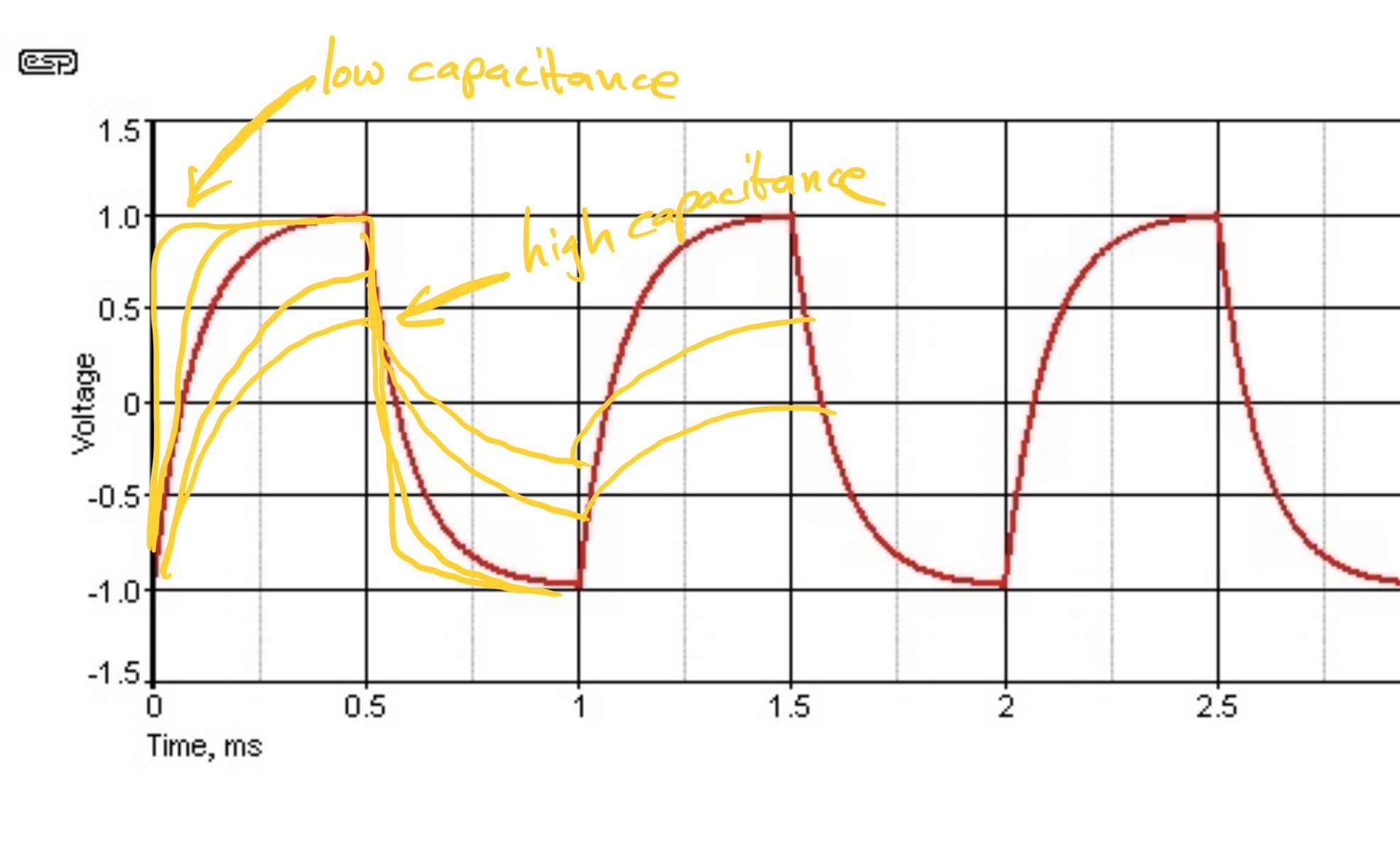
But it would be very analogous to putting a capacitor on a circuit with a square wave signal. I was looking for a good diagram that shows what happens to the highs and lows of a square wave as capacitance increases but not finding any that wouldn’t be confusing. Eventually, with a big enough capacitor, the square wave just turns into an average value without highs or lows with the average value being between the peak and the minimum.
This is the best I can find but had to add rough profiles for different amounts of capacitance. But what happens is the capacitance rolls off the leading edge more and more which is the bonus. The peak height (humidity) will eventually be lower as capacitance increases. That’s the water buffer aspects which is good. The problem comes at the lows. That same roll-off of the highs pulls up the lows which means the cabinet can’t reach the same low humidity.
Since it’s humidity difference between source and sink that drives the water movement, lifting the low humidity will slow water removal.
In the graph, voltage is analogous to humidity and capacitance is how much desiccant is added with more capacitance standing in for more desiccant. The average value will be a weighted average since the humidity profile isn’t a square wave but is a low duty cycle ‘square” wave.
I don’t know how understandable this stuff is but these kinds of effects and phenomena are found in many different systems since the driving forces all tend to behave very similarly. Electrical circuit analogies are very commonly used to describe all sorts of other physical processes.
I had seen the CNC video. I currently store my expensive engineering filament in a home made dry box with a renewable desiccant unit. But I’m hoping the inslogic/Sunlu box will be better sealed.
I have separate driers, AMS Pros and AMS-HTs for the actual drying. But to be honest, PCTG is becoming my GoTo filament. I do mostly desert, outdoor products and PCTG seems to be holding up well so far. So I’m drifting away from the more difficult and smelly filaments for my particular applications.
Agreed. I was hoping the silica gel would behave enough like a filament that the i10 would maintain or reduce the moisture content in the silica gel over time. Therefore, if the silica gel picked up any extra moisture from the ambient air, I’d expect it to be removed automatically by the i10 eventually.
@MZip I’m not understanding the argument as to why it wouldn’t work, but I hope a quick experiment of some kind will settle it.
FYI, pre-orders allegedly open at 2am CDT tomorrow, Tuesday September 15.
That’s ok. It’s no biggie. But just knowing the effect might be there (which I’m confident it will be) will help in interpreting what you see.
I think they just used a logging hygrometer to capture those humidity profiles. A microcontroller and sensor would be the same.
To explore the “capacitance” effect of using lots of beads, I’d start with a few spools of filament that have a little water content to give the cabinet a load and capture what that humidity trace looks like for a while. What we’re interested in is the difference between the peaks and valleys.
Put however much beads you want to try (more will have a stronger effect) in a Praki with the amount of water needed to get them to around the bottom humidity the cabinet is hitting with the filament and let the beads soak it up and verify the humidity is right. That will simulate them having soaked up water as you are proposing without adding much extra load. Put them in the cabinet and capture that humidity curve.
What you should see is during the regeneration cycle the beads will be scavenging the extra humidity in the cabinet generated by the regeneration cycle. That should lower the peak humidity during those spikes. That’s the good side.
But what I believe you will also see is during the dehumidification part of the cycle the cabinet humidity doesn’t go as low because water will be coming off the beads and adding load to the dehumidifier.
The highs won’t be as high and the lows won’t be as low. Since what drives getting water off the filament is the low humidity, it not being as low will also slow water being removed from the filament. That’s the bad side.
By humidifying the beads to the same level as the low humidity value the cabinet is hitting, you won’t be adding additional load over what the beads themselves add in this way of operating.
What you should see is with just filament is some difference between highs and lows. With beads in there the highs shouldn’t be as high and the lows not as low. The difference between highs and lows should be reduced with beads and the higher lows should slow the water removal from the filament but measuring that would be much harder.
(Note - spell correct changed ‘highs shouldn’t be as high and the lows not as low” to “highs should be as high and the lows not as low”. It now should read ok.)
It should do that. The dehydrator should dry everything over time. But raising the low part of the humidity curve will just make the dehydrator less efficient. Everything in the cabinet will see a higher bottom humidity so won’t dry as quick or as thoroughly. The magnitude will depend on bead quantity, water load in filaments, etc.
Initially the dry beads will speed everything up because that bottom humidity will be lower. The beads will be a sink during the highs of regeneration and the lows of dehydration.
It’s just that as they approach that bottom humidity themselves, they won’t just be a sink during the highs. They will turn into a source during the lows which will compromise performance.
We don’t know the magnitude of the effect either but the problem there is that desiccants hold so much more water than filaments. They will dominate the other stuff in the cabinet. Great at first. Not so great when they start turning into a source so I think the effect will be pretty noticeable.
Experiment in progress. Let’s have some fun: Place your bets on the outcome!
Continuing from the last photo, which showed the molecular sieves in a sealed cereal container maintaining 2%RH (see above).
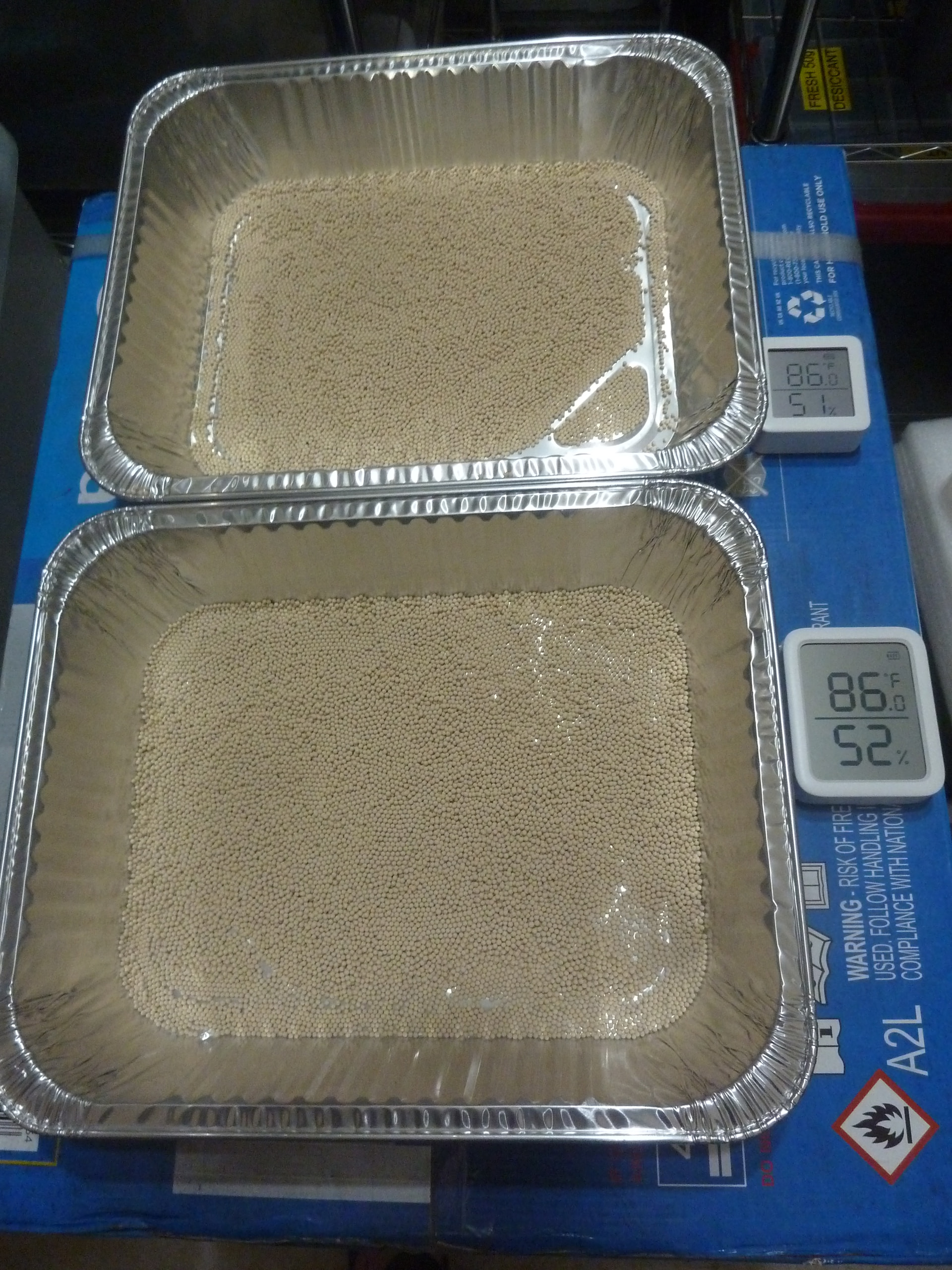
I empied the sieves onto two pans, each in a thin layer, and let them sit in my garage overnight and through the morning:
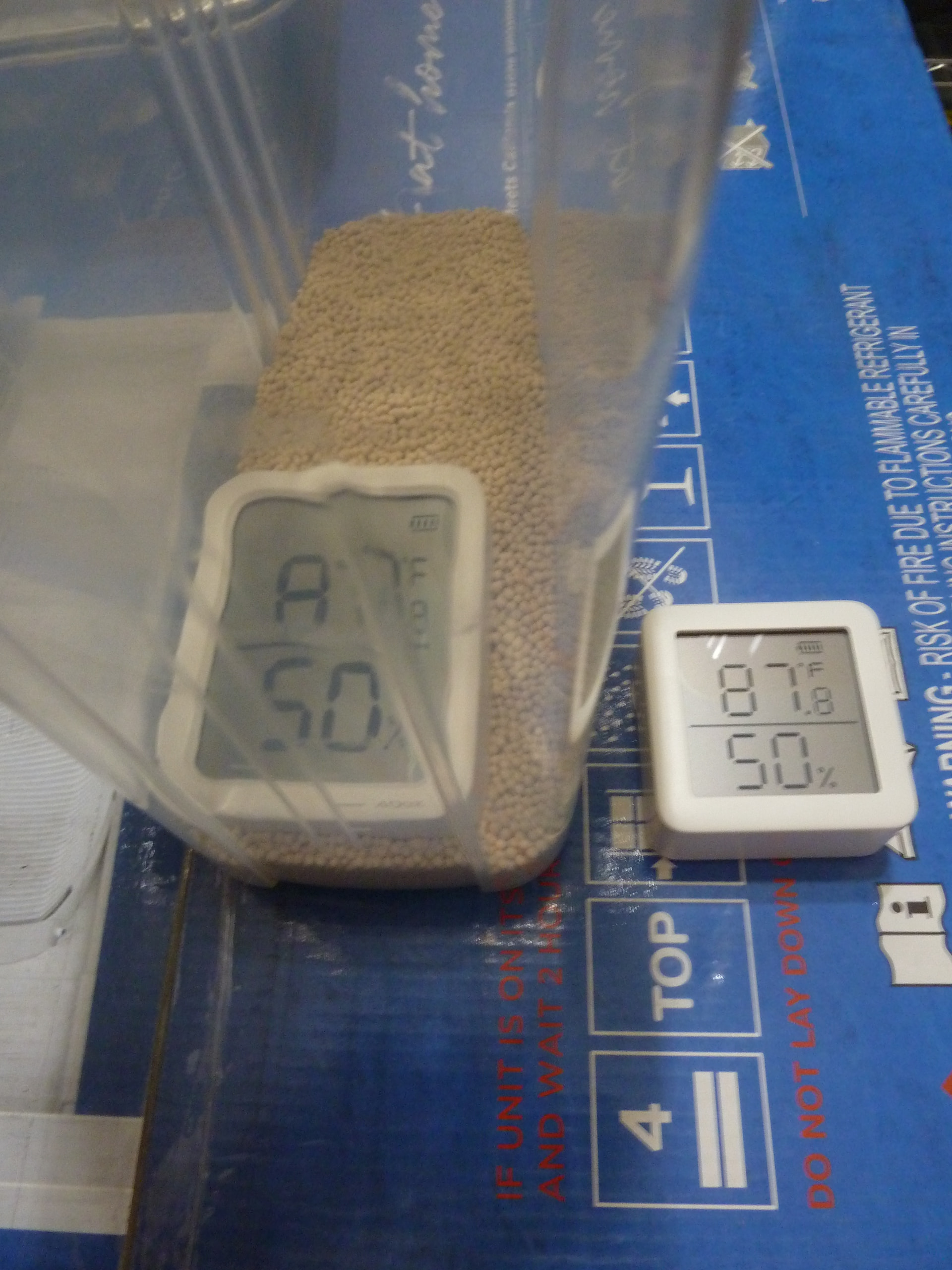
Then this afternoon I dumped them back into the same cereal container as before, sealed, and let it equilibrate. Here it is after equilibrating:
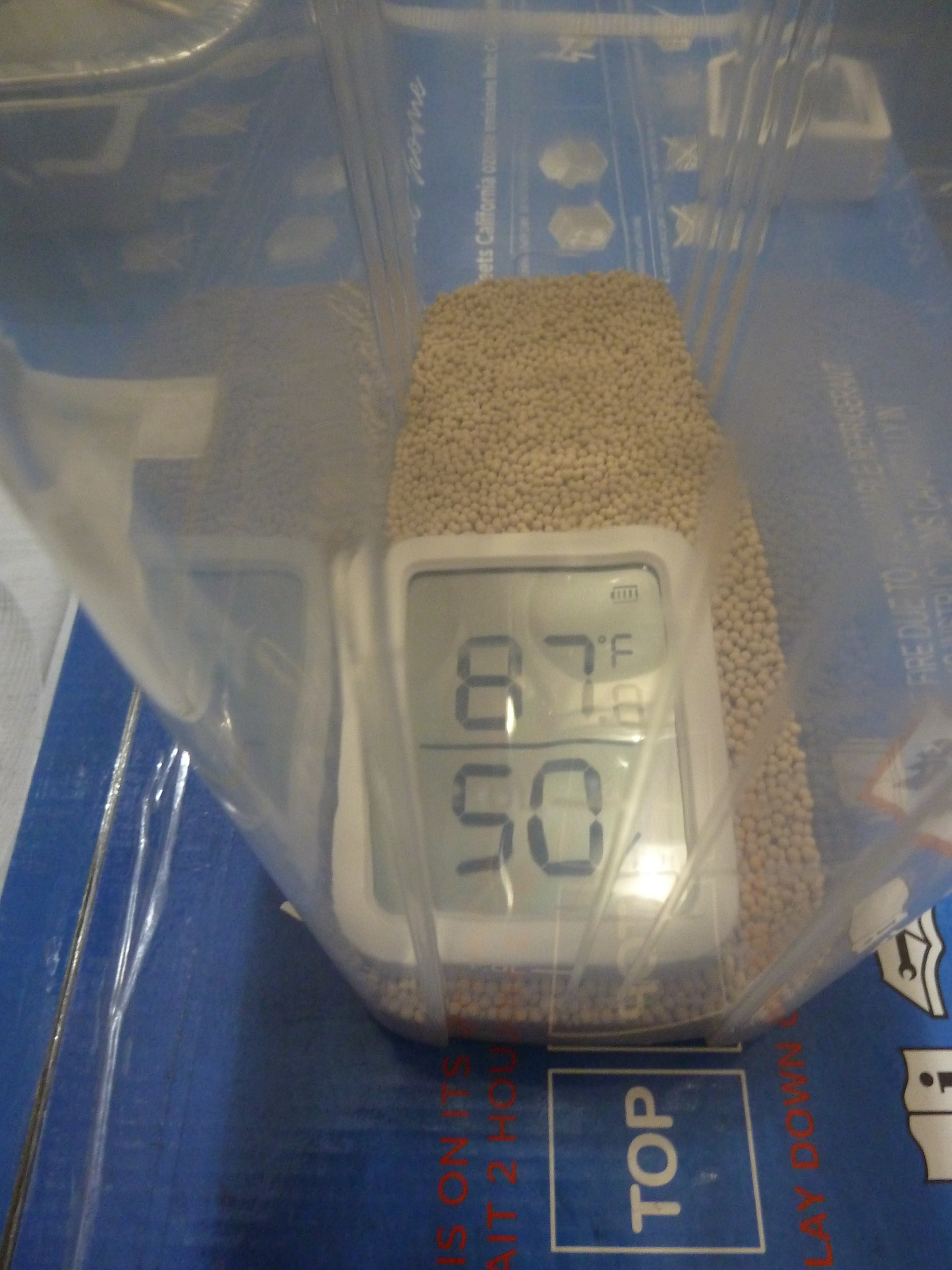
It matches ambient garage relative humidity. Therefore, it’s as saturated as it can get in this garage environment. No need to humidity soak it any further:
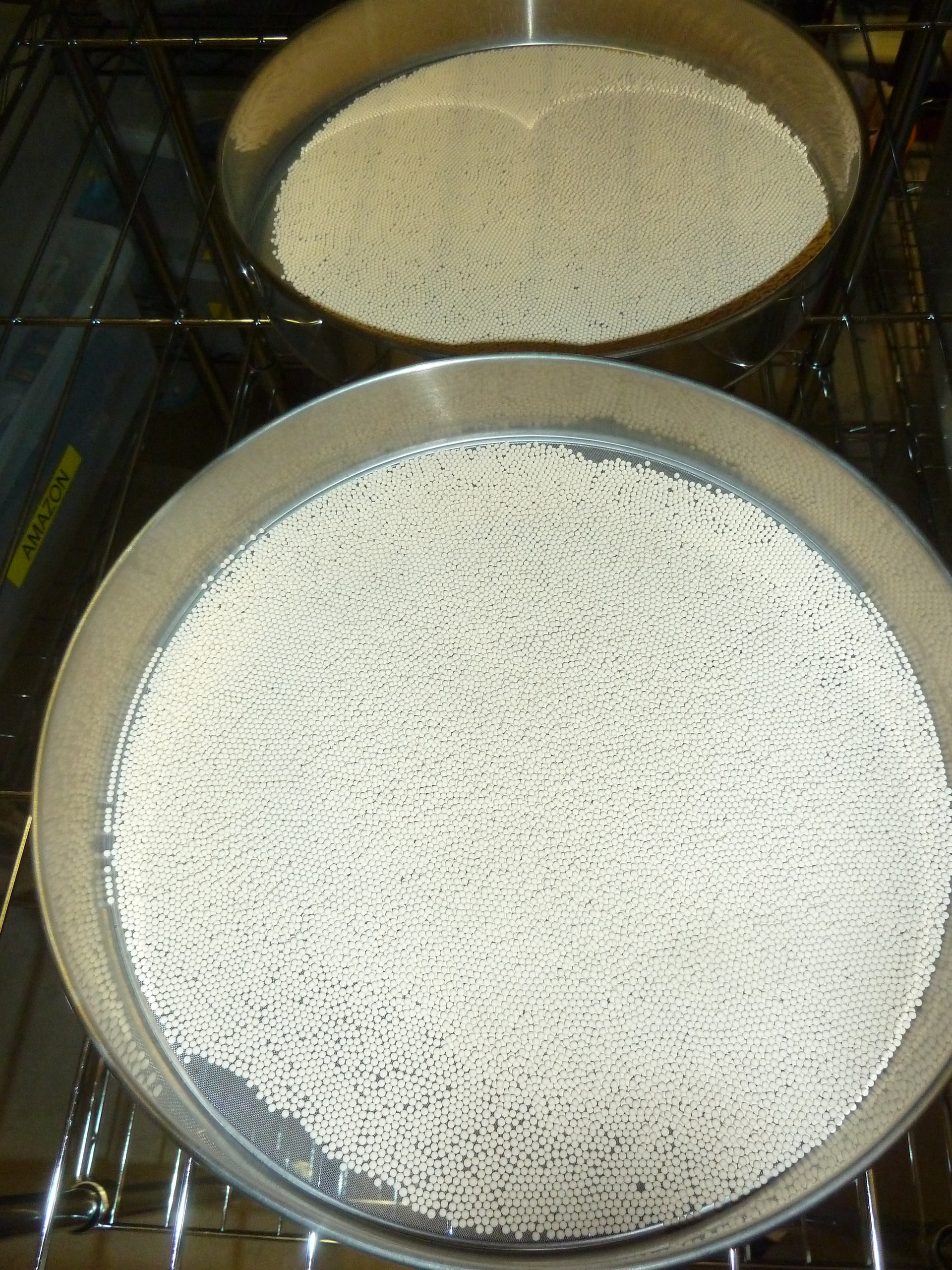
Next I poured it onto two flour sifter sieves, each with a “thin layer” of the sieves:
And put them in my blast oven:

Which I set to 85C:
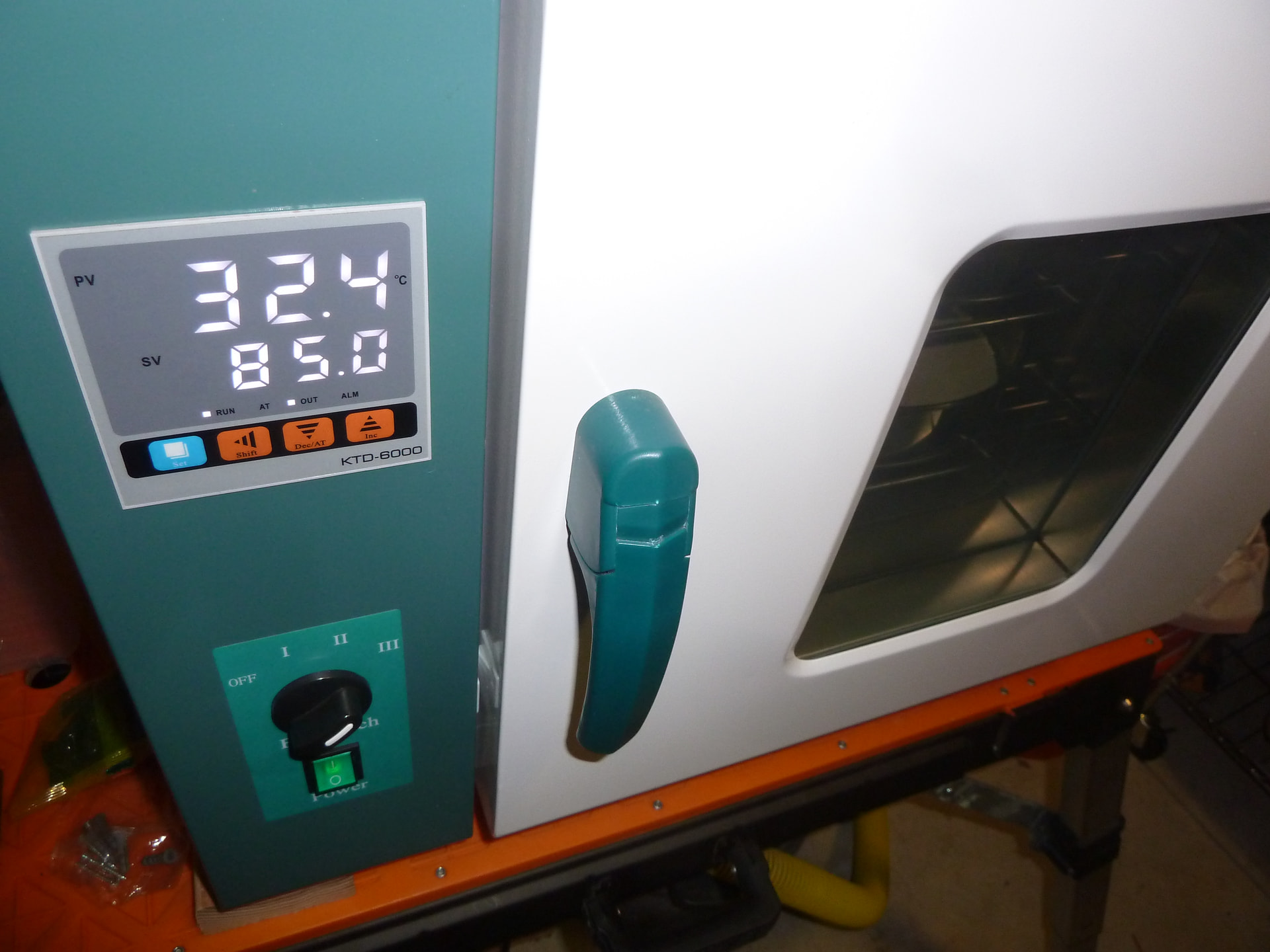
whereupon it began it’s temperature climb.
How long should I run it for? I can cut it off at any time, but unless anyone here has a preference, I’ll terminate the 85C bake in about 2 hours, emtpy into a sealed 2 steel wall thermos vessle for it to cool off, and then pour back into the same cereal container as before, seal with the switchbot TH sensor inside, and let it equilibrate.
Question: Based on the discussion here, what RH do you predict it will have once it equilibrates inside the seealed cereal container? @Alex_vG ? @MZip ? @krellboy ? Anyone? Anyone? Buehler? Anyone?
I’ll snap a photo and post the result.
I think it would be interesting to run it at 80C, matching the photo above for 20 mins and see what happens. I’m not familiar with molecular sieves, and I have no dog in this fight but 80C for 20 mins should/might mimic the FilaDC’s performance. My guess would be hopefully less than 5%?
PCTG has become my new favorite filament as well. I buy mine from 3D-Fuel, and there is usually a 10% discount code available. I also use reward points for additional savings. If you wait for the Re-Fuel line to go on sale, it becomes an even better value. In my experience, many of the Re-Fuel colors have been perfectly good.
If you are trying to simulate the performance of the dehumidifier, by drying for 2 hours you probably got them way drier than the dehumidifier regeneration cycle does so I would expect a lower humidity when it cools. The time alone keeps this from being a fair comparison or analogue of the cabinet dehumidifier cycle.
You should regenerate the sieves for the same time and temperature as the cabinet dehumidifier since both of those materially affect dryness with any desiccant. Dry it longer and it will hit lower humidity. Cook it cooler and that will cause higher humidity.
The regeneration time is only a few minutes going by memory. I think all bets are off but if Krellboy’s temperature accurately reflects bead temperature I’d say below 10% but no idea how far below.
Another issue just to be aware of is you were careful to lay out monolayers of beads. If they are in a box-like configuration in the dehydrator that will likely skew results too. Plus the air circulation aspects probably introduce another difference.
If trying to simulate the performance of the cabinet dehydrator you need to match everything that matters where possible or else you’re testing something different that has less predictive value for the cabinet. You want to keep things you can’t approximate in mind when interpreting the results. And you want to minimize the number of differences. Depending on what differences you have, you can introduce positive and negative deviations that you don’t know magnitudes of and they may even cancel. Every unknown and difference steals the utility of a simulation.
Added - thinking about it, if what you are doing is exploring the different ways to optimize operating parameters then there’s lots probably to learn there.