I cant keep up with this topic.
Just ordered one. December is a little ridiculous to me, but I guess it will be a good Christmas present to myself.
I cant keep up with this topic.
Just ordered one. December is a little ridiculous to me, but I guess it will be a good Christmas present to myself.
That’s a sophisticated technique, splitting off some percentage of the dry air you generate as a purge gas. It’s the magic bootstrap. As I’ve come to learn, oxygen concentrators and industrial twin cylinder air dryers do the same, so it’s tried and true even though it still boggles my mind a bit. Some kind of ratchet effect.
It’s not that sophisticated. It’s just an aquarium pump and a bead column but I use all the dry air. The aquarium pump does a good job of providing what turned out to be a near-ideal flow for my single-bay filament dryer.
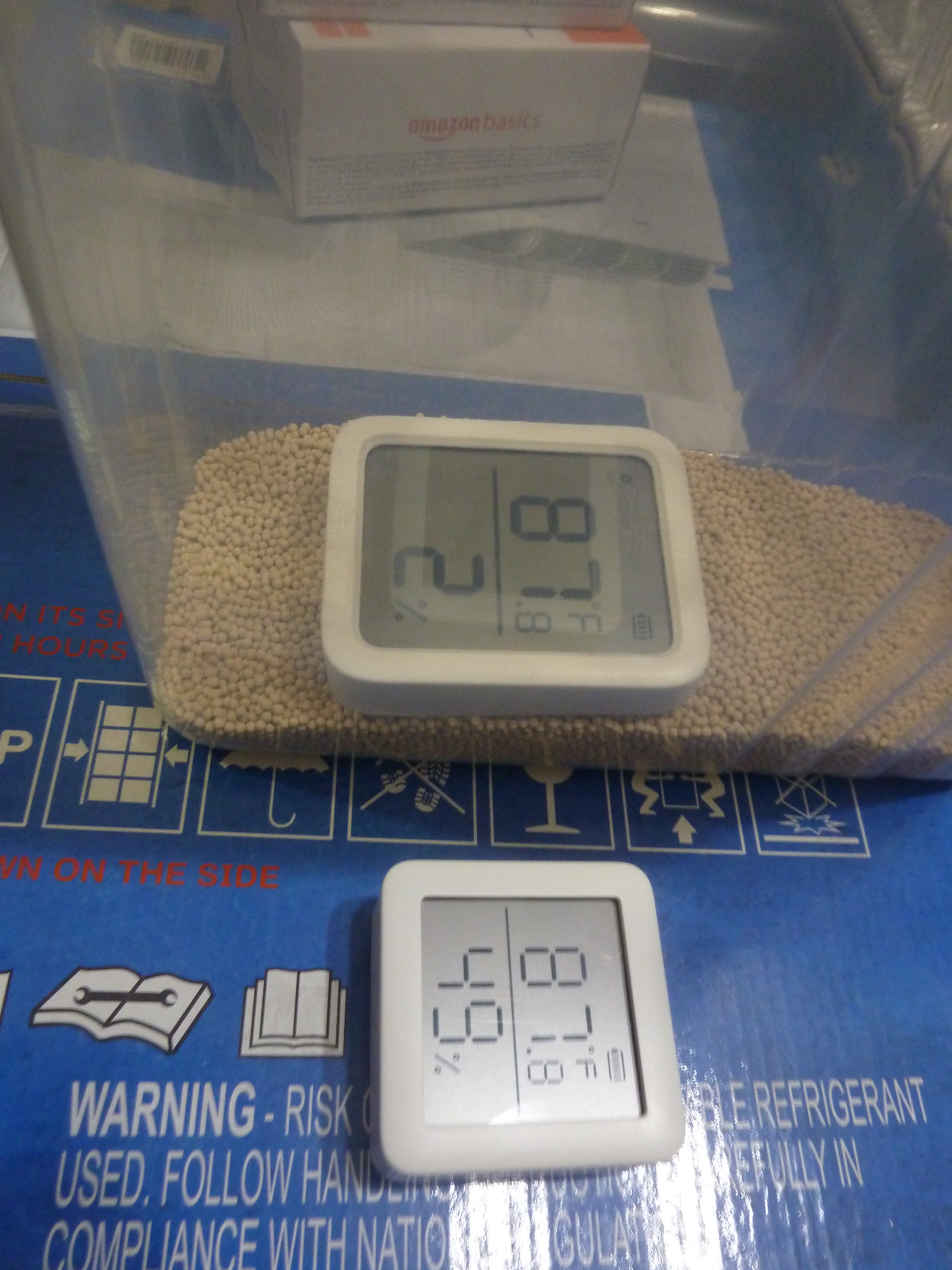
It is the magic bootstrap. It turned my Sunlu S2+ from a poor(ish) filament dryer into a standout that turns out spools that peg my hygrometers at below 10% without desiccant.
And sure, industrial air dryers do the same. So do oxygen generators, compressed air tanks, etc. But they don’t do it for around $40 and isn’t a fire risk as there is with an oxygen generator. No compressed gas hazards as with cylinders. No contracts. No compressor.
I have a couple of spare air dryers and if for any reason the cabinets turn out to not perform as I want, I’ll plumb each one into a cabinet and have sub-10% RH cabinet space depending on if there are leaks in the cabinets or not. I’ll use microcontrollers and humidity sensors to cycle the air dryers and disable the PTC heaters if I do this.
And I’m thinking lately that running it closed loop would be the next big jump in efficiency. I think I got hung up on thinking closed loop had to be leak free or it wasn’t worth the effort, but the extra effort turns out to be small and even a somewhat leaky closed loop probably wins over pure open loop, if one defines “winning” as a maintenance schedule with fewer manual desiccant changes on the calendar without changing the amount of desiccant that needs regenerating per regeneration. My, that was a mouthful to really say it right. 
Closed loop would take cobbling in an inlet port on my aquarium pump to do that but it could be done.
The way I do it for filament drying it’s open loop because the filament dryer adds a lot of water to the air from the filament. It’s much more efficient to remove the small amount of water from the ambient air to get dry air than to remove the comparatively much larger amount of water liberated from the filament. So I just discharge/vent it as a waste stream,
But it would depend on how much water needs to be removed which will depend on how dry filament is that goes in. In a dry air environment undried spools will shed some amount of water which probably ultimately will be a significant fraction of the water that evolves during a dry.
So whether it’s better to recirculate or not will depend on if people dry or not, etc. Air has very little water in it even at high humidity compared to a spool of filament. But more than that I bet I can count on a single finger the number of people who will do that if these cabinets underperform. Me.
Makes sense for the filament dryer scenario. For closed loop I was thinking more of the stay dry scenario.
That’s what I thought it would be released, but not 3 months. I do want them, but I think I would have waited till next year and not waited. It’s the waiting that will ■■■■ me off. Waiting – I am not very good at being patient lol.
Got it. In case anyone (who am I kidding?) was thinking of trying with wet filament, I wanted to say why that’s not a good idea. It’s a subtle difference but a big difference.
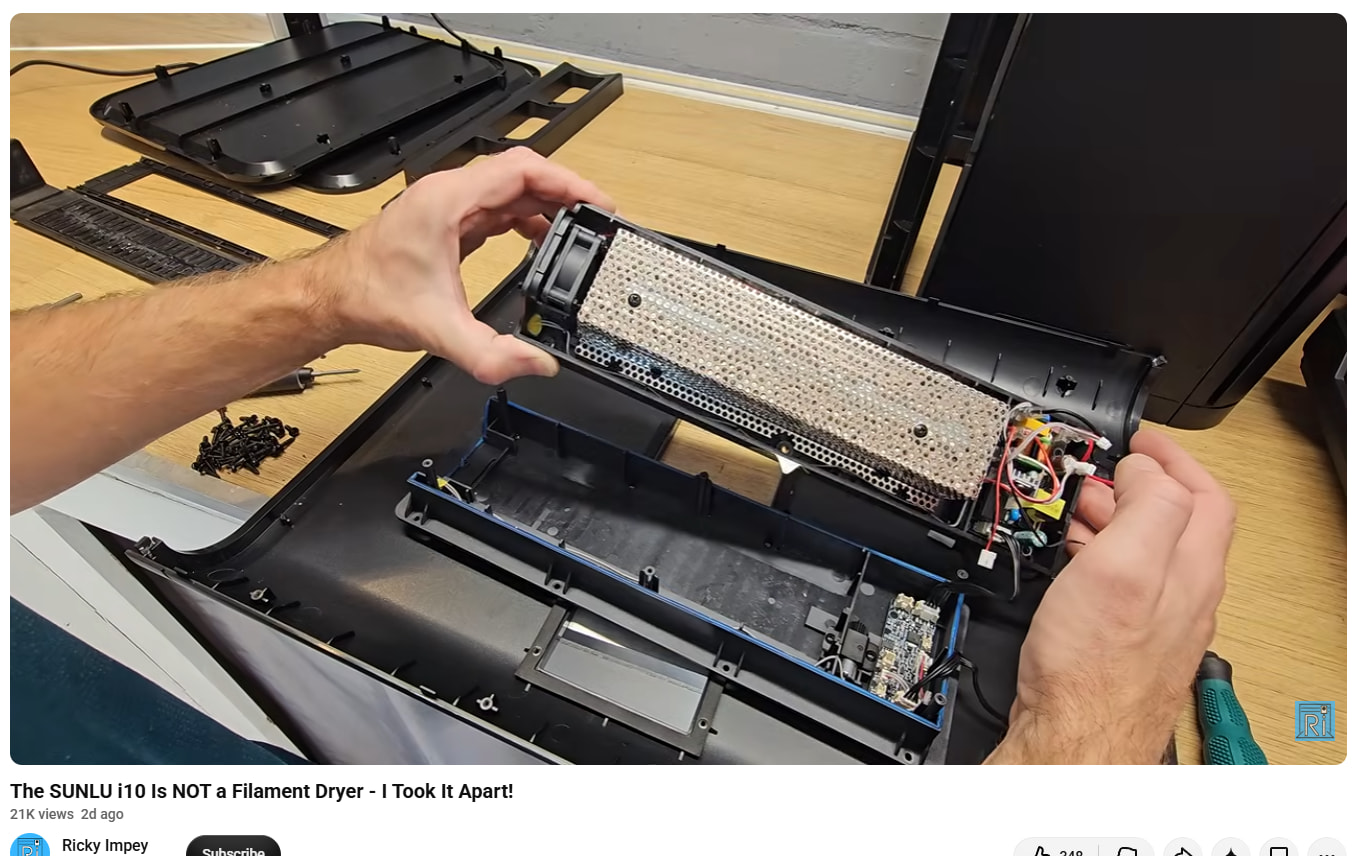
Did you guys see this? https://www.youtube.com/watch?v=PeMeoEEq3VQ
It’s a bit hard to follow this thread, so apologies if it was discussed.
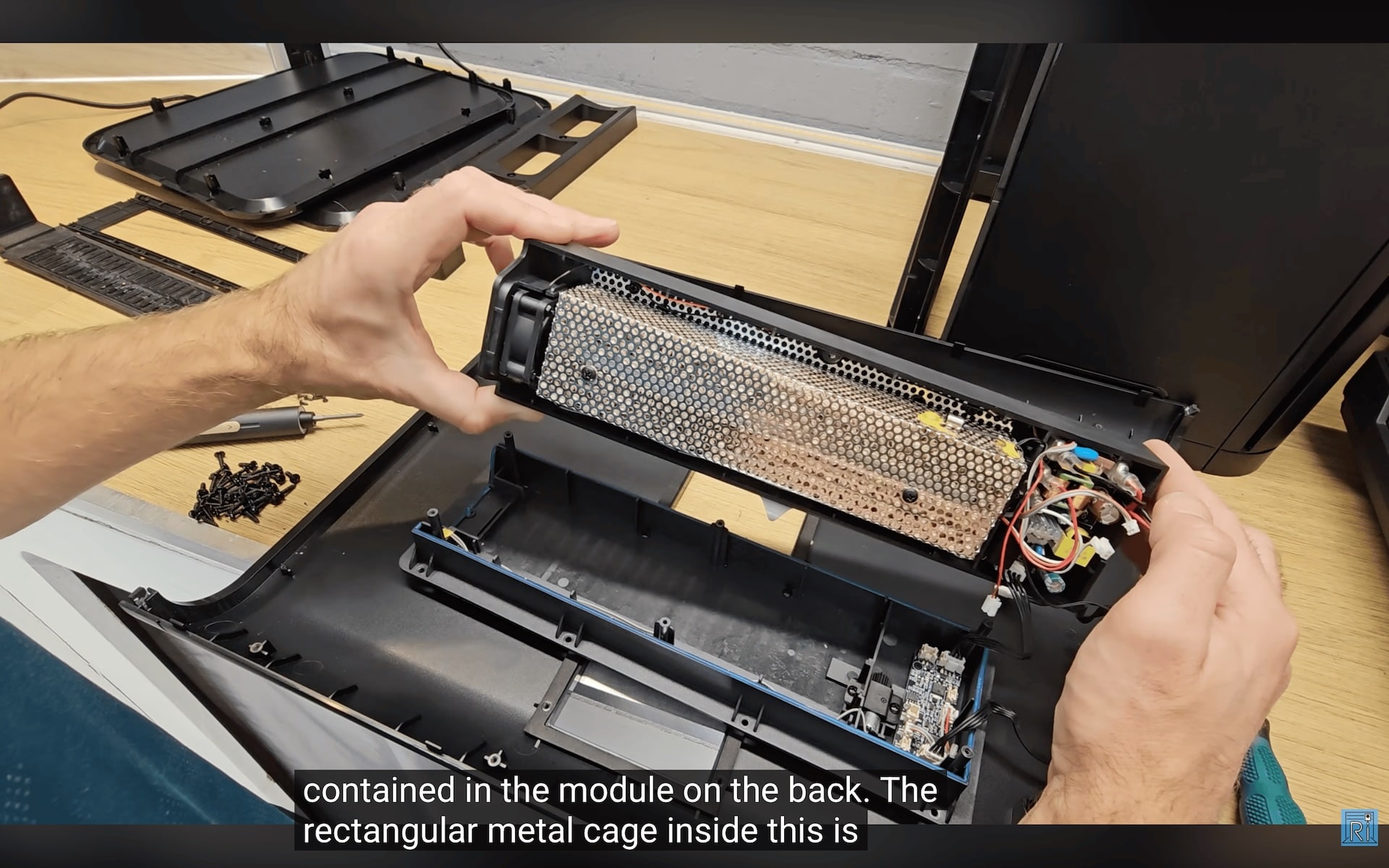
Great find! Check out this screen grab:
Check it out. I think what we are looking at here is an axial fan at left blowing air down a central tube inside the metal mesh desiccant box. That seems likely to be pretty good at getting air through all the beads. As I don’t see an obvious heater, I’ll bet it is also in that central tube: So the fan can force air through the heater, the hot air directly to the beads, and carry the moisture away.
He also noted that it seems to pull under 50 watts when drying, and is rated for 100W max. I guess with all the desiccant right there, it won’t need the massive heaters that filament driers use.
Yea, for sure an axial fan and a central tube (or likely a PTC rectangle) with sieves literally enclosing it. Appears to be a smart design and I think quite safe.
I wonder if it’s running off 12VDC, as a lot of 50w fan ptc heaters do? Neither here nor there, but it would seem like another layer of safety compared to powering it straight from mains AC, like certain AC driven 3d printer heated beds that ran into problems that I’m sure we’ve all read about.
Meanwhile,
Very impressive! I take this to mean you could actually dry molecular sieves to a usuable level (admittedly not ideal, but useable) inside an 85C capable filament dryer if you wanted to. That stands in stark contrast to Bambulab’s recommendation for the molecular sieves it sells, which, AFAIK, is to treat it as garbage and throw it out rather than regenerate it. Bambulab’s stated reason for that is that the little bit of silica gel with indicator dye that they include in their molecular sieve packets would not survive the usual temperatures that molecular sieves are regenerated at. While that concern is valid, it would survive 85C. So…news you can use if you so choose.
Yes just spot on. My research indicates it’s using a 200 g shot of molecular sieve which is not a lot. Probably just adequate given the cabinet size. But the nature of molecular sieve has the capacity to pull down to 0. I’m putting together an electrical enclosure box to hold 21 spools with a 500 g shot of activated alumina ultimately controlled and regenerated through a molecular membrane. No heat required. activated alumina should pull down to sub 10 and the membrane can pull the moisture from activated allumia whereas it can’t from a molecular sieve due to the tight bond, it holds. Regardless of which method is used to keep a dry box dry the real secret is making sure the filament in the cabinet is dry before you put it in there.
I definitely agree. Thing is there are lots who think their filament is dry when it actually isn’t. For them they’ll see the cabinet humidity have a harder time coming down from the water load.
Good luck with the cabinet! Please keep us posted how it goes!
Thank you for posting that! Very interesting and he answered more questions.
I’d love to see the final result of your work! Please share photos and notes on the forum here when you feel it’s ready to share. Thank you!
I went back and watched that Rickey Impey video again and all those panels he removed in the disassembly caught my eye. They all look like pretty close-fitting joints but any gaps or leaks will reduce performance.
There didn’t look to be any normal gasketing that I could see but maybe the panels have a gasket material molded into the edges?
Something new on my list. If those panels aren’t sealing all around might look into making them tight.

ok, more seriously: ¼" or 1/8" gasket tape is probably the way to go. Unlike caulking it’s not going to glue the panels together, just fill gaps. I’m thinking the kind used in speakers to seal the drivers to the cabinet.
(I can’t avoid a dad joke.)
In all seriousness, silicone caulk would be much better. It’s a sealer, not a glue. So it is removable. On the other side, gaskets/tapes/EPDM all require a precise pressure between two sealing points in order to … actually seal something.