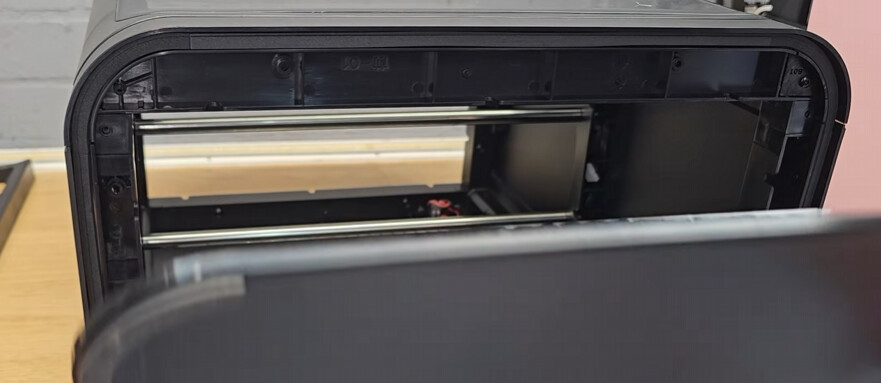
If any sealing is even necessary. But that is something I will test. I just didn’t see any gasketing.
But stuff gets co-moulded with different plastics all the time. Maybe the gasketing just wasn’t visible or it was and I didn’t recognize it. Or mabe the gasket is integral to the part.
Running an initial experiment with just an empty i10 and noting the length of time between regenerations would seem like a good starting point. Then if you did enhancements afterward you’d have some way of judging how much better the improvement was, as well as letting others know so we can pool information about which improvements have the highest payoff. In that sense, even failures are valuable information, so we know what not to repeat.
From what I’ve read, uncured Butyl is the gold standard as a sealant with the lowest VTR, but it’s also a sticky mess.
Maybe they’re glad they didn’t, because right now only Sunlu knows how many units were sold. If it were a big crowd funded success, then the whole world would know, and the clones would come that much faster.
To be honest, those storage units are not exactly rocket science. I do hope that it will be a huge success, because I need a compact and efficient dry rack for the filament. Cereal boxes and etc are garbage, IKEA huge boxes are ghetto. Industrial metal dry cabinets are expensive, loud, and not suitable for a home application.
The quickest competition would likely come from the 25%RH 180L version, like
or the model discussed on the pre-fork thread, but upgraded to run down to 10%. I suspect the economics would favor that over four Sunlu’s for the same space. On the other hand, with four separate units, you could divide up your filaments by type: PLA in one, PETG in another, NYLON in a third, maybe TPU in the forth. I’m not sure how well mixing different filament types is going to work out, unless maybe you’re super diligent at drying them all to a 10%RH equivalent (or the lowest of whatever you deem the acceptable minimum for each type to be) in the first place. i.e. a big increase in complexity? Otherwise, I suspect the more moist rolls with be donating their moisture to the already drier rolls, at least initially. Though maybe longer term the desiccator will equalize them? But then it seems you’d be depending on the desiccator to be doing real drying, rather than just bonus drying. Not sure. What do you all think? IIRC, so far all of the reviews have glossed over this potential mixed-filament-type storage issue.
I think you’re exactly right. The way to know how the water will move is to use the humidity value. Filament that tests to higher humidity will donate water to the air and whatever humidity that produces will set if water gets absorbed by other spools. If their humidity value is below the cabinet air humidity they will be absorbing some.
I’m not super diligent about drying. It just works out that my method does indeed give me spools that pull humidity values to 10% or below.
All my filament will go into these cabinets dried like that. I won’t be putting wet spools in there.
Then you’re golden. As for others, depending on their methods, who knows?
Given the chaos of different drying methods and beliefs, I’m thinking the safe bet for most people will be, like the song says, keep 'em separated, at least by type:
Yep. I suspect some will swear their cabinets don’t work. They will need to be reminded to try with the cabinet empty to remove inadequately dried filament from the equation or just give it a couple of weeks.
According to the CNC Kitchen review, the FilaDC was even able to dry wet filament within a few weeks.
As long as it maintains the 10%RH, I don’t see, why other spools should be a problem for better dried spools.
If a spool is less then 10% RH equilibrium, it will take up humidity anyway. If it expells moisture, the cabinet will suck it away.
Also, moisture takeup is a slow process, even for very hygroscopic filament. If the surface windings should pickup a bit of moisture because the surrounding air is at 15%RH at times, that doesn’t mean that the whole spool is wet within hours.
As long as the FilaDC is able to maintain an average 10%RH, I wouldn’t worry too much, be other wet spools or the regeneration cycles.
In the CNC Kitchen video it didn’t maintain 10% RH with the 10 different “wet-ish” spools. It only got down to 16% RH though it looked like the humidity was still lowering over time. One of the spools was cardboard and the guy was weighing the spools to plot moisture loss and they were still losing moisture.
Anyway, if you have spools dried to 10% humidity value in a cabinet around 16% humidity value, they will pick up some amount of water. You are correct that the water will also be able to be removed again fairly easily as the humidity continues to fall but the humidity has to be reduced in the cabinet to get that water to come back off.
The cabinet humidity is the sum of the water being given off by the individual spools and by the dehumidifier removing it. The more water coming off filament will increase the humidity. Less water coming off the filament and the dehumidifier can lower the humidity more.
The dehumidifier was removing water and the humidity was dropping in his test but it’s a slow process so there’s days/weeks where one spool can be adsorbing water liberated by another.
But it might not be that bad - as you say. If I’m going to have a spool soaking up water I’d much rather that be in a 16% RH cabinet than a 40% RH ambient room.
The relative contributions of all these things, and which are important and which aren’t, are going to take some time and experience to fully nail down I think.
I agree with you, but it hinges on this assumption. Suppose you have 9 rolls of PLA that were dried to 20%RH and one roll of nylon dried to 10%RH. I predict that when you put them all together in the cabinet, the i10 will not quickly drop the interior air down to 10%RH. Instead, I predict it will drop to 20%RH and then the drop in RH will radically slow down. All the while the nylon will be picking up moisture. If it takes days or weeks for the i10 to reach even 15%, that nylon may have picked up a lot of moisture. But would it really take that long? I don’t know. It’s an empirical question.
As an aside, it’s easy to supercharge filament drying to not even have to worry about wet vs dry spools, plastic types, etc. It’s dead simple and absolutely works. Since I started doing a dry air purge my dried filaments pull right to 10% indicated - as low as my filament hygrometers go - and I just do not see water issues/effects. All my filament settings are stock. I don’t have to tune out water. It just works.
It’s best to add the aquarium pump air at the top of the bead column and take the dry air off at the bottom. You also need some kind of screen or something to keep beads from getting pulled into the tubing by static electricity. Plumb the dry air in near the bottom of the filament dryer. But this is the basic system. You can use a plastic water bottle as the bead column. Long and narrow is better than short and wide. Multi-bay filament dryers may be too much for an aquarium pump. Use indicating beads (orange not blue) and you know when to recharge when the color change starts nearing the bottom/exit.
Nobody has to put wet spools into these cabinets. Those who don’t dry (or don’t dry well) who go through lots of filament will possibly keep these cabinets running at high humidity all the time and not see the full benefits you paid for.
100% agreed. For the benefit of others, I’ll just briefly mention another bonus of your method of using dry air as a purge gas during the drying process is that it yields predictable and repeatable drying results that don’t change just because the ambient humidity might change. It makes it an especially good fit for drying when a mix of different filament types are to be co-housed in an i10. For those reasons yours is the most professional method that I’m aware of, and should avoid the need to “keep 'em separated”. With the i10 coming online, hopefully more people with mixed filaments will recognize this advantage your method has and adopt it.
Hopefully sooner rather than later, but having seen how set in their ways so many people are, for many of them it won’t be until pigs can fly. Their loss. Maybe they’ll come around eventually when they see enough other people doing it.
You are 100% correct - drying to consistent RH provides consistent melt behavior. It also bundles up differences between plastics. RH determines which way water flows but if two spools have equal RH values, same plastic or not, they won’t be supplying water to the more hygroscopic stuff. (There’s more to that than just that statement though.)
And not everyone needs dry air. Putting their dried spools in these cabinets will tattle on how well they are drying, though. If they can’t get their cabinet humidity to come down, barring some malfunction, their filament is just wet to some degree. Easily verified by running the cabinet empty.
But I’m very familiar with the results of using dry air and I won’t dry filament without it. Since I started using dry air I’ve had occasion to rush printing with filament that wasn’t fully dry and it’s very noticeable. To each their own, though.
The negative reviews on that dehumidifier cabinet are not encouraging. Sounds like the QA is non-existent. A couple even mention that it drives humidity up inside the cabinet, which sounds like something was installed backwards.
I can’t even get Amazon’s chatbot to tell me what the mechanism of dehumidification for this product is.