I also want to mention that oddly enough whenever I add Brims the layer issue doesn’t exist. The Brim ALWAYS prints fine and doesn’t have those gaps between lines like the actual print object has.
There are flow rate settings for first and top layers under advanced or experimental.
I wonder if that flow rate is absolute or relative to the standard flow rate. It really feels like a slicer issue to me.
In Dev mode there are such settings:
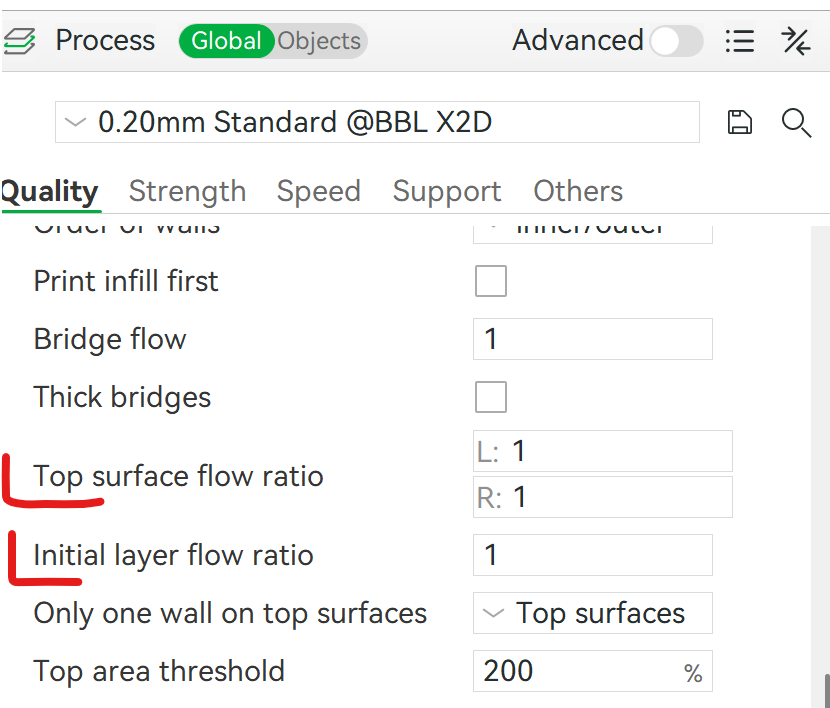
But most probably it will need to be tuned for every object and every combination of materials, nozzles and etc. Which will be madness of testing, and absolutely fail the idea of the Bambu printers.
I absolutely support the idea that if A1 could print something with given quality X2/H2 should be able to do the same or better. With all the better tech inside.
I fully agree. If it works on A1 printers, it should be possible to have it work on all others too.
It still feels like a bug in the slicer somehow.
If it were a Bambu Studio issue, it shouldn’t show up in Orca Slicer. I was told the nightly build supports H2C.
This has been my entire motivation to push on this issue and thrilled to see the discussion over the last few weeks.
I think all of us who have used FDM printers accept there are some precision limitations, but it’s not an acceptable response for Bambu to then simply write this off as “limitations of FDM” printing with the very obvious and apparent better quality differences within the lower-tier (ie. non-flagship and much cheaper) Bambu Lab FDM printers.
I’m still suspecting this can likely be solved with slicer and or firmware updates, which does require ongoing troubleshooting not just by the larger community here, but internally by the Bambu Lab engineers.
For anyone from Bambu who might read this: There does seem to be a push over the last year to release more devices and capabilities, this has likely lead to the trade off in quality over quantity, but anyone in management should know degradation in any one aspect of the balanced scorecard (process perspective) usually result in downstream negative affects in the other parts (customer perspective). As a customer, knowing my very expensive BL flagship printer is producing a lower quality output (even if more capable) than a low-tier device makes me question future purchases (which will affect company financial performance if competitors are are more reliable).
It does appear the H2C has been added back into the OcraSlicer nightly builds from when I last checked a few weeks ago. If I have some time I will try some of my models I have had issues with and the test model above.
Bambu Studio and Orca Slicer have more in common than you may think.
If I hear that first and top layer have issues, and other layers are fine, a hardware issue seems unlikely.
If only the first layer has an issue, it might be a Z-offset issue and therefore be hardware related. But the hardware has nothing specific to say about the top layer imho.
Just a wild guess though.
Yeah, and why the ironing on these devices should be so hard to dial in compared to all lower tiers.
Either they tried to introduce some very smart algorithm, or the old “magics” from the old gen printers are just not applicable on this extruders, and they need to create new algorithms now, but too busy with too many products. Or the only one dev that knows actually how the tune them left. Stuff like this, things from the real life, that we already saw more or less in other cases and products.
Yes, I understand. But when I print the same object on my P1S, it turns out perfectly. You said yourself that your H2D doesn’t give you any trouble, and you’re using the same slicer we are or did I misunderstand that? I still think there are different issues at play occurring at different levels, that result in similar symptoms. If it were easy to fix, surely Bambu would have resolved it by now, after all these months.
As you can see first they said this is a bug then they said this is limitation of the technology…