So the new Bambu Studio update makes the P2S go into filtering mode while printing PETG, this is great  part of the problem is gone!
I requested exactly this function some days ago and they put it in instantly. Nice 
Wonder why they didn’t do this as well for PLA 
PLA would have more issues with a hot hamber than PETG…
My problem was, I like to print PETG-CF or -GF and without circutaltion mode there is no air filtration for CF/GF particles. Thats fixed now.
Hopefully they roll this change out to H2D too, @SupportAssistant - could the H series also go into filtering mode when printing PETG?
I made this…
I’m not sure if the aux fan is able to pull air through a filter, but a bucket for carbon granules should be possible. I’ll upload the model with an “Action Bucket” in a while.
Check this out
Nice! Love the little clips. Now, can you get a filter in there??? The P2S filter maybe?
It is possible, but I would need to raise the P2S about 50-70mm off the ground!
OMG! U Made it =D Well done!
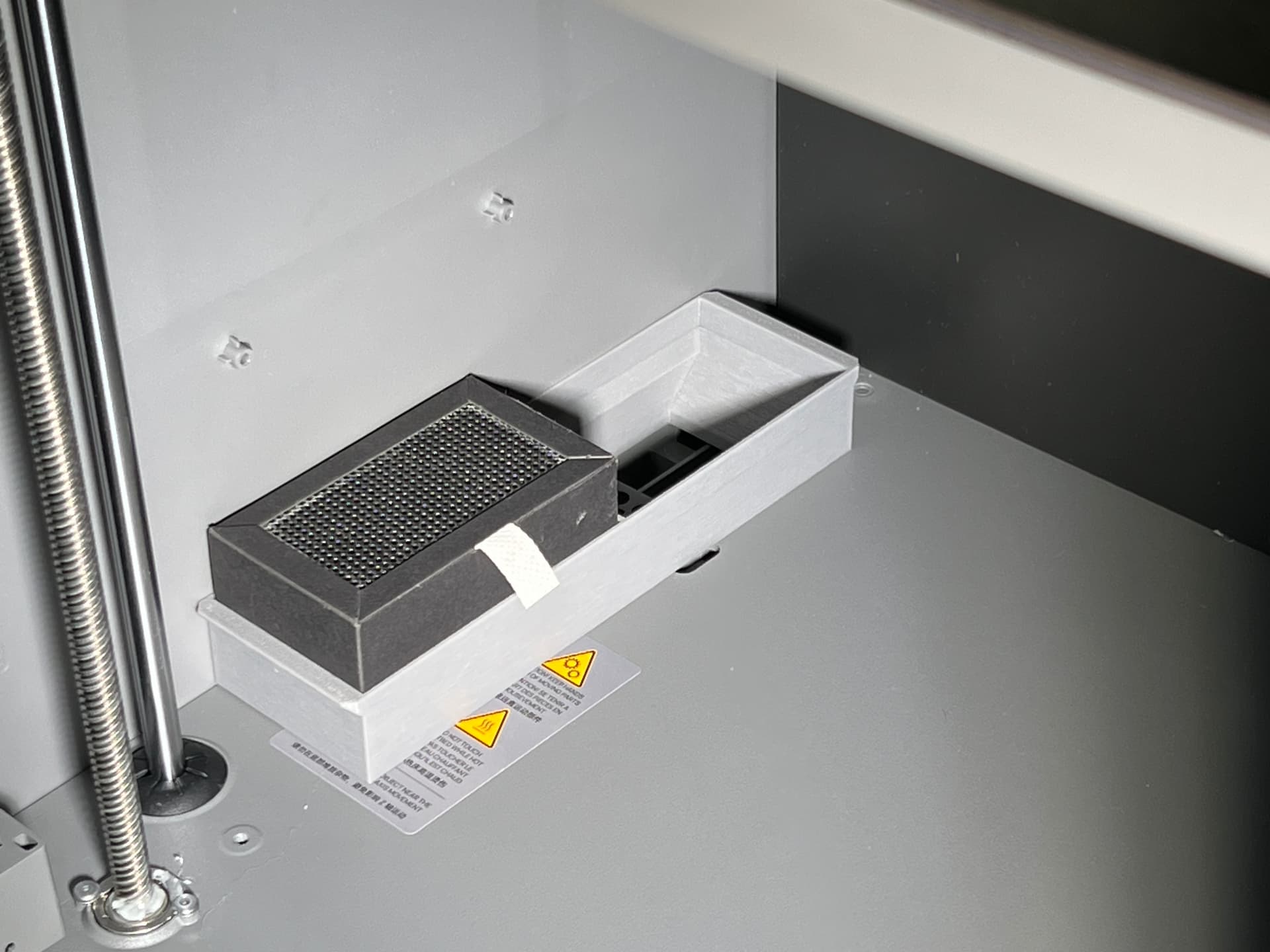
Good work!  25charrrrrrr
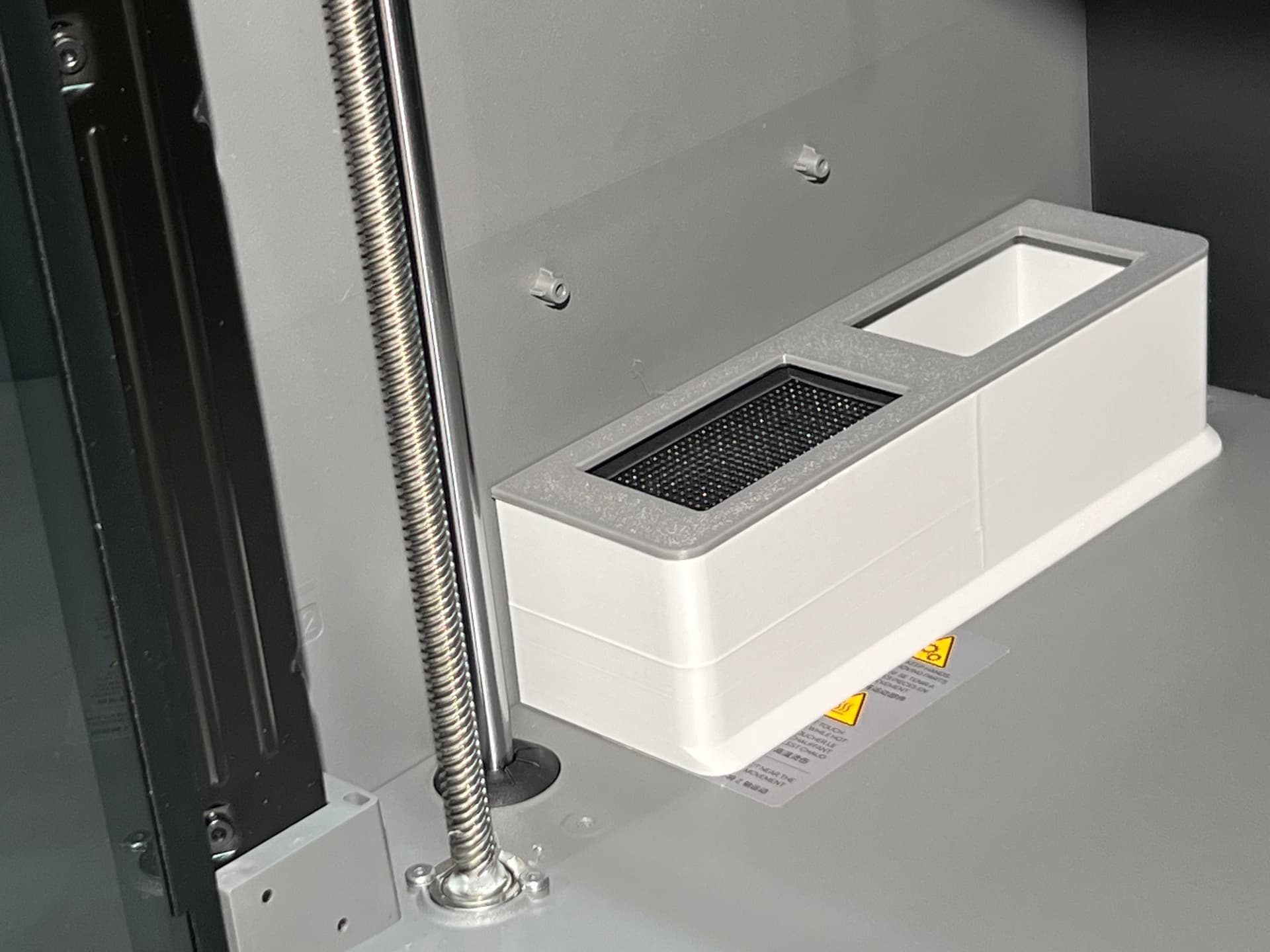
Nice, you’ve made a solution that requires no extra electronics! You just need to increase the surface area of the duct underneath to turn it into a better heat exchanger so the air cools a little as it goes through 
There’s a model on maker world that’s called " HEPA & carbon filter for Bambu Lab X1C, P1S" so I might try using that if it’s compatible.
Sorry for the million questions, but Is there any chance you would be able explain to me in layman’s terms how your creation works please?
I sort of understand the issue with the air being pushed out when the cooler air is drawn in, but i’m not sure how this fixes it.
Also I was watching some of it being printed and there’s a part where the extruder is skipping over the fins of the air duct, and it’s printing in thin air, did you have to code that part yourself or does the printer somehow already know what to do?
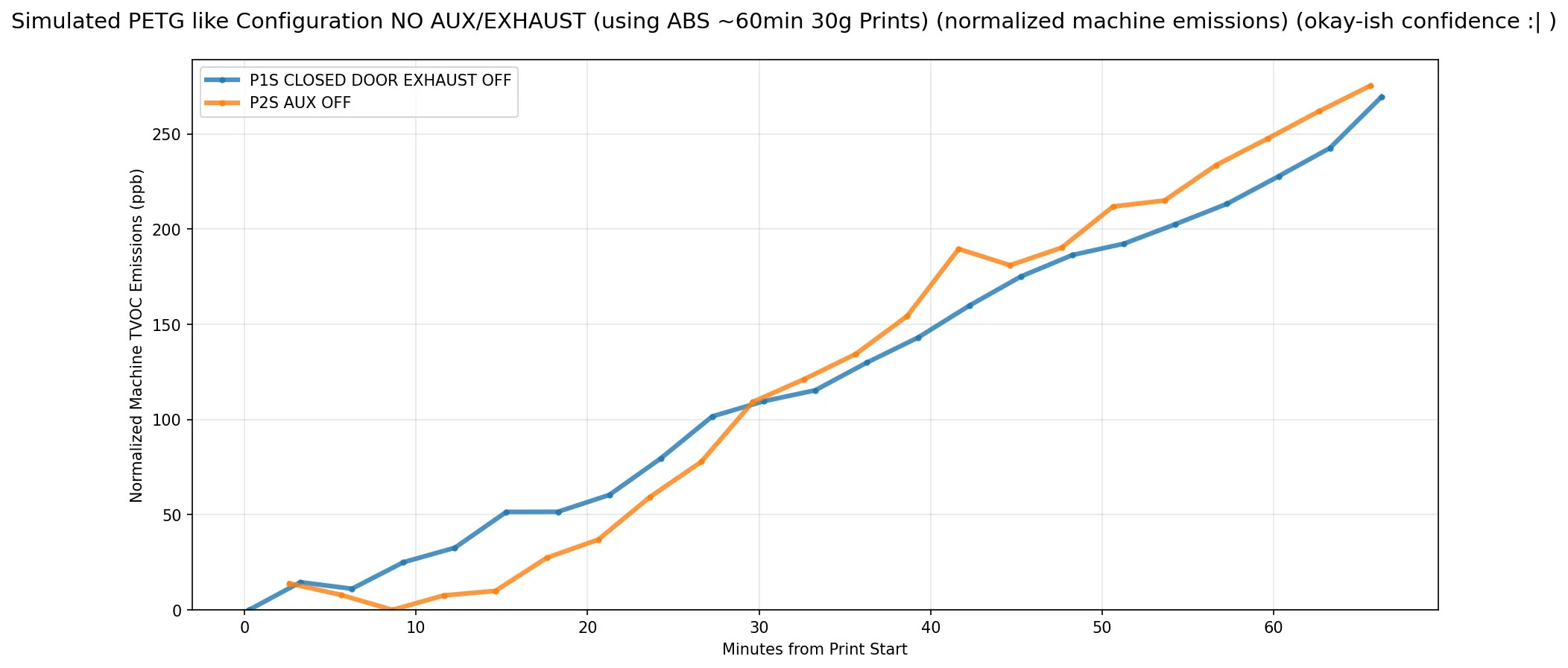
Hi, I kind of spend a few days testing out the VOC output for P1S vs P2S.
Here is a link to the post on Reddit which goes into more detail (test-setup, flaws of my test-setup, etc.):
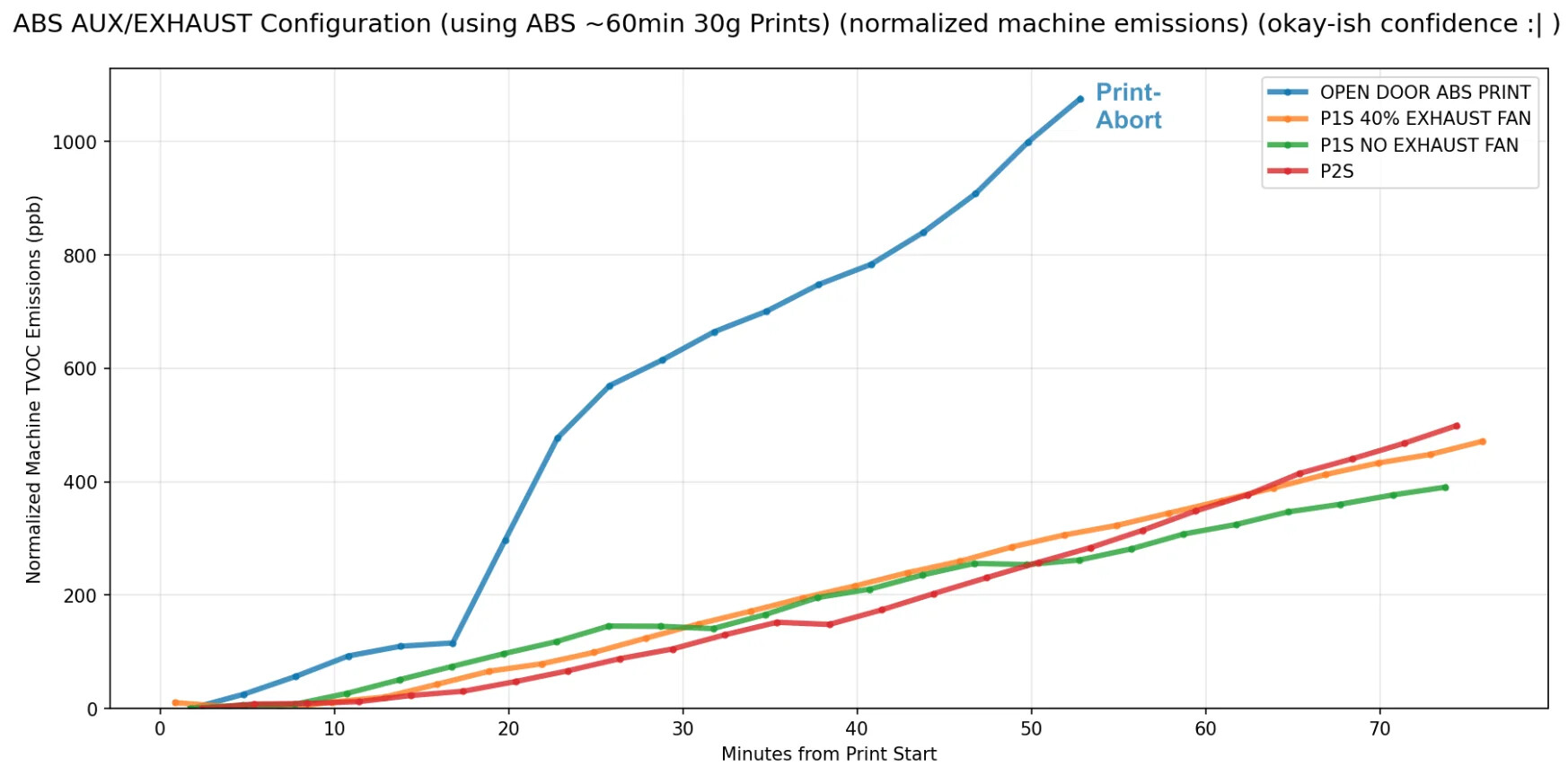
Personally, I think that after checking how the printers behave, in all cases the printer emits some VOCs no matter what settings you use or what you do. I assume it’s due to heat convection and not a perfectly airtight case, since with PETG it emitted much less VOCs (almost baseline levels)in the no-fan condition. In some instances, simply having all fans disabled resulted in the lowest amount of VOCs detected. However, at some point, you have to open the door, and at that moment you’ll be hit by a higher concentration of VOCs and smell, which will then still spread throughout the room.
I think the exhaust filter design isn’t really ideal. These “filters” don’t physically block air particles, they adsorb VOCs, and depending on the airflow speed, they won’t fully adsorb everything in a single pass because the contact time is too short. Keeping the air inside the build chamber as long as possible and allowing multiple passes through the filter will result in the best performance, especially when you finally have to open the door at some point, since a lot of VOCs will still be present in the chamber. I assume the exhaust system can’t quickly clear all the air to keep the chamber free of VOCs. It did smell less when opening the door of the P2S compared to the P1S, during the ABS test though.
I didn’t know that they pushed out an update that allows for PETG to work with the heat/filter mode, though, so the post and my tests were mostly done with the assumption of it using that mode.
ABS:
PETG/PLA in Cooling Mode:
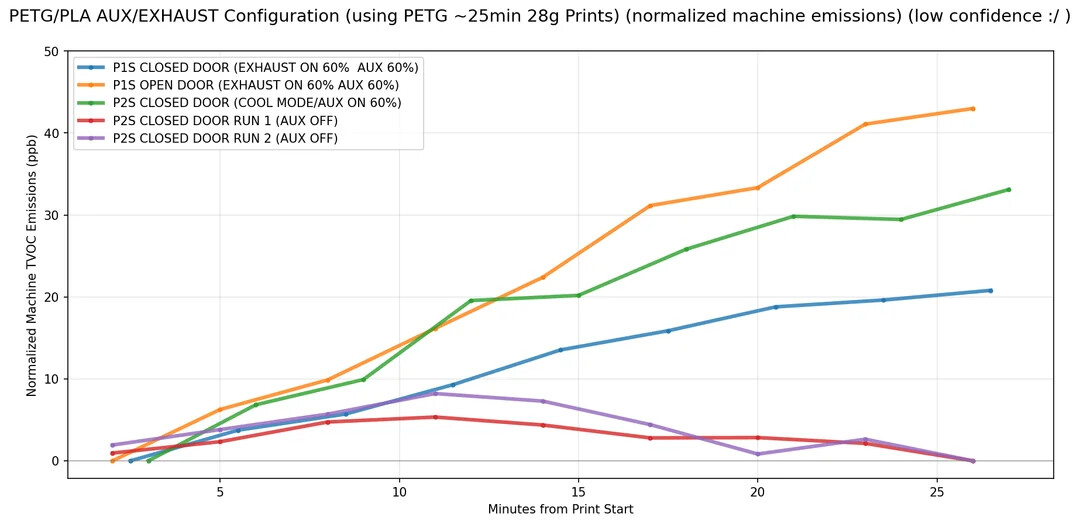
And a condition that was just what the filament profiles were set for PETG (but printed in ABS to get more VOC, since PETG/PLA produces so little). This kind of just tests the general air-tightness of the case.
I think the best-case would be to have a 100% air-tight case and do some recirculation of the air similar to this one:
At the very least, this one would minimize the spread of VOCs for PLA. But the real solution is to ventilate the room more often. In my room, every 40 minutes for ABS is enough if you can tolerate the smell. For PLA or PETG, probably even longer intervals are fine, since they do not produce styrene and emit fewer VOCs.
Alternatively, to prevent VOC build-up in the first place, create a slight negative pressure and push the air out of the window:
and put the hose out of the window.
Oh, and this one will probably even get more useful now that PETG will also use the internal filter mode, I made this mod to blow the air down during ABS prints:
I hope the results are at least somewhat helpful  . Treat them with caution, though. The ABS tests were fairly easy to do since the sensors picked it up easily, but the PETG ones were much harder because of the lower levels emitted and more airflow around the printers. At some point, I just reduced the print times because I was getting tired of repeating the tests so many times while testing out different sensor positions.
Great write-up! I wonder if the little bump in PETG emissions was from the poop that was ejected out.
What does the TVOC measure? Is it both VOCs and particulates?
I’m surprised by the first graph that the P2S line is on par with the P1S line even though it has a built-in recirculating filter.
TVOC stands for Total Volatile Organic Compounds, the sensors I used measure that. In general, metal oxide VOC sensors can’t differentiate between gases, they just sense the presence of any VOCs in the room. Like if I had cleaned any of the build-plates with IPA the readings would go to like 60k, but that is with a different type of VOC than what ABS produces (same with PETG/PLA they both don’t produce the same VOCs that make ABS so dangerous).
The sensor I used only measures VOCs, no particles or anything like that and Active Carbon filters (atleast as far as I’ve read so far) only adsorb VOC gases, they don’t filter fine particles. HEPAfilter only filters out particles, they don’t do a lot with VOCs or other gases.
I wrote a bit more about it in the reddit post, I sadly don’t have a separate room where I could have done the tests, so these results are with me present during the test at my computer moving as little as possible (I measured my human baseline and used that and the CO2 readings from a real CO2 sensor as estimate for human activity in general, to detrend/filter out that baseline. I assumed this would work since the VOC sensors I use are kind of used for estimating CO2 readings called eCO2, but they don’t really work that well for that since we nearly everything can produce VOCs (brushing teeth, perfume, IPA). As an example, I lost one test-run for the PLA/PETG graph (which is like 16:00~23:00 of sequential slow printing) because I forgot about that and brushed my teeth between single-test prints, so I had to repeat all of those tests a day later again  .
.
I’m surprised by the first graph that the P2S line is on par with the P1S line even though it has a built-in recirculating filter.
This is now purely speculation on my part, but I think that’s just the case of leaking air out due to heat convection + at least some of the air being blown into the wall and then exiting through the not airtight gaps.
I can’t explain it in any other way, I mean this heat-convection thing can be also seen with the no-fan condition it doesn’t smoothly exit the printer it always leaves in “puffs” or steps. When printing with PETG which prints at lower heatbed temperatures and chamber temperatures, the no-fan condition produces extremely low levels that are close to just me sitting in the room.
With the middle step on the P2S, it happens exactly when the build-plate reaches the carbon-filter, before that the carbon filter is below the build-plate:
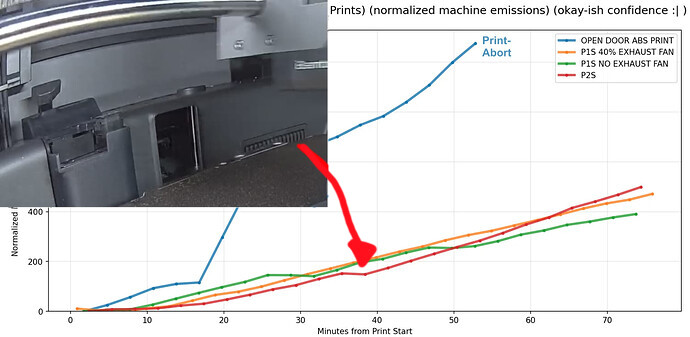
At least that is what fuels my current assumption of heat-convection + air being pushed to the case and then escape through some gaps.
I hope someone else at some point also does some VOC tests and can hopefully confirm or deny my results I’m just tired after doing this for nearly two weeks in my free time to quench my curiosity and also because I promised it on reddit, lol.
Edit: Also, that the P2S performs as well as the P1S, it’s not just the sensor picking it up. Near the end of the 1-hour print, I was able to smell it with both the P1S and the P2S, and the no exhaust fan condition.
Edit2:
I wonder if the little bump in PETG emissions was from the poop that was ejected out.
During the hole test no poop was pushed out, I made sure filament switching (from the AMS) was done at the beginning while I was still having the window open and exchanging air with the outside. If anything, the poop bumps would have only happened at the beginning.
The test print itself was rather simple, just a tube that covers a big span of the z-height with multiple walls until I hit the time/estimated filament used and no infill, stock 0.4mm nozzles and also flow rate/temperatures set on both printers to the same values.
That’s interesting. But still only a small % of the air would go directly from the nozzle to the carbon filter if only a small % of the filter is above the bed… I’m unhappy with where the P2S draws in air to the recirculating filter. The P1S sucks in air from the top for the exhaust filter, closer to the nozzle height.
On my H2D filter, I made sure the air is taken from nozzle height and not just recirculating air below the plate, to catch the high VOC/particulate concentration air
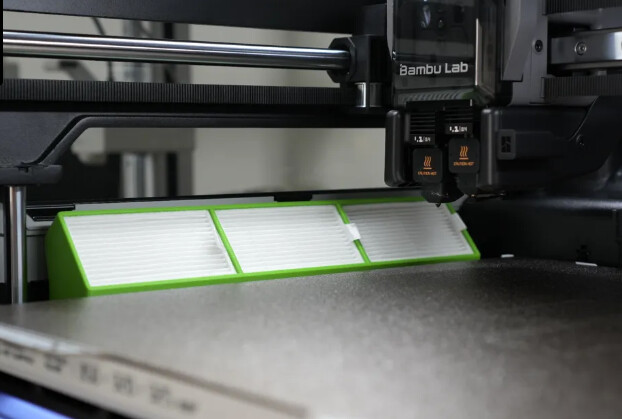
It’s looking pretty yellow and gross now:
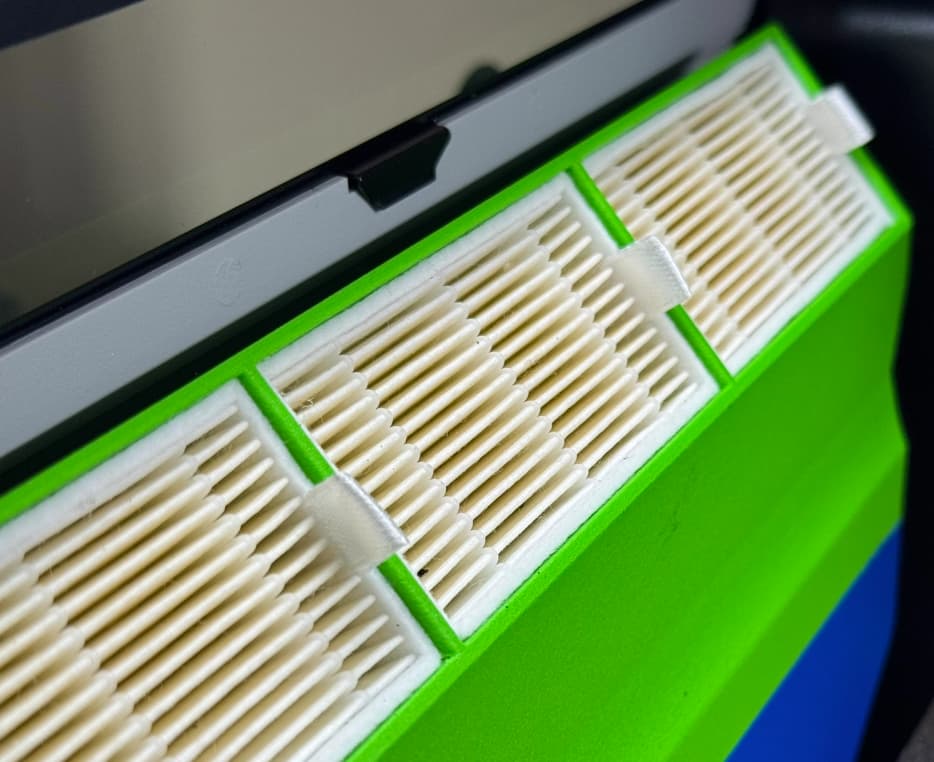
At some point, I think I’ll put a large filter here I think, and either exhaust it out with a large fan or have it recirculate with the existing fan:
Yeah, that’s true, though I’m not sure if that fixes the issue of “VOC getting out of the print chamber anyways”, but it at least gets closer to the source when it comes to filtering which will probably help in some way.
At least my current conclusion on this matter is at least now is that the chamber is keeping most of the VOCs away and at least for ABS and also now PETG it does something .
The only things I changed so far is adding a small Home Assistant automation that turns on the heating/filter mode and the auxiliary fan after a print is finished, keeping them on until I reach the printer and open the door (or automatically stopping after 15 minutes). This helps reduce the smell and VOCs when removing the prints, which I still think is when most of them are released into the room, it always smells that way. And printing that outlet downwards deflector, which seems to circulate the air a bit more.
In general, I regularly have to ventilate regularly anyway because “Stoßlüften”  is basically the law here, so the worry about PLA/PETG fumes was a bit low to begin.
Oh, one thing your filter can do is probably make it that a separate HEPA filter can be stacked on top (if no VOC+HEPA combo filters are released).
HEPA filters are super useful for when you print a lot of CF or GF infused filaments, and also to keep that sticky ABS goo mostly concentrated at one spot.
In the shop, they only offer filters for VOC/Gases for the P2S no combo filter.