Does that say 550mm? If that is the print size… What is the image cropped next to it? Where can I buy it?
No, I’m not sure what the 550mm is, but the out side dimensions of the printer are listed as 492x514… so still larger than the X1/P1 printers.
According to my sources (the other voices in my head), it’s gonna be a pancake printer unlike any other.
Some say dual head, so after the pancake is done, it can dispense the syrup. Personally I was hoping for 3 heads, because It’ll be missing the all important buttering step. 
There’s speculation that the delays in release are being spurred on by the trade wars going on; making it difficult to acquire the Canadian maple syrup needed to properly supply the end users with.
Don’t worry. I know some have speculated that they’ll source cheaper, corn syrup based syrups, but there’s been a lot of user pushback against this cheapening, and there’s a bit more confidence we’ll get the quality syrup we all deserve.
Thanks for noticing 
If you scroll down on the site, there is an X1S. Is there anything on that?
Everything up until now is pure speculation. Hopefully we will see a release within the next 3 weeks.
One of those hurry up and wait kind of deals.
I’m keeping my expectations low, cuz they’ve hurt me enough already lol. I also dont know why they would call it an AMS 2 and add the Pro. If its essentially almost the same AMS with some heaters jammed in it, why not just call it AMS Pro. Or AMS 2 if say the routing and engineering of the feeding was upgraded as the original AMS left a lot to be desired. In which case i’d hope it would be backward compatible if its really just the same thing +dryer box now. Hopefully more effort to upgrade was put in to what the new printer will be. i’m just hoping for a justifiable selling point (for me). I’m pretty satisfied with print quality from whats already out there (that i own). I dont see it being bigger than say the Creality K2, or much faster than current printer speeds (minus the incorporation of what dual nozzling will offer), and a heater chamber isnt really that impressive anymore (though itd hope this is def in there)…I guess if the biggest selling point then is the dual nozzles hopefully its incorporated in a why thats specular, otherwise I don’t see putting up the numbers or lasting as a top dog like the X1C did
Companies (Especially Apple) add the pro just to make it look cooler.
Finally after 2500+ replies here the most logical answer is given.
If they release a large flagship along side another large non flagship, they could have an ams 2 that holds 5 rolls(larger printer top) and the pro could be the heated part for the flagship. Realistically, if priced accordingly, they could sell the existing 2 lines along side them for probably another year. Offsetting the 3 line releases/refresh by a year or so(bedslingers, small core xy and large core xy being the 3 lines). Giving each machine a 3 year life cycle
Just thoughts.
Hold your horses buddy. Bambu said it will be launched in Q1/25… Q1 ends on March 31st, which is not that far away…If not launched by then, it will definitely be launched on April 1st… guaranteed… 
That sounds very familiar… like army familiar 
They just added an option for a chamber heater, which they claim will go to 60-70°C.
They also claimed that without a heater the chamber would get to 50-60°C, about which I am skeptical and even if true would probably take a very long time.
Also someone requested a 350C nozzle, which they sounded open to.
@NoahKatz Thanks for updating me! I’ll take another look.
350C seems like the new minimum that even the K2 Plus can do. The Qidi Plus 4 claims to go up to 370C, and there are plenty of aftermarket options which can go even as high as 500C:
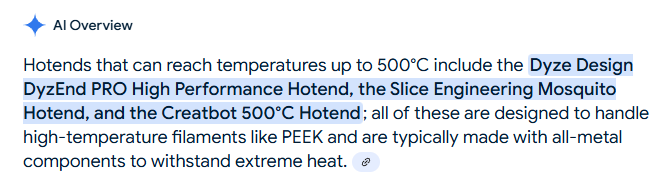
Not sure what the tradeoffs are, but if I could get one of those, and if it worked well, I’d be future proofed for a long time with respect to nozzle temperature. I presume the argument in favor of a lower temperature is that not as much cooling is required, and so smaller hotends fans can be used, and thus lower mass in the printhead, which is always a good thing. On the other hand, if you went with the CPAP tubing to deliver the cooling air, instead of the more typical fan on the printhead, then you could scale up the cooling by driving more air through the conduit without any corresponding increase in mass. You can already see that on some of the Delta printers, like from FLSun, or with more experimental printers that may send compressed air to the printhead through a smaller, even lighter weight flexible conduit tube.
I realize a lot can be added as an aftermarket option, especially if running plain vanilla Klipper, but I’d still rather run stock equipment, if at all possible, because there’s leverage to be had by being part of a community that’s running the same hardware. That way you can install updates as they come along without worrying that it might cause an unexpected breakdown somewhere. Also, that way you can cooperate with others on developing joint solutions to a single common problem instead of a thousand different solutions to a thousand different configurations–that’s more of a “you’re on your own”, ultimately, scenario, depending on what you have or don’t have.
I wponder how important a factor chamber temperature is though.
That’s an awfully big temperature difference between the print temperature and chamber, and I’m not sure how much the effect of thermal expansion and subsequent warping can be controlled by fiber reinforcement when the plastic is in a molten or very soft state.
At least for the filaments I’m aware of, if the nozzle can get to 370C, then chamber temperature is more likely to be the limiting factor on what kind of filament you can print than the need for a higher nozzle temperature. 65C for chamber temperature is below the recommended ideal for some filaments. @streetsports can push his up to 70C before it “errors out”. He didn’t say whether the error out was the electronics failing or the firmware sensed a temperature problem (to possibly prevent a thermal runaway scenario) and started to shut things down. I presume it was the latter, so maybe that could, in principle, be overridden in software, unless it was hardwired in some way, in which case overridden at the hardware level. In which case you’d either want to keep an eye on it, or else install a higher trigger threshold before it “errors out”. There’s some risk in attempting it, but that’s where pooling knowledge with others who are attempting the same thing can be helpful.
I’d be curious to know exactly why Qidi went from their initial 80C limit down to the more common 60C. What problems did they encounter that made them reduce the limit? I suspect it may have been no problems, but that running the electronics beyond its spec meant they couldn’t guarantee what would happen, so they backed off for that reason: liability. I don’t know though. That’s a total guess on my end. The maximum chamber temperature on a Prusa Pro HT90 is 90°C. I’d be happy with that. Does it really need to cost $10K to get to that number?
[Edit: Here are some filaments that would seem to have higher recommended temperatures:
1. PEEK (Polyetheretherketone)
- Hotend Temperature: 360–450°C
- Bed Temperature: 120–160°C
- Chamber Temperature: 70–150°C
- Properties: High strength, chemical resistance, and excellent heat resistance. Used in aerospace, automotive, and medical applications.
2. PEKK (Polyetherketoneketone)
- Hotend Temperature: 360–400°C
- Bed Temperature: 120–160°C
- Chamber Temperature: 70–150°C
- Properties: Similar to PEEK but with slightly different processing characteristics. It has better printability and similar high-temperature performance.
3. PPSU (Polyphenylsulfone)
- Hotend Temperature: 370–400°C
- Bed Temperature: 100–150°C
- Chamber Temperature: 90–140°C
- Properties: High chemical resistance, impact strength, and thermal stability. Used in medical and aerospace applications.
4. PI (Polyimide) – Kapton
- Hotend Temperature: 380–450°C
- Bed Temperature: 120–180°C
- Chamber Temperature: 100–250°C
- Properties: Extreme heat resistance, used in aerospace and electronics.
5. PVDF (Polyvinylidene Fluoride) – Some Grades
- Hotend Temperature: 350–380°C
- Bed Temperature: 100–120°C
- Chamber Temperature: 70–90°C
- Properties: Excellent chemical resistance, used in chemical processing and electronics.
For printing these materials, you typically need:
- An all-metal hotend rated for 450°C (like the E3D SuperVolcano, Phaetus Rapido UHF, or DyzeDesign DyzeX).
- A heated bed capable of reaching at least 100–160°C.
- A heated chamber (or at least an enclosure) to prevent warping and delamination.
Short of that, maybe with time the chemists will come out with some modified filaments that can still work at lower temperatures, as has been done with, for example, some modified ABS that you can now buy all over the place. Or maybe loading them with CF or GF will reduce their tendency to warp, perhaps allowing them to print at a lower chamber temperature. Even the 110v X1C can reach 120C bed temperature, which is at the edge for some of the above filaments but comfortably good enough for the others, so bed temperature isn’t limiting much right now. Rather, chamber temperature seems to be the big unsolved problem currently (unsolved for cheap, I mean).
I can kinda imagine the problem: how do you provide adequate cooling with a fan if the chamber temperature is hot? If using CPAP, how do you keep the chamber temperature hot if you’re pumping in a lot of cool air for cooling the print while printing? You’d need chamber heaters which can keep up with the cooling dilution, and enough fans to keep it all well mixed. Seems like it could maybe be relatively straightforward if done that way.
Did you guys see LDO opened pre-orders for an enclosure kit for the BoxTurtle? It comes with one PolyMaker PolyDrier base, but you can put THREE of them on it.
I’d think/hope that because these are high temperature materials with presumably high softening points, the amount of cooling that is adequate is at a much higher temperature.
Qidi plus 4 went up, I had it in my cart to buy it today and they took it out. Already have the pro, probably good enough, not any reason not to wait for the bambu now.
The error is just software based. Its for thermal runaway. In klipper, there are 2 settings. 1 is for max adjustment(65c) and the other is for runaway(70c). Im guessing its a safety thing and the hardware can actually go higher. At 69c, I saw no negative side effects but 1 degree higher and the print would have stopped. It can be raised in klipper. This is why I say completely open klipper is dangerous for newer people. Could easily make the wrong adjustment and start a fire or brick the printer.
The pei printed well but lost adhesion half way through. I was trying to print a build plate, so assumed it would probably warp. Made it to layer 4 before the corners peeled up. Ordered some Vision miner Nano Polymer Adhesive(stupid price) to retry this weekend. Going to also print on glass this time, because the plate will probably taco
@krellboy $50 off here
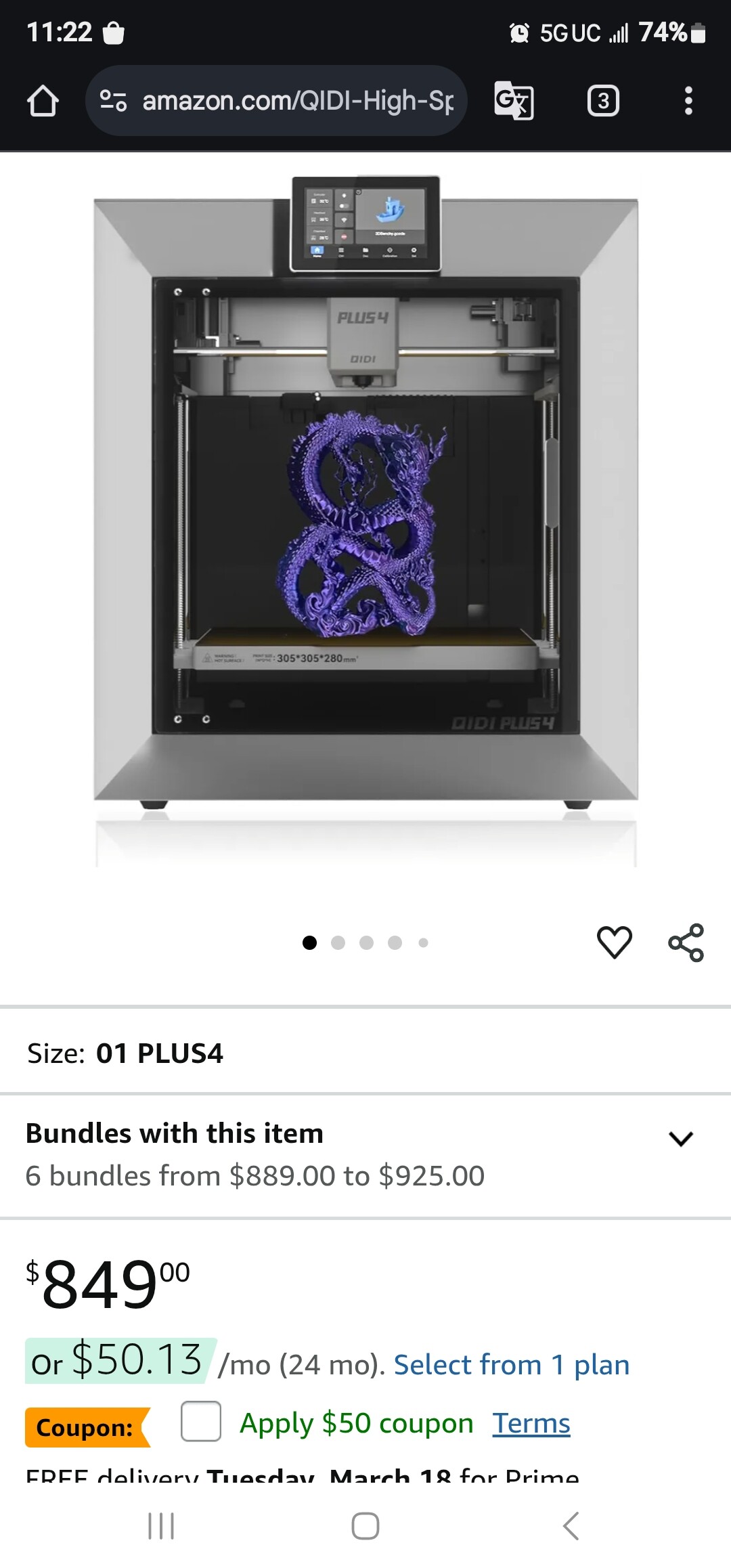
i dont think there will be more than 4 rolls Filament, because they would need an extra split unit to feed the printer heads. If there are 2 printer heads this could get to complex. Additional if you need a a bigger filament changer, just get 2 of them. The patents Bambu labs has also only shows a 4 Split component. Of course i can be wrong, but a filament changer with 5 Filaments makes no sense to me. Because this new complexity of the needed parts and the additional programming needed for that in comparison to how useful it would be does not match.
https://www.reddit.com/r/BambuLab/comments/14qskg2/bambu_lab_p1s_x1s_x1e_three_new_bambu_lab/
Appears to be an old thing
Where do you get this from? The “Q1” bit? I feel like that might not happen at this point.
I would’ve expected the Cyber Brick things to launch with the new printer, but I suppose not.