I have two Vorons which are speed wise close to the Bambu, Printquality far beyond any consumer printer.
The Mk4 will replace the X1C for multicolor prints longterm. At least if the MMU3 will be kinda nearly good.
I don’t know about that. Once the Bambu Pro comes out, it’s all going to change.
I agree with that Prusa use to be a good brand, but nowadays the MK4 look more like an anachronism, and his price relative to its technology is just a joke
Why just dont you buy a 5$ mirror and a new magnetic sticker ? I took me less than 15 minutes to remove the original magnetic sticker, stick the mirror an stick a new magnetic sticker on the mirror.
I want a rigid solution and an evenly heated bed. I mostly print ABS. The constant high bed temperature will make the mirror/glas falling slowly into the hole of the buildplate below.
Also, my current solution (alu tape - within 0.1mm) to mitigate the warped bed is probably better.
I’m used to nearly rigid dead flat beds - there I want to have the Bambu too. 
Does anyone know which thermistor is used in the Bambu bed?
1 Like
I would have loved that the bed to be perfectly flat from the start too.
But I am really happy for now with the mirror solution, easy & fast to set up (I dont understand how and why this thread have become so huge). I have used mirrors for years on other printers without trouble, heat is pretty homogeneous from what I can measure.
That said, I not often print ABS even if I never had trouble with it, I will post here if I encounter any of the problems you mentionned like deterioration. I suppose there are tons of differences depending on how the mirrors are manufactured.
do you have any problems with the mirror and heatbed temp over 100°C ?
I also want to test the option with the mirror in the next days 
For now, I never had any trouble on any printer related to heat and mirror, but maybe depending on manufacturer … I usually pay my mirrors 4€ to 6€ depending on their sizes , so not the best quality.
But, depending on what ou already have in spare, you will have to buy a new “good” magnetic sticker and 3M double side sheets.
I have used :
- Mirror 250x250 (3mm thick)
- GIANTARM Magnétic Sticker + PEI plate 260x260 (the textured PEI plate is great, I often use it with the Bambulab now)
- 3M 468 MP - 300x300 double side sticker
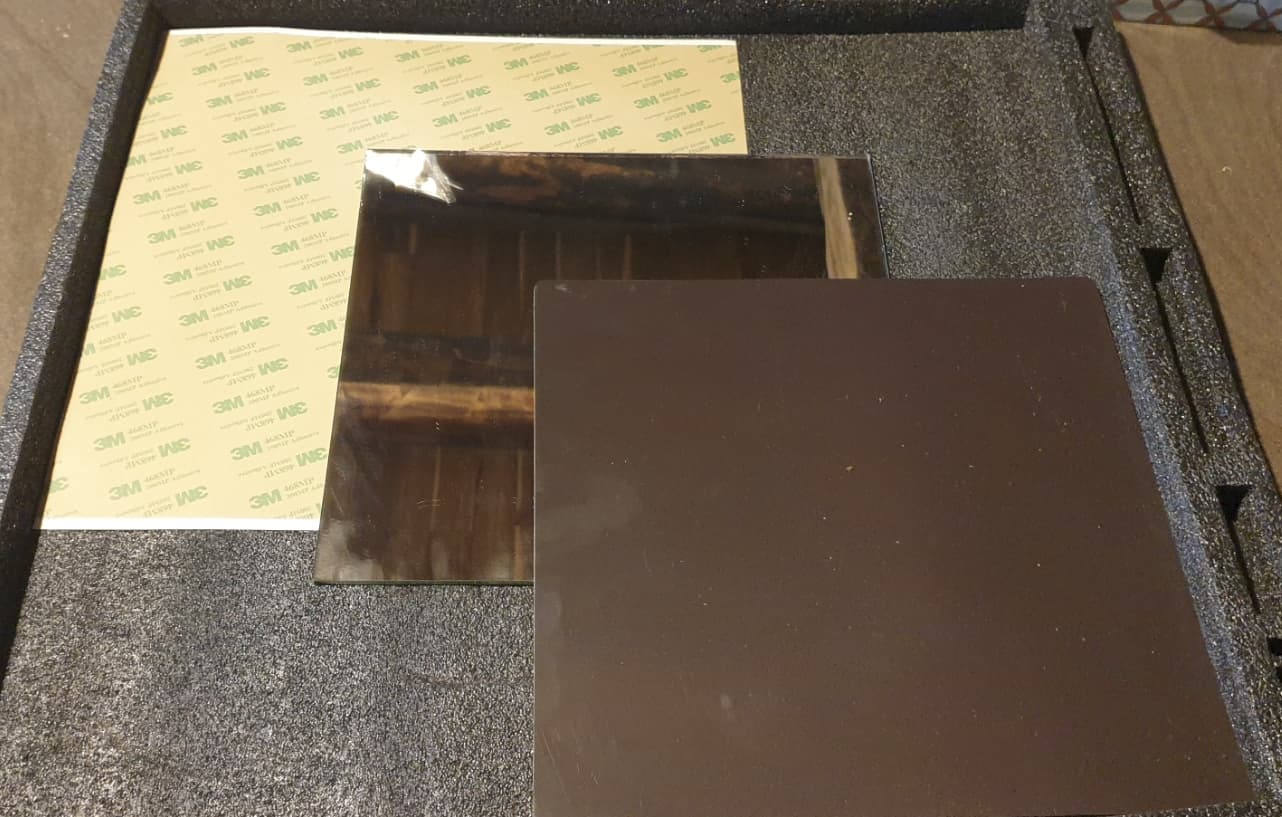

1 Like
Hold on, so essentially you glued a square glass sheet on top of the Engineering Plate?
I am assuming this works like any other glass bed, correct? Any temp issues?
I just love the simplicity of this idea.
Also, what did you do about the nozzle wipe area?
1 Like
My idea would now be to glue a thin sheet of metal to the underside of the glass/mirror in order to be able to easily mount the mirror without having to glue anything to the original bed. would it be possible? And then of course a magnetic foil on top so that you can mount the print sheets there

3M double side sticker can be removed, same as you can remove the original magnetic sticker with a little help of heat.
Once magnetic sticker is removed put/stick using 3M something flat (I have chosen mirror but can be anything that is flat and handle heat) on it and stick a new magnetic sticker on top of that.
You can perform some tests before sticking using 3M double side sticker, if you want to be sure it works the way you want. But there are no much risk, you will still be able to remove/unstick it and try something else.
It is not necessary to over complexify this “problem”, wich is pretty easy to fix for anyone who have already played with low budget printers.
1 Like
This statement is based on your own experience or it’s only some “theory”? And what exactly is “slowly”?
I’ve printed on glass “hotfix” of my warped bed for several tens of hours on 100+ degress and the deflection of the glass compared to unused one is literally zero (or unobservable). If “slowly” means “within months”, I don’t care, I can replace the glass when/if that happens.
Modern floatglass or mirrorglas does not really deform that easily. It was more of a problem a few hundret years ago where glass was not forming a solid crystal structure and slowly (over the span of decades or centuries) was slowly following gravity “flowing” downwards. You can still see the effect on some old church windows. Modern glass does not have this weekness anymore, and has a glass transition temp. of above 270°C, which is usually not reached in desktop printers.
I would doubt you will really notice any permanent deformation due to heating. But glass can bend a bit if you pull it down via magnets to the banana bed, but also it will only be a minor effect.
Some more information on heat for mirror + magnetic sticker bed :
This is a 0.1mm thick ABS layer on Textured plate set to 100° :
Dont worry about imperfection, I did not clean the plate for a long time and I have used a two years old spool that was in a big mess with lot of other things.

Interestingly it really look like a paper sheet, it is tearing like paper.
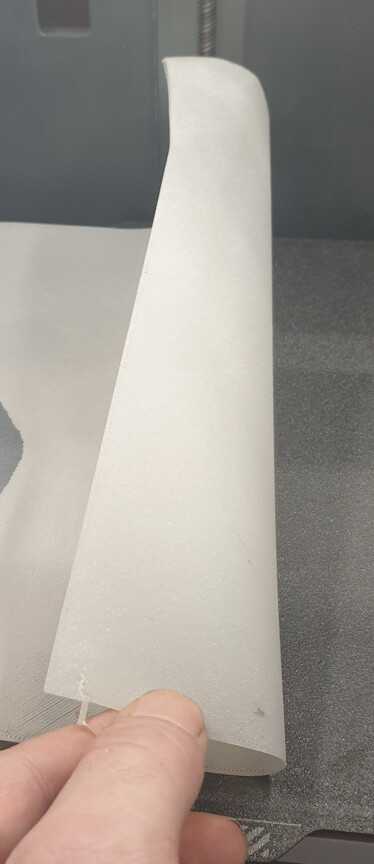
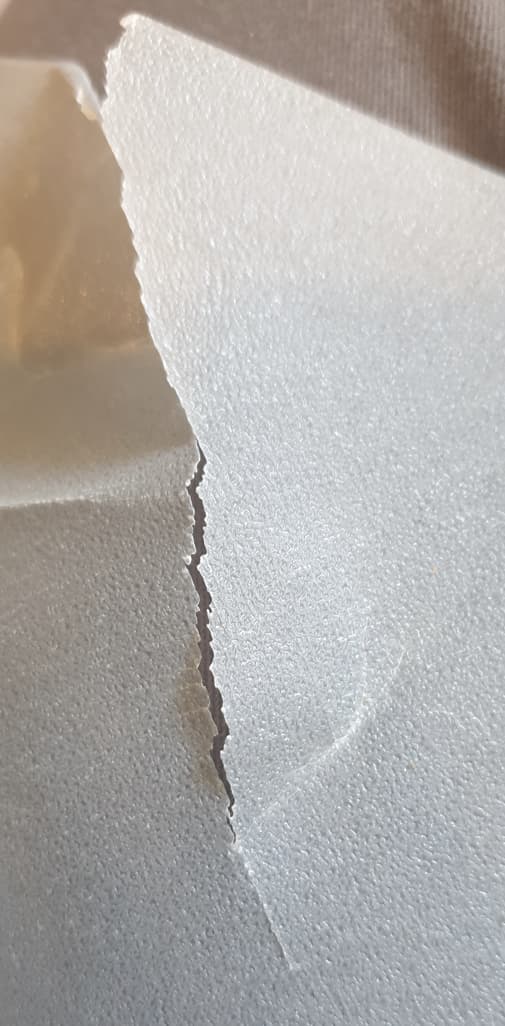
About heat, I have used IR camera and heat look pretty good (about 7°C less than the bed setting value), but due to difference of material IR emissivity/reflexion, values may not be exact, for example plastic looks hotter than the plate.
That’s why, I have measured the temperature of the thin ABS layer of plastic rather than the plate as I have supposed that it will be less reflective than the plate (but even plastic act a little as a mirror for IR, I can clearly see the hotend reflexion on the plastick layer when I am filming the plastic layer with the IR cam, wich is obviously not the case with a standard camera).

One thing noticeable with this thicker and more heavy bed is that it introduce a bit more heat phase shift, which is a well know phenomena in insulation study. This is the time the heat need to go from the heater under the aluminium plate to the top of the bed, basically it require a little longer to the heat to reach the top of the bed (not that much, not enouhgt to be a problem), this result in the fact that what the printer display as the bed temperature is not exacly the heat of the top of the bed, but it is already the case with printers beds in general.
Another thing noticable is that with more mass it require a little longer to cool down, once again not enought to be a real problem.
How many mm deviation do you have now? Can you still see light under a ruler when you put it on the print bed?
From the higher point to the lower, I think there is about 300µm.
With a ruler the bed looks like perfectly flat, it is a bit tilted due to the 3 lead screws which use only one motor and belt and should be leveled by hand, see : Manual Bed Leveling / Manual Bed Tramming | Bambu Lab Wiki
Note that I get different results depending on the PEI plate and how I set it in place.
Overall I will say I have a maximum of 100µm/150µm of real deviation/warping depending on plate, (not counting tilting)
Yes that’s essentially what I did, with just glue stick “blobs”. I was printing PLA so I wasn’t too worried about the temperature. I suspect trying to print ABS might reveal a problem, but I didn’t have time to try it.
As best I could tell when I ran the nozzle wipe area still worked as per normal, since the glass sheet was far enough forward for the nozzle tip to clear the glass and wipe on the engineering plate.
Once I get back from vacation I may take a leap and remove the Bambu magnetic sheet, and then glue the glass in place around the perimeter of the plastic frame with a fine bead of RTV. I may use a 0.5mm thick thermal pad between the aluminum heat bed and the glass:
https://www.amazon.com/dp/B084RDNS8R?smid=A2T6N244WTLWGU&ref_=chk_typ_imgToDp&th=1
Then I’d put a magnetic sheet on the glass and go back to using my Wham Bam Pex plate.
1 Like
I have a few different sheets coming in the mail
2 are the 235x235 magnetic sheets and 2 are 235x235 ferrous sheets that will attract to the magnet sheets
My plan is to place the ferrous sheet on one side of a glass plate and the magnetic sheet to the other side
If it all works then the glass plate will stick to the original bed with the ferrous sheet magnetically and the top of the glass with a magnetic sheet will allow me to use my regular removable build plates
Cheap, easy and a solution that if it works does not permanently modify the print bed
I’ll post my results once everything arrives and I put it all together
1 Like
I’m still looking for a magnetic sticker that has the exact original dimensions, as well as the same radius on the corners and the smooth coating on the top.
Does anyone have any idea where I can buy such a sticker? Bambu has not heard back about this after over a week.
Just an update on the “Bambu Lab P1P/X1C Warped Bed Correction Plate” I’ve been making for my farm machines. I received a second prototype of the design that further refines the final mass, thickness, and magnet positions. With the changes, I was able to do more testing, this time across the X1C’s. I made several full sheet first layer prints, both with and without bed leveling applied - the results are encouraging. Attached is a shot of the new plate, removed from the machine, holding a generic textured pei sheet. What follows is a comparison of first layer prints exposing problem areas on the uncorrected bed (print on left) and with the correction bed installed (print on right). Again the Bambu ABL does a pretty good job of making a solid first layer, but the print is of course warped regardless. What is interesting is turning off ABL for the prints you can quickly identify the cratered areas of the OE bed and see the results of actually having a flat build surface (using the aluminum correction plate). Again… these full sheet prints were made with the bed properly trammed and ABL turned off, just to highlight the corrective action of the aluminum plate. You’ll notice on the uncorrected bed, any craters in the OE bed, show up as separations in the first layer sheet. Any significant hills show up as scuffing/snagging. The difference is as expected.


2 Likes
That was never a problem:
